
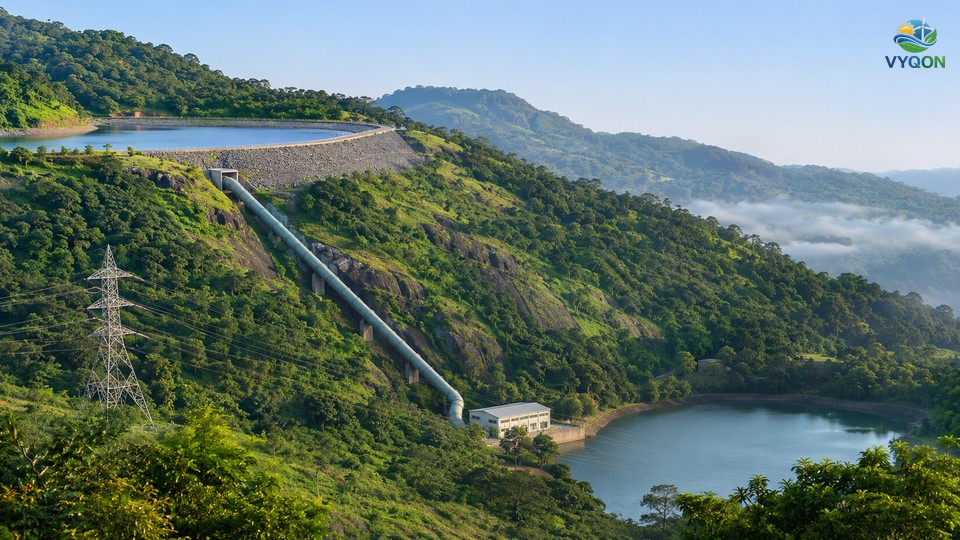
Tata Power’s board has approved an investment in the 1,800 MW Tata Power Shirwata pumped storage project in Maharashtra, with a capital requirement of Rs 11,871 crore and a construction period of 51 months. The company disclosed the decision to the stock exchanges on 11 November 2026 under Regulation 30 of the SEBI (Listing Obligations and Disclosure Requirements) Regulations, 2015, saying the board took the decision at its meeting held that day.
What the Tata Power filing says
The filing sets out the details in a short table, as required by the SEBI master circular on such disclosures. The main points are:
- Project: a 1,800 MW pumped storage project (PSP) at Shirwata, Maharashtra.
- Investment required: Rs 11,871 crore.
- Period for adding the capacity: 51 months.
- Financing: debt of 75% and equity of 25%.
- Existing capacity: Tata Power’s overall existing capacity stands at 16.9 GW, and the company describes its existing capacity utilisation as being at an “optimum level”.
On the 75:25 split, a simple calculation gives about Rs 8,903 crore of debt and about Rs 2,968 crore of equity. The filing does not give these two amounts separately, so they are VYQON’s arithmetic and not company figures. Spread over 1,800 MW, the investment works out to roughly Rs 6.6 crore per MW of pumped storage capacity.
The filing does not name the lenders, the expected commissioning date, the offtakers or the tariff. These points were not disclosed, so this report does not state them.
Why Tata Power says it is building the project
According to the filing, the pumped storage project will be instrumental in Renewable Energy Round the Clock (RE-RTC) applications. The company says it will help shift energy from hours of surplus generation to hours of demand, and will contribute to decarbonising hard-to-abate industries.
Pumped storage works by moving water between two reservoirs. When power is plentiful, for example during strong solar generation, water is pumped from the lower reservoir to the upper one. When demand peaks, the stored water is released through turbines to generate electricity. Tata Power described the same principle in its 2023 announcement of the project, saying such plants provide peaking power and support solar and wind plants to deliver steady supply.
Background: the 2023 Maharashtra MoU
The Shirwata project is not new to the company’s plans. Tata Power and the Government of Maharashtra signed a Memorandum of Understanding in August 2023 to develop two pumped hydro storage projects with a combined capacity of 2,800 MW in the state. In the company’s own release, the 1,800 MW project is located at Shirawata, Pune district, and a 1,000 MW project at Bhivpuri, Raigad district. The two projects carried an estimated combined investment of approximately Rs 13,000 crore at that time.
The place name appears in different spellings in company documents: Shirwata in the stock exchange filing and Shirawata in the 2023 release. Both refer to the Pune district project.
The 2023 release said the projects would support the Maharashtra Government’s goal of a USD 1 trillion economy by 2028 and would generate employment for over 6,000 people. The MoU was signed at Mantralaya in Mumbai in the presence of Devendra Fadnavis, then Deputy Chief Minister. Dr Praveer Sinha, Tata Power’s CEO and MD, called pumped storage a reliable and efficient way to store energy.
Tata Power’s experience with pumped hydro
Tata Power has operated hydro plants in the Western Ghats for about a century. The company’s 2023 release lists three hydro generating stations: Khopoli, Bhivpuri and Bhira. The Bhira station includes a 150 MW pumped storage hydro unit. The Shirwata project would be many times larger than that unit, at 1,800 MW, which makes it one of the company’s largest pumped hydro projects.
What it means for India’s clean-energy sector
India is adding large volumes of solar and wind capacity, and these sources generate power in patterns that do not always match demand. Storage is one way to close that gap. A project of 1,800 MW can absorb surplus daytime generation and return it in the evening, when solar output drops while demand remains high.
For developers and buyers of renewable power, a large, firm storage resource in Maharashtra could support round-the-clock supply products, which is the use case the company names in its filing. Tata Power has also been adding battery storage; see our report on its 60 MWh Mumbai battery storage sites.
Large pumped storage projects need capital that is committed years before any revenue. By choosing a 75% debt structure for Rs 11,871 crore, Tata Power signals that the project will rely heavily on long-term borrowing. Offtake arrangements and the final financing partners will decide how quickly the project moves from approval to construction, and the company has not yet disclosed either.
For Maharashtra, the project builds on the 2023 agreement with the state. The earlier Rs 13,000 crore figure covered both the Shirwata and Bhivpuri projects, so it cannot be compared directly with the new Rs 11,871 crore for the 1,800 MW unit alone.
Official references
- Tata Power, Regulation 30 disclosure to BSE and NSE dated 11 November 2026 (board approval of investment in the 1,800 MW Pumped Storage Project at Shirwata, Maharashtra): https://www.bseindia.com/xml-data/corpfiling/AttachLive/9d55161e-7758-49f4-8740-4ad95e6b2ba0.pdf
- Tata Power media release, “Tata Power signs MoU with the Government of Maharashtra for Development of 2800 MW of Pumped Hydro Storage Projects”: https://www.tatapower.com/news-and-media/media-releases/tata-power-signs-mou-with-the-government-of-maharashtra-for-development-of-2800-mw-of-pumped-hydro-storage-projects
Leave a Comment