
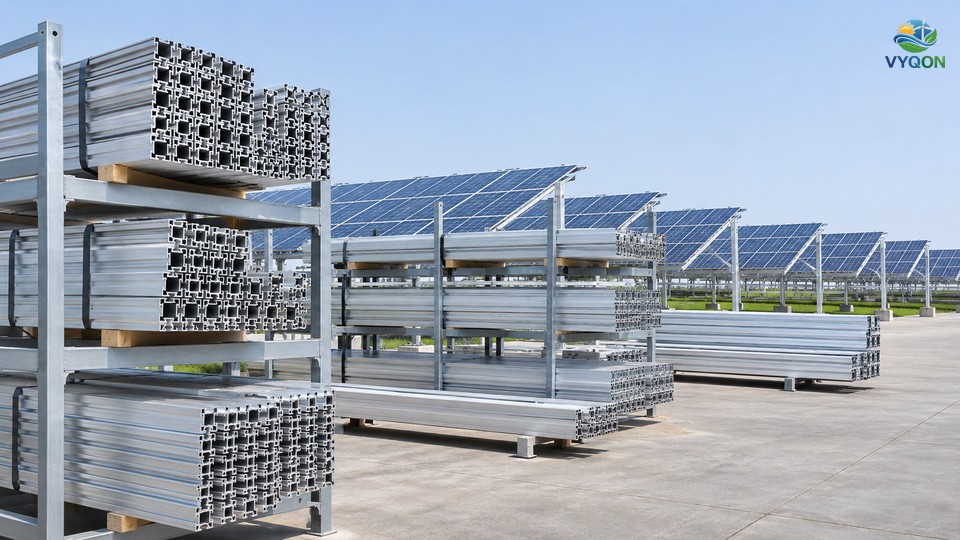
India’s trade remedies authority has started an anti-dumping investigation into aluminium extrusion profiles, structures and articles imported from China, Malaysia, Vietnam and Thailand. The Directorate General of Trade Remedies (DGTR), under the Department of Commerce, issued the initiation notification on 9 November 2026 under file number 6/67/2026-DGTR (SETU case ID AD/OI/079/2026). Solar mounting structures are named in the product scope, which gives this aluminium extrusion anti-dumping case a direct link to India’s solar build-out.
No duty has been recommended at this stage. The notification only opens the investigation, which will test whether dumping, injury to Indian producers and a causal link between the two exist.
What the notification says
The Designated Authority, Amitabh Kumar, states that the investigation is initiated “suo motu” under Section 9A of the Customs Tariff Act, 1975, read with Rule 5(4) of the Anti-Dumping Rules, 1995. The Authority took cognizance of information supplied by the Aluminium Extrusion Manufacturers Association of India (ALEMAI), which represents 228 manufacturers, and by its member producers, together with import data from the Trade Intelligence and Analytics portal of the Department of Commerce.
ALEMAI told the Authority that the domestic industry is suffering injury because of a significant rise in dumped imports from the four countries. Nine member producers also filed representations seeking anti-dumping duty and furnished their financial statements.
The import data show that shipments of the subject goods from China, Malaysia, Vietnam and Thailand increased during the period of investigation. Together these four countries accounted for about 90% of India’s total imports of the subject goods in that period.
Product covered, including solar mounting structures
The product under consideration is “Aluminium Extrusion Profiles, Structures and Articles thereof”. The goods are made by the extrusion process as profiles, bars, rods, tubes and pipes, and may be sold in mill finish or with surface treatments such as anodising or powder coating.
The scope covers extruded profiles for architectural, industrial, transport, electrical and general engineering use; bars and rods other than wire rods; seamed or seamless tubes and pipes; doors, windows, curtain-wall and facade systems, partitions, louvres and railings; and other articles made mainly from extrusions. The notification lists heat sinks, LED and lighting profiles, industrial framing (T-slot) profiles, solar mounting structures, ladders, furniture, kitchen and wardrobe profiles, bicycle parts and formwork among these articles.
Solar mounting structures are therefore one of many end uses, not the main subject of the case. They matter for the clean-energy sector because ground-mounted and rooftop solar projects use aluminium or steel structures to hold modules in place.
The goods fall under Chapter 76 of the Customs Tariff; the notification says the tariff classification is indicative only. No Product Control Number (PCN) methodology has been proposed yet.
Existing duty on solar panel frames
The Authority notes that an anti-dumping duty is already in force on “Anodized Aluminium Frames for Solar Panels/Modules” from China, imposed through Customs Notification No. 16/2024-Customs (ADD) dated 27 September 2024. How such goods should be treated within the new investigation will be examined during the proceedings, and interested parties may comment on it.
Aluminium extrusion anti-dumping findings at initiation
The investigating team constructed the normal value for all four countries from the cost of production supplied by three ALEMAI member producers, adjusted for a reasonable profit margin and selling, general and administrative expenses. Export prices come from transaction-wise import data.
On that basis the Authority finds prima facie evidence that the normal value is higher than the ex-factory export price, and it estimates the dumping margins to be above the de minimis level. On injury, the notification says the volume of imports from the four countries has risen significantly in absolute terms, that the imports undercut domestic prices, and that the industry reports falling profitability, losses, declining cash profits, lower return on capital employed and significant under-utilisation of capacity. The Authority adds that complete information on economic parameters is not yet available.
The Authority describes the domestic industry as fragmented and made up largely of micro, small and medium enterprises (MSMEs).
Period of investigation and timelines
The period of investigation is 1 April 2025 to 30 June 2026, a 15-month period. The injury period covers 2022-23, 2023-24, 2024-25 and the period of investigation. The normal period is twelve months, but the Authority chose fifteen because MSME producers keep their records on a financial-year basis.
Interested parties must register on the SETU portal and upload confidential and non-confidential versions of their responses within 37 days from the date the intimation letters are transmitted. Comments on the scope of the product and the PCN methodology are due within 15 days of transmission.
What it means for India’s clean-energy sector
For solar developers and engineering, procurement and construction (EPC) firms, the case is worth watching because mounting structures are among the listed articles. Any duty would raise the cost of imported aluminium structures, although the notification does not say how much solar mounting trade is covered. The Authority has made no recommendation on any duty.
Developers who source aluminium mounting systems, module-frame makers and importers can file comments on scope and on the treatment of solar frames through the SETU portal within the deadlines.
Leave a Comment