
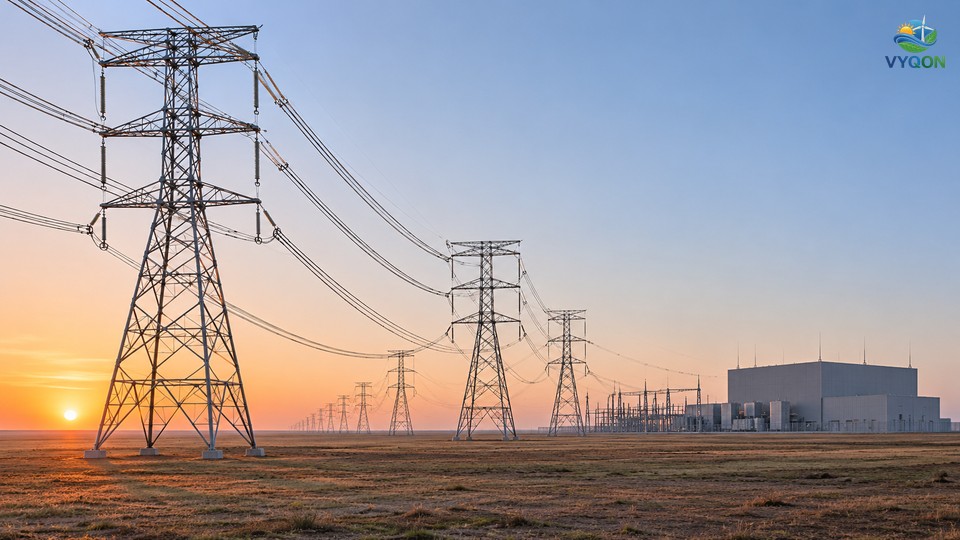
India’s National Committee on Transmission (NCT) has recommended a 1,150 kV transmission corridor to interconnect the country’s Western Region and Eastern Region, at an estimated cost of about Rs 68,816 crore. The minutes of the NCT meeting were released late on 10 November 2026. The first phase of the 1,150 kV transmission corridor includes a 6,000 MW (4 x 1,500 MW) +/-800 kV high-voltage direct current (HVDC) link from Bhadla in Rajasthan to Raigarh in Chhattisgarh. The corridor is planned to pass through Chhattisgarh, Odisha and West Bengal and is expected to take about six years to build.
What the NCT has recommended
The recommendation covers an ultra-high-capacity corridor that would tie together the Western and Eastern grids of the country. The estimated project cost is about Rs 68,816 crore. The recommended scheme combines new 1,150 kV alternating current (AC) infrastructure with a long-distance HVDC link. The HVDC link is rated at 6,000 MW and is built from four 1,500 MW units, running at +/-800 kV between Bhadla, the large solar hub in Rajasthan, and Raigarh in Chhattisgarh.
The corridor is meant to be implemented through tariff-based competitive bidding (TBCB), the route used for most inter-state transmission schemes in India. Under TBCB, developers bid for the right to build, own, operate and transfer a transmission project, and the lowest levelised transmission charge normally wins. The build time is about six years from the award of the project.
Why 1,150 kV
A transmission line at 1,150 kV carries far more power per circuit than the 400 kV and 765 kV lines that form the backbone of India’s grid today. Higher voltage allows large blocks of electricity to be moved over long distances with lower losses and a narrower right-of-way per megawatt moved. India has so far built its long-distance corridors mostly at 765 kV for AC and +/-800 kV for HVDC. The recommended corridor adds a higher AC voltage level on the Western-Eastern route and pairs it with a new +/-800 kV HVDC link.
The pairing of Bhadla and Raigarh is notable. Bhadla in Rajasthan is among the largest solar clusters in India, and the HVDC link connects it to Raigarh. Linking the two regions at this scale gives system planners a stronger path to move power between regions as demand and generation patterns change through the day and the season.
Planning background
The corridor was discussed in a Special Joint Consultation Meeting for Evolving Transmission Schemes (CMETS) involving the Western, Eastern and Northern regions, held on 21 September 2026 to deliberate the 1,150 kV ultra-high-capacity transmission corridor for interconnection of the Western and Eastern regions and associated interconnections. The Central Transmission Utility of India Limited (CTUIL) issued the minutes of that meeting on 26 October 2026, and they are published on the CTUIL website. Such regional consultation meetings are the first step in India’s transmission planning process: the schemes are evolved with the regional power committees and state utilities, and then placed before the NCT, which recommends them for implementation.
The consultation minutes describe the network in two phases. The NCT has recommended only the first phase for now, and the later phase is left for a future decision. That approach lets grid planners build the first part and review the rest as demand and generation develop.
What it means for India’s clean-energy sector
India’s renewable capacity is growing, and moving that power between regions depends on strong inter-regional transmission. A high-capacity corridor from Bhadla to Raigarh and onward into the Eastern Region would add transfer capacity between the Western and Eastern grids.
For the grid, a 6,000 MW HVDC link provides controllable power flow, which helps manage the variability of renewable generation. For transmission developers, a project of about Rs 68,816 crore is a large opportunity once bids are invited.
What to watch next
Several steps remain before construction can begin. The recommendation has to be taken forward by the Ministry of Power and the transmission utility, the bidding process has to be run, and a successful bidder has to be chosen. Land acquisition, forest and environment clearances and right-of-way across three states will also decide how closely the six-year schedule can be met. A bidding date has not been reported.
Official references
- Central Transmission Utility of India Limited (CTUIL): Minutes of the Special Joint CMETS Meeting involving Western, Eastern and Northern Region for deliberating the 1,150 kV Ultra High Capacity Transmission Corridor for interconnection of WR and ER and associated interconnections, held on 21.09.2026 (minutes dated 26 October 2026): https://ctuil.in/uploads/ists_consultation_meeting/minutes/179309382309MoM%201150kV%20final%201.pdf
Leave a Comment