
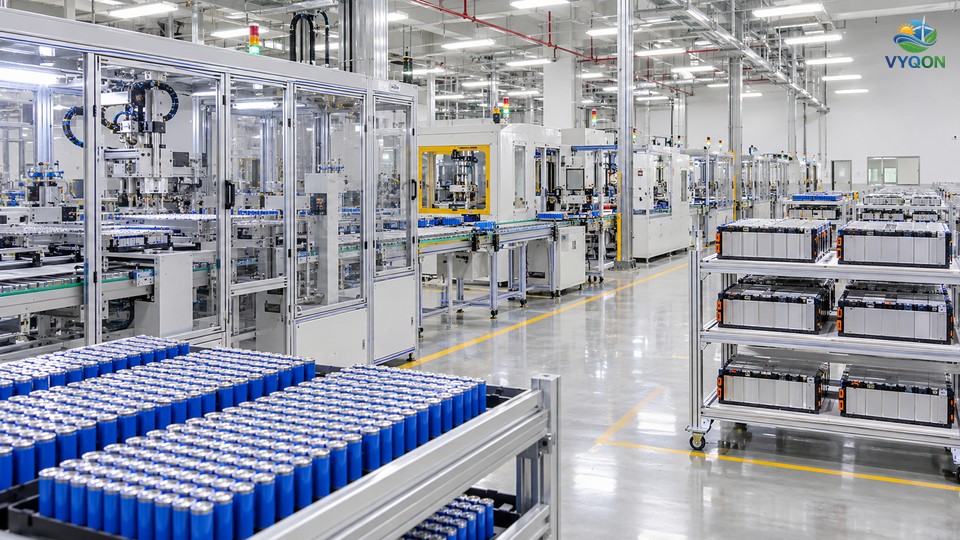
The Ministry of Heavy Industries (MHI) has received 22 bids in its 10 GWh ACC PLI tender, for 10 GWh of Advanced Chemistry Cell (ACC) manufacturing capacity earmarked for grid-scale stationary storage (GSSS) applications. The capacity is the last tranche of the 50 GWh targeted under the Production Linked Incentive (PLI) scheme for the National Programme on ACC Battery Storage. Technical bids were opened on 11 November 2026 at MHI in the presence of the bidders, and the ministry described the response as strong. The news was reported on 12 November 2026.
The 22 bidders in the 10 GWh ACC PLI tender
The ministry named the 22 companies that submitted bids: ACME Solar Holdings, Amara Raja Advanced Cell Technologies, Avaada Electro, Exide Energy Solutions, Fujiyama Power Systems, GK Energy, Godawari New Energy, JPM Energy Solutions, JSW Neo Energy, Lineage Power, Mahendra Sponge and Power, Megha Engineering and Infrastructures, Nsure Reliable Power Solutions, Reliance Industries, Renew Photovoltaics, Sai Bioenergy, Shirdi Sai Electricals, Sun Drops Energia, Utex New Energy, Vikram Solar, Waaree Energy Storage Solutions and Zetsol Energy.
The list mixes battery makers, solar module manufacturers, developers, infrastructure companies and newer entrants. Bidding does not mean an award: the ministry has not said how much capacity any bidder has asked for, or who will be selected.
How the tender works
MHI released the Request for Proposal (RFP) on 15 July 2026 for a global tender to select beneficiaries who will set up giga-scale ACC manufacturing facilities with a cumulative capacity of 10 GWh in India. The bidding runs online through a two-stage Quality and Cost Based Selection (QCBS) process on the Central Public Procurement (CPP) portal. The tender documents were available from 15 July 2026, and a pre-bid conference was held on 29 July 2026.
In its July release, the ministry gave 13 October 2026 as the bid due date and 14 October 2026 as the date for opening technical bids. The technical bids were eventually opened on 11 November 2026, so the schedule moved from the dates first announced. The next stages of the QCBS process, including the evaluation of technical bids and the opening of financial bids, have not been announced.
VYQON reported earlier on the launch of this global tender for the final 10 GWh of ACC capacity, and the 22 bids mark the first public sign of how much interest it has drawn.
Background: the PLI scheme for ACC battery storage
The Union Cabinet approved the PLI scheme on the National Programme on Advanced Chemistry Cell (ACC) Battery Storage in May 2021, with a total budgetary outlay of Rs 18,100 crore for achieving ACC manufacturing capacity of 50 GWh in the country. The scheme aims to reduce India’s dependence on imported ACCs by strengthening domestic manufacturing and encouraging large domestic and international players to set up a globally competitive ACC battery-manufacturing ecosystem.
According to the ministry, out of the targeted 50 GWh, 40 GWh of capacity has already been awarded to domestic manufacturers. The 10 GWh now on offer is therefore the remaining capacity, and it is specifically earmarked for grid-scale stationary storage rather than for other uses such as electric vehicles.
What it means for India’s clean-energy sector
India is adding renewable energy capacity quickly, and grid-scale batteries are becoming central to managing the evening peak and the variable output of solar and wind. The PLI scheme exists to cut dependence on imported cells, so domestic ACC capacity matters for supply security. The ministry says the 10 GWh allocation will support the country’s growing energy storage requirements arising from rapid renewable energy deployment, strengthen energy security, reduce import dependence and develop a globally competitive battery manufacturing ecosystem.
The mix of bidders also shows how the storage supply chain is changing. Solar module makers, renewable developers and conglomerates are looking at cell manufacturing alongside established battery companies, which could lead to a wider base of domestic cell suppliers for storage projects in the coming years.
The ministry says the strong participation reflects growing industry interest in India’s ACC manufacturing potential and supports its aim of a technologically self-reliant and sustainable ACC ecosystem under the Viksit Bharat 2047 vision. Winners will still need to build plants, meet the scheme’s conditions and deliver cells at scale, so the real test will come after the selection is complete.
Leave a Comment