
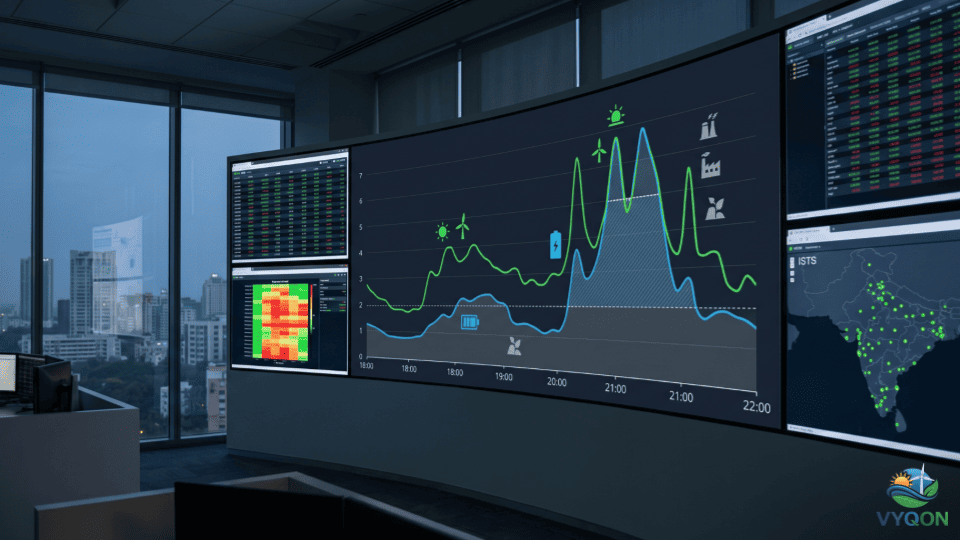
The Solar Energy Corporation of India (SECI) issued a Request for Selection (RfS) on April 19, 2026, for the implementation of the first “Contract for Difference” (CfD) tender (Tender ID: SECI-CfD-I). This pilot follows the Ministry of New and Renewable Energy (MNRE) guidelines released in March 2026. The tender provides for the procurement of 500 MW of renewable energy capacity to provide 1,500 MWh of daily peak power supply from projects connected to the Inter-State Transmission System (ISTS).
SECI-CfD-I Technical Parameters
| Parameter | Specification |
| Total Capacity | 500 MW (1,500 MWh total daily supply) |
| Technology Source | ISTS-connected Renewable Energy (Technology Agnostic; with or without Energy Storage Systems) |
| Strike Price Ceiling | ₹6.10/kWh |
| Contract Tenure | 12 years from Scheduled Commissioning Date (SCD) |
| Project Model | Build-Own-Operate (BOO) |
| Capacity Limits | Minimum 50 MW; Maximum 125 MW per bidder |
Mandated Operational Protocols
The delivery of peak power is governed by the following operational requirements:
- Peak Hour Delivery: Energy must be supplied for three hours daily within the 18:00 to 24:00 time block. SECI retains the right to designate specific time blocks within these hours if necessary.
- Non-Solar Restriction: The designated supply hours must fall exclusively within “non-solar hours” as defined by General Network Access (GNA) Regulations.
- Volume Requirement: Developers must sell a minimum of 3,000 kWh of energy per MW of contracted capacity daily during the designated peak hours.
- Market Sequence: Power must be bid on power exchanges in the following sequence: Green Day Ahead Market (GDAM) → Order Carry Forward (OCF) to Day Ahead Market (DAM) → Real Time Market (RTM).
- Shortfall Penalty: In the event of a weekly supply shortfall during peak hours, the developer must pay a penalty calculated at 1.5 times the difference between the strike price and the highest market clearing price (across GDAM, DAM, or RTM) observed during non-solar hours for that week.
- Sourcing Flexibility: A maximum of 25% of the annual renewable energy requirement may be sourced from green market segments or bilateral agreements to satisfy supply conditions.
The Contract for Difference (CfD) Mechanism
The CfD mechanism is a financial settlement process intended to provide revenue stability based on the relationship between the discovered Strike Price (SP) and the Market Clearing Price (MCP).
- Settlement Logic:
- If the MCP is higher than the SP (MCP > SP), the developer pays the difference to the CfD pool managed by SECI.
- If the MCP is lower than the SP (MCP < SP), SECI pays the shortfall to the developer from the CfD pool.
- Settlement Constraints: CfD settlements are subject to a maximum hourly quantum of 1 MWh per MW of contracted capacity.
- REC Revenue Clause: Any revenue generated from the sale of Renewable Energy Certificates (RECs) associated with power sold in DAM or RTM segments must be deposited into the CfD pool.
- Profit and Loss Sharing: Daily settlements are shared between the developer and the CfD pool in a 30:70 ratio (30% to the developer and 70% to the CfD pool), with monthly reconciliation.
- Stabilization Fund and SECI Obligation: A ₹76 crore (₹760 million) Stabilization Fund has been established by the Government of India as a revolving buffer. The government’s liability is capped at ₹76 crore; should the pool balance reach zero or become negative, SECI is required to replenish the pool from its own resources.
- Operational Fee: SECI may retain up to 25% of the profits credited to the pool (after the developer’s share) to cover operational expenses, following a two-year moratorium.
Bidder Eligibility and Financial Criteria
Participation in the SECI-CfD-I tender requires compliance with the following technical, financial, and legal standards:
- Technical Eligibility: Bidders must have commissioned power projects (as owner or EPC contractor) within the last seven years totaling a capacity based on their quoted capacity (X):
- One project of at least 4X/5 MW.
- Two projects of at least X/2 MW each.
- Three projects of at least 2X/5 MW each.
- Financial Eligibility:
- Net Worth: Minimum requirement is the sum of ₹96.80 Lakhs (₹9.68 Million)/MW for Solar PV, ₹136.80 Lakhs (₹13.68 Million)/MW for Wind/Other RE, and ₹24.00 Lakhs (₹2.40 Million)/MWh for Energy Storage Systems (ESS).
- Liquidity: Bidders must satisfy one of the following criteria:
- Annual Turnover: Minimum ₹66.84 Lakhs (₹6.68 Million) per MW of quoted capacity.
- PBDIT: Minimum ₹13.37 Lakhs (₹1.34 Million) per MW of quoted capacity.
- Line of Credit: Minimum ₹16.71 Lakhs (₹1.67 Million) per MW of quoted capacity.
- Legal Status: Bidders must be incorporated as companies under the Companies Act, 2013. Foreign entities may participate but must form an Indian SPV with at least 51% shareholding prior to signing the CfD Agreement. Proprietorships, LLPs, and NGOs are excluded. Bidders from countries sharing a land border with India must be registered with the Competent Authority.
Critical Tender Milestones
| Milestone | Date / Timeline |
| RfS Issue Date | April 19, 2026 (15:40:09) |
| Pre-bid Meeting | May 4, 2026 (11:30:11) |
| Online Bid Submission Deadline | May 22, 2026 (18:00:54) |
| Offline Bid Submission Deadline | May 26, 2026 (18:00:07) |
| Techno-Commercial Bid Opening | May 28, 2026 (10:00:39) |
| Financial Closure | 6 months from the Letter of Award (LoA) |
| Scheduled Commissioning Date (SCD) | 12 months from the effective date of the CfD Agreement |
Leave a Comment