
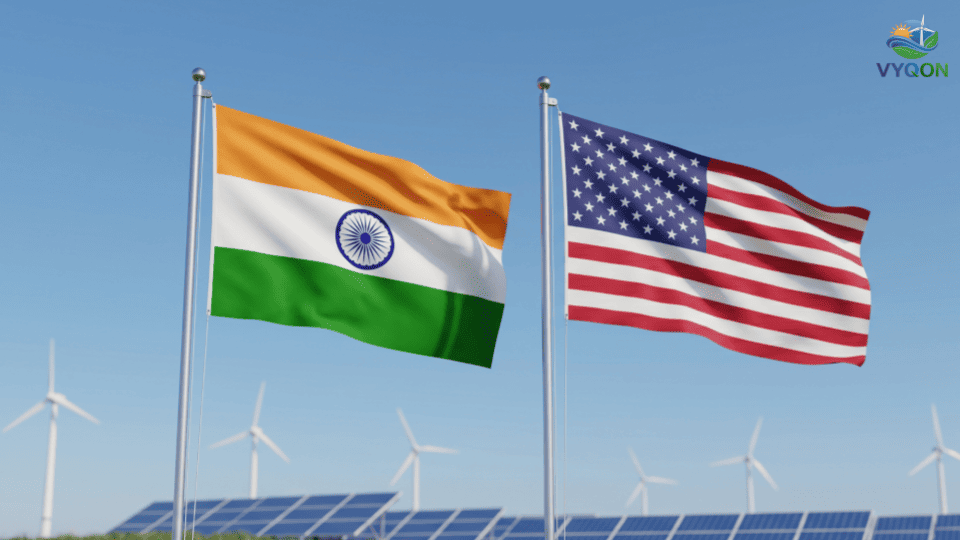
On February 6, 2026, the United States and India reached a framework for an Interim Agreement regarding reciprocal and mutually beneficial trade. This framework follows the February 13, 2025, launch of the “U.S.-India COMPACT (Catalyzing Opportunities for Military Partnership, Accelerated Commerce & Technology) for the 21st Century” by President Donald J. Trump and Prime Minister Narendra Modi. A central component of this development is the reduction of U.S. tariffs on Indian goods to an average reciprocal rate of 18%. This agreement serves as a precursor to a comprehensive Bilateral Trade Agreement (BTA) and aligns with “Mission 500,” a strategic objective to reach $500 billion in total bilateral trade by 2030. The framework provides targeted tariff relief for the Indian solar module sector and establishes significant purchase commitments for U.S. energy and technology.
The Trade Deal Specifics: Tariff Restructuring and Reciprocity
The Interim Agreement restructures the previous tariff environment that had seen many Indian exports subject to an effective duty of approximately 50%. This previous rate was comprised of a 10% baseline duty, a 15% reciprocal layer, and a 25% punitive duty linked to India’s purchases of Russian oil and other trade asymmetries.
Under Executive Order 14257, the new effective reciprocal tariff rate is set at 18%. According to data from India’s Ministry of Commerce and Industry, of the USD 40.96 billion in Indian exports previously subject to reciprocal tariffs, USD 30.94 billion will see rates reduced to 18%. An additional USD 10.03 billion in exports will see tariffs reduced to zero.
Specific Indian product categories subject to the 18% rate include:
- Textiles and apparel
- Leather and footwear
- Organic chemicals
- Machinery and parts
- Plastics and rubber
- Home décor and artisanal products
Subject to the successful conclusion of the Interim Agreement, the United States will remove reciprocal tariffs on a range of goods identified in the Aligned Partners Annex to Executive Order 14346, including:
- Generic pharmaceuticals and pharmaceutical ingredients
- Gems and diamonds
- Aircraft parts
Furthermore, the United States will remove tariffs on Indian aircraft and parts previously imposed under Proclamation 9704 (Aluminum), Proclamation 9705 (Steel), and Proclamation 10962 (Copper). In exchange, India has committed to the cessation of Russian oil purchases in favor of U.S. hydrocarbons and the gradual reduction of its own tariffs and non-tariff barriers on U.S. exports “towards zero.”
Solar Sector Impact: Market Access and Competitive Positioning
The reduction of tariffs from 50% to 18% significantly alters the competitive landscape for Indian solar manufacturers. The U.S. market is a critical destination for the industry, accounting for 97% of Indian solar exports in 2025.
The 18% rate establishes a clear tariff differential in favor of India relative to other regional exporters. While India’s rate is reduced, China continues to face a 35% U.S. tariff. India also gains a marginal advantage over other Indo-Pacific competitors including Vietnam (20%), Thailand (19-20%), Malaysia (19-20%), Bangladesh (20%), Cambodia (19%), and the Philippines (19%).
Industry leaders have described the U.S. market as a “strategic turning point” for Indian clean-tech:
- Saatvik Green Energy: CEO Prashant Mathur stated that the deal transforms the U.S. from a high-risk market to one of significant opportunity, mitigating concerns regarding Chinese producers circumventing trade barriers.
- Vikram Solar: Chairman Gynaesh Chaudhary noted that the agreement enhances global competitiveness by providing price efficiency and long-term demand visibility.
- Rayzon Solar: CEO Amit Barve highlighted the immense demand in the U.S. market and the advantage of the new tariff structure.
Despite the reduction, the industry remains attentive to ongoing U.S. antidumping and countervailing duty (AD/CVD) investigations involving allegations of “selling below cost.” Indian manufacturers have called for the withdrawal of these investigations as part of the deepening trade partnership.
Strategic Energy and Purchase Commitments
Central to the “Mission 500” objective of $500 billion in total bilateral trade by 2030 is a specific commitment by India to purchase $500 billion worth of U.S. goods over the next five years. This procurement strategy is intended to rebalance trade flows and secure supply chains in critical sectors.
India’s five-year purchase commitment includes:
- Energy Products: Liquefied Natural Gas (LNG) and coking coal.
- Technology: Graphics Processing Units (GPUs) and specialized data center equipment.
- Aviation: Civilian aircraft and aircraft parts.
- Precious Metals: Strategic procurement of gold, silver, and platinum.
The shift in energy policy, moving from Russian crude to U.S. hydrocarbons, was a fundamental condition for the U.S. to roll back the 25% punitive duty and initiate the reciprocal tariff adjustment.
Non-Tariff Barriers and Regulatory Alignment
The Interim Agreement contains binding provisions to address non-tariff barriers (NTBs) that have historically restricted market access. India has agreed to a six-month timeline to determine if U.S.-developed or international standards, including testing requirements, are acceptable for U.S. exports in identified sectors.
Key regulatory and market access commitments include:
- Agricultural Access: India will provide preferential access for U.S. products such as dried distillers’ grains (DDGs), red sorghum, tree nuts, bourbon, and motorcycles. The U.S. noted that USD 1.36 billion of Indian agricultural exports will receive zero additional duty access.
- ICT and Medical Devices: India will eliminate restrictive import licensing procedures and quantitative restrictions on Information and Communication Technology (ICT) goods and medical devices.
- Automotive: India will receive a preferential tariff rate quota for automotive parts subject to Proclamation 9888. Both nations intend to discuss standards and conformity assessment procedures to reduce double-testing requirements.
Key Trade Metrics
| Metric | Value |
| Previous Effective US Tariff on India | ~50% |
| New Reciprocal Tariff Rate | 18% |
| 2030 Bilateral Trade Goal (Mission 500) | $500 Billion |
| India’s 5-Year Purchase Commitment (US Goods) | $500 Billion |
| Indian Exports to US (2024 Base) | $86.35 Billion |
Framework Implementation
The transition from the Interim Agreement framework toward the finalization of a comprehensive Bilateral Trade Agreement (BTA) is governed by the roadmap established in the Terms of Reference for the COMPACT. These measures are executed under the authority of Executive Order 14257 (April 2, 2025) and were formalized through the joint statements issued in February 2026. Both governments have committed to prompt implementation to solidify economic security alignment and enhance supply chain resilience.
Leave a Comment