
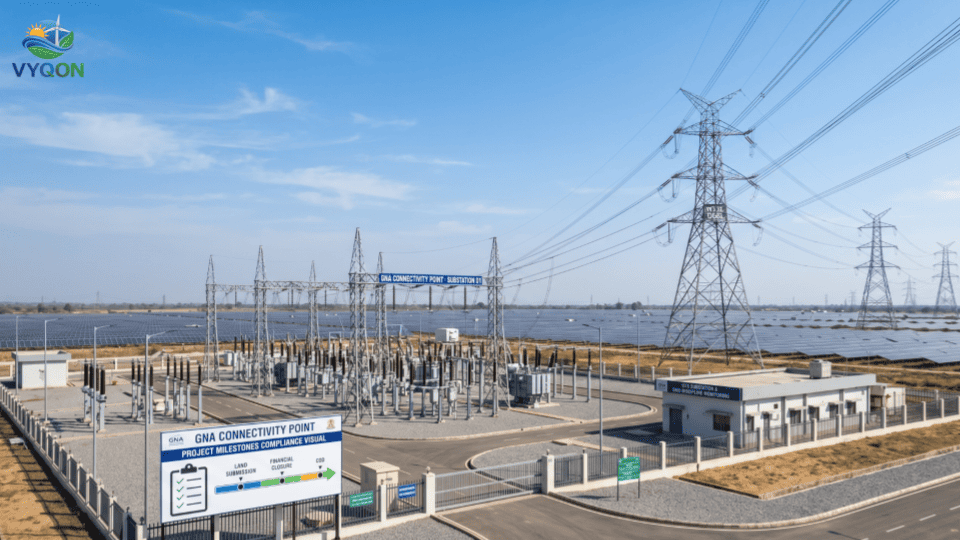
The Central Electricity Regulatory Commission (CERC) has issued a landmark draft procedure for the levy of Milestone Extension Charges (MEC) under the Connectivity and General Network Access (GNA) Regulations, 2022. This move signals a significant transition from the “ad-hoc” regulatory environment—marked by recent high-profile litigation involving Serentica Renewables and ReNew Green Energy—toward a standardized, uniform framework. By formalizing the “Power to Relax” (Regulation 41) into a structured procedure, the Commission aims to ensure grid discipline and optimal transmission resource utilization while providing developers a transparent, though costly, pathway for project delays.
Master Milestone Compensation Table
The proposed framework introduces a graded daily penalty structure. Charges escalate based on the duration of the extension to discourage the hoarding of grid connectivity, which the CERC continues to treat as a scarce public resource.
| Milestone Type | Maximum Extension | Daily Extension Charge (₹/MW/day) |
| Submission of Land Documents | 3 Months | Month 1: ₹1,500 (Base) Month 2: ₹1,650 (10% increase) Month 3: ₹1,800 (20% increase) |
| Financial Closure (FC) | 6 Months | Months 1–3: ₹1,500 (Base) Month 4: ₹1,650 Month 5: ₹1,800 Month 6: ₹1,950 (Note: Linear escalation of ₹150/month starts after Month 3) |
| Commercial Operation Date (COD) | 12 Months | Months 1–6: ₹3,000 (Base) Months 7–9: ₹3,300 to ₹3,900 (10% monthly increase) Months 10–12: ₹6,000 (200% of base rate) |
Financial Impact Note: The “Firm Start Date” Caveat
A critical distinction for project finance and legal teams is that the payment of MEC does not alter the project’s “Firm Start Date.” Even if an extension is granted and charges are paid, the entity remains liable for all applicable mismatch charges under the Sharing Regulations, 2020. This underscores the Commission’s stance that milestone extensions are a mechanism to prevent connectivity revocation, not a shield against operational transmission liabilities.
Eligibility and Compliance Thresholds
To qualify for an extension, the Nodal Agency requires applicants to demonstrate “meaningful progress” through the following bolded thresholds:
- Land Document Extensions: A minimum of 20% of required land documents must already be submitted.
- Financial Closure Extensions: Grantees must demonstrate 50% land documentation (if under the Land BG route) or 25% land documentation (if under the LoA/PPA route).
- COD Extensions: Applicants must provide 100% land documentation (Land/Land BG route) or 50% (LoA/PPA route). Additionally, they must furnish proof of Financial Closure and comprehensive EPC contract award details.
Administrative Procedures and Special Provisions
The draft procedure outlines rigorous operational rules for developers seeking relief:
- Advance Notice and Payment: Entities must apply to the Nodal Agency at least 15 days before the original milestone deadline. MEC must be paid 15 days in advance on a per-day basis. If the milestone is achieved earlier than the requested extension period, the Nodal Agency will refund the unutilized portion without interest.
- COD Grace Period (Regulatory Gap Waiver): Addressing a recurring “regulatory gap” identified in the Serentica and ReNew disputes—where revocation dates were sometimes triggered on the same day as the GNA effective date—the CERC has proposed a two-month waiver. No MEC will be levied for the first two months following the GNA effective date to allow for trial runs and substation energization. However, the total extension remains capped at 12 months.
- Consequences of Non-Compliance: Failure to remit MEC in advance or meet the revised timelines will result in the automatic revocation of connectivity and the encashment of applicable Bank Guarantees (BGs).
- Fund Allocation: All collected MEC will be credited by the Nodal Agency to the Deviation and Ancillary Services Pool Account.
Next Steps and Stakeholder Engagement
The CERC has invited stakeholders to submit comments, objections, and suggestions on the draft procedure, registered under Petition No. 5/SM/2026.
- Submission Deadline: April 30, 2026.
- Submission Method: Comments may be sent via email or in physical form to the Commission’s secretariat.
- Public Hearing: A separate notice will be issued to schedule a public hearing following the review of stakeholder feedback.
Leave a Comment