
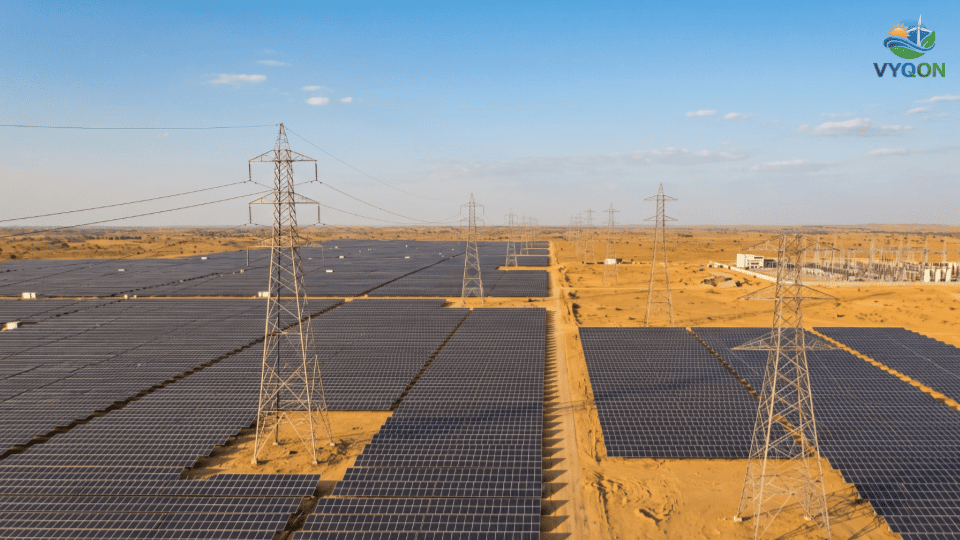
The Infrastructure-Generation Mismatch
The Central Transmission Utility of India Limited (CTUIL) has formally identified a critical “planning difficulty” regarding the evacuation of renewable energy from Rajasthan. This deficit is defined by a significant disparity between the volume of connectivity applications received and the current transmission infrastructure roadmap. According to data submitted to the Central Electricity Regulatory Commission (CERC) and the Ministry of Power, CTUIL has received approximately 133 GW in connectivity applications for the Inter-State Transmission System (ISTS) in Rajasthan.
However, transmission schemes have been evolved for only 73 GW of capacity, which are currently in various stages of implementation. This leaves a “balance capacity” of 60 GW for which transmission schemes are yet to be developed. This 60 GW shortfall represents the primary technical bottleneck preventing the final grant of connectivity for nearly half of the state’s projected renewable generation.
Regional Concentration and Data Analysis
The infrastructure crisis is exacerbated by the extreme geographic concentration of renewable potential and connectivity applications. The following data points define the quantitative scale of the regional grid requirements:
- Total Connectivity Applications: Approximately 133 GW of ISTS connectivity applications have been received for Rajasthan’s renewable complexes.
- Planned Infrastructure: Transmission schemes have been evolved for 73 GW; the remaining 60 GW constitutes the gap where schemes are yet to be evolved.
- Renewable Potential Distribution: Of Rajasthan’s total 179 GW renewable potential (as declared by MNRE/SECI), 163 GW—more than 85%—is concentrated in four districts: Jaisalmer, Jodhpur, Barmer, and Bikaner.
- Application Density: These four districts account for approximately 117 GW (90%) of all connectivity applications received in the state.
- Current Installed Capacity: As of October 31, 2025, the total installed generation capacity in Rajasthan stood at 54.77 GW, up from 22.02 GW in March 2020.
Evolution of Transmission Technology: EHVAC to HVDC
Grid planning in Rajasthan has reached a techno-economic limit regarding traditional Extra High Voltage Alternating Current (EHVAC) corridors. CTUIL reporting indicates a shift toward High Voltage Direct Current (HVDC) systems for long-distance evacuation.
Techno-Economic Limits of EHVAC
Current planning includes 61 GW of EHVAC corridors. However, EHVAC technology is no longer considered viable for further expansion in the region because the distances from Rajasthan’s renewable potential zones to the borders of neighboring states now exceed 600–700 km. Point-to-point transfers to remote load centers in the Western and Eastern Regions frequently exceed 1,000 km. Furthermore, high solar concentration in EHVAC corridors creates significant grid stability challenges, including reactive power variations that lead to low voltage during peak solar scenarios and high voltage during off-peak periods.
HVDC Implementation and Project Scrapping
With the Northern Region expected to face an extreme power surplus and export scenario starting in 2026, CTUIL is prioritizing HVDC links capable of 6,000 MW point-to-point transfer. A primary project is the Bhadla-Fatehpur ±800 kV HVDC link, a 950 km corridor designed to evacuate 6 GW to Uttar Pradesh.
Technical delays at other nodes, such as the Bikaner-V Pooling Sub-station (PS), have been attributed to major shifts in planning. An initial HVDC system was planned to connect Bikaner-V to Begunia in Odisha to service projected Green Hydrogen demand. This link was subsequently scrapped due to the non-receipt of adequate applications from Green Hydrogen developers in the Eastern Region and upcoming thermal generation in that area, necessitating the evolution of alternative transmission schemes for Bikaner-V.
Regulatory Response: The CERC Ruling in Petition 666/MP/2025
The regulatory landscape was significantly altered by the CERC order dated April 10, 2026, in the matter of Saurya Urja Company of Rajasthan Limited (SUCRL) v. CTUIL. The ruling addresses developers who have received “in-principle” connectivity but are stalled due to the absence of final transmission coordinates.
Relief Measures and Bank Guarantee Protocols
CERC has mandated that CTUIL offer a withdrawal option to applicants who have not received a “Final Grant of Connectivity” due to these planning difficulties. The terms of this relief are governed by the following protocols:
- Withdrawal Timeline: CTUIL must offer the withdrawal option by May 10, 2026 (within 30 days of the order). Applicants have two months from the date of communication by CTUIL to exercise this option.
- Financial Terms: Developers who withdraw are entitled to a 100% refund of Land Bank Guarantees (Land BGs) and Connectivity Bank Guarantees, specifically Conn-BG1, Conn-BG2, and Conn-BG3.
- Forfeiture: The withdrawal requires a 50% forfeiture of the initial application fee, with the remaining 50% returned.
- Status of Non-Withdrawal: For applicants who do not exercise the option, CTUIL will continue to retain all submitted BGs under the applicable regulatory framework.
GNA Regulations Amendment
The processing of these applications is now governed by the Third Amendment to the GNA Regulations, which became effective on September 9, 2025. Applications are currently being transitioned under Regulation 37.10(b)(i). This amendment provides developers an additional nine months to submit land documents from the date CTUIL communicates tentative coordinates for sub-stations that are neither under construction nor operational.
Current Status of Transmission Scheme Development
As of the latest reporting period, there are 33 ISTS projects under construction in Rajasthan. These include infrastructure under the Green Energy Corridor (GEC) framework, such as GEC Phase-I (which commissioned 1,054 ckm of lines and 1,915 MVA capacity) and GEC Phase-II (currently implementing 659 ckm of lines and 2,191 MVA capacity). Specific assets under development include the 400kV GSS Jaisalmer-2 and the 220kV GSS Chhatargarh.
The Bikaner-V PS scheme reached an agreement phase during the 40th Northern Region Consultation Meeting for Evolving Transmission Schemes (CMETS) on September 12, 2025. However, final geographic coordinates remain unavailable. These coordinates will be finalized only after the Bid Process Coordinator (BPC) is notified and the successful Transmission Service Provider (TSP) determines the exact site location. Until the 60 GW gap in evolved transmission schemes is addressed, final connectivity for approximately 50% of the state’s pending applications remains in a transitional status.
Leave a Comment