
Black mass export ban: what DGFT has notified
The Directorate General of Foreign Trade (DGFT), under the Department of Commerce in the Ministry of Commerce and Industry, has prohibited the export of lithium-ion battery black mass. In Notification No. 49/2026-27, dated 10 November 2026 in New Delhi, the government amended the export policy for ITC (HS) code 8549 1400 from “Free” to “Prohibited”.
The notification came into effect immediately and stays in force until further orders. The black mass export ban was issued by Lav Agarwal, Director General of Foreign Trade and Ex-Officio Additional Secretary to the Government of India, and is to be published in the Gazette of India Extraordinary, Part-II, Section 3, Sub-section (ii).
What the HS code covers
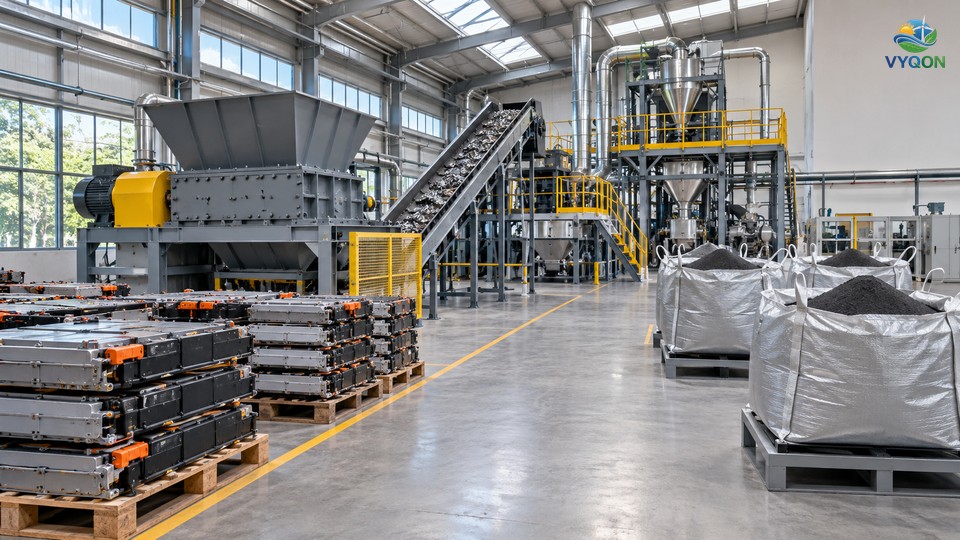
The affected entry is waste and scrap of primary cells, primary batteries and electric accumulators, including spent primary cells, spent primary batteries and spent electric accumulators, in the category “unsorted and not containing lead, cadmium or mercury”. The notification’s subject line identifies this entry as lithium-ion battery black mass. Black mass is the dark powder-like material produced when spent lithium-ion batteries are shredded, and it is the feedstock from which metals such as lithium, cobalt and nickel are recovered by recyclers.
Legal basis and transition
The Central Government issued the change in exercise of powers under Section 3 read with Section 5 of the Foreign Trade (Development and Regulation) Act, 1992, as amended, read with Paras 1.02 and 2.01 of the Foreign Trade Policy 2023. It amends the export policy of the item in Chapter 85 of ITC (HS), Schedule II of the Export Policy.
The notification also says that the provisions of Para 1.05 of the Foreign Trade Policy 2023 on the transitional arrangement apply. The text of the notification does not describe what that arrangement means for specific consignments.
What the notification does not say
The notification does not state the reason for the change, does not give export volumes or values, and does not mention any exemption or licensing route. Those details have not been disclosed in the official document reviewed for this report, so none are assumed here.
What it means for India’s clean-energy sector
Battery recycling sits alongside the growth of electric vehicles and energy storage, and black mass is the intermediate product that links the two. Under India’s Battery Waste Management Rules, 2022, issued by the Ministry of Environment, Forest and Climate Change, producers and importers of batteries are responsible for the collection and recycling or refurbishment of the batteries they place on the market, under an extended producer responsibility framework. A prohibition on exporting unsorted black mass applies to the recyclers’ intermediate product, and companies that handle it will need to read the notification closely.
Anyone affected can check the notification on the DGFT website and the final Gazette publication for any further clarification.
Official references
1. Directorate General of Foreign Trade, Ministry of Commerce and Industry, Notification No. 49/2026-27 dated 10 November 2026, amendment in export policy of waste and scrap of primary cells, primary batteries and electric accumulators (lithium-ion battery black mass) under ITC (HS) 85491400: https://content.dgft.gov.in/Website/dgftprod/58145d8f-19de-4e3a-b7ba-95fdb2ed5ea4/Notification%20No.%2049%20of%202026-2027.pdf
Leave a Comment