
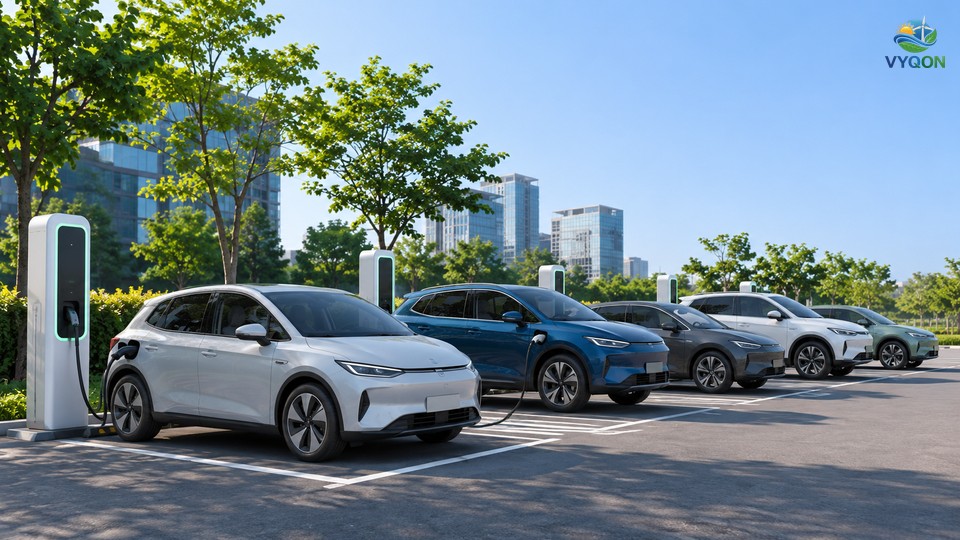
Electric car sales in India in 2026 have crossed 3 lakh units in a calendar year for the first time. According to VAHAN registration data, 304,701 electric cars, SUVs and MPVs were delivered to customers between 1 January and 9 November 2026. That is already 109,130 units, or 56%, more than the 195,571 units registered in the whole of 2025, with about seven weeks of the year still left.
What the VAHAN data shows
VAHAN is the national vehicle registration database run by the Ministry of Road Transport and Highways, and it is the standard source for retail sales of vehicles in India. The 304,701 figure covers electric passenger vehicles registered between 1 January and 9 November 2026. Because the count stops on 9 November, the final 2026 total will be higher. Forecasts for the full year differ between analysts, so this article does not quote one.
Month-by-month sales
Monthly registrations rose through the year:
- January: 21,568
- February: 16,300
- March: 25,502
- April: 25,984
- May: 28,416
- June: 33,640
- July: 34,717
- August: 32,587
- September: 38,440, the highest month so far
- October: 37,516
- 1 to 9 November: 10,031
Monthly sales have stayed above 30,000 units in every month since June. Only February, at 16,300 units, fell below 20,000 units this year.
Who is selling the most
Tata Motors leads the market with 120,895 electric cars registered this year, a share of about 40%. It is the first manufacturer to cross 100,000 electric cars in a calendar year. Mahindra is second with 69,660 units, about 23% of the market. JSW MG Motor is third with 56,988 units, about 19%.
The rest of the market is much smaller:
- VinFast: 15,867 units, about 5%
- Maruti Suzuki: 12,390 units, about 4%
- Kia: 7,612 units
- BYD: 6,755 units
- Hyundai: 6,013 units
- Toyota: 762 units
- Stellantis: 436 units
Together, Tata Motors, Mahindra and JSW MG Motor account for roughly four of every five electric cars sold this year.
Luxury electric cars
Luxury electric cars made up 7,323 of the 304,701 units, about 2.4% of the total. BMW leads this group with 4,273 units, followed by Mercedes-Benz with 1,416 units, Tesla with 1,153 units and Volvo with 383 units.
Why the numbers matter
The 2026 total is more than 1.5 times the whole of 2025. The pattern through the year, with sales above 30,000 units a month from June onwards, suggests demand is no longer limited to a few months. It also points to a wider choice of models: the market now includes models from Indian, Japanese, Korean, Chinese, Vietnamese, American and European brands, from small hatchbacks to luxury SUVs.
The data also shows that the market is still concentrated. Three manufacturers hold most of the share, while several global brands have sold only a few hundred or few thousand units. Whether the newer entrants gain share will depend on pricing, charging access and new launches, none of which can be read from registration figures alone.
What it means for India’s clean-energy sector
For the power and clean-energy sector, a larger electric car fleet means more demand for charging, and more demand for electricity that can be supplied from renewable sources. Electric cars are one part of the wider electric vehicle market, and two-wheelers and three-wheelers still make up most EV registrations by volume. Even so, passenger cars use more energy per vehicle, so growth in this segment matters for charging infrastructure planning, distribution networks and time-of-day tariffs.
The numbers are also useful for manufacturers and battery suppliers. A segment that has moved from about 196,000 units in 2025 to over 304,000 units by early November 2026 gives planners a clearer sense of volumes for cells, packs and charging equipment.
What to watch next
The first thing to watch is the final 2026 total once the full year of registration data is in. The second is whether monthly sales stay near 35,000 to 40,000 units during the festive season. The third is whether the share of the leading three manufacturers changes as more models come to market.
Official references
1. VAHAN Dashboard, Ministry of Road Transport and Highways (vehicle registration data): https://vahan.parivahan.gov.in/vahan4dashboard/
Leave a Comment