
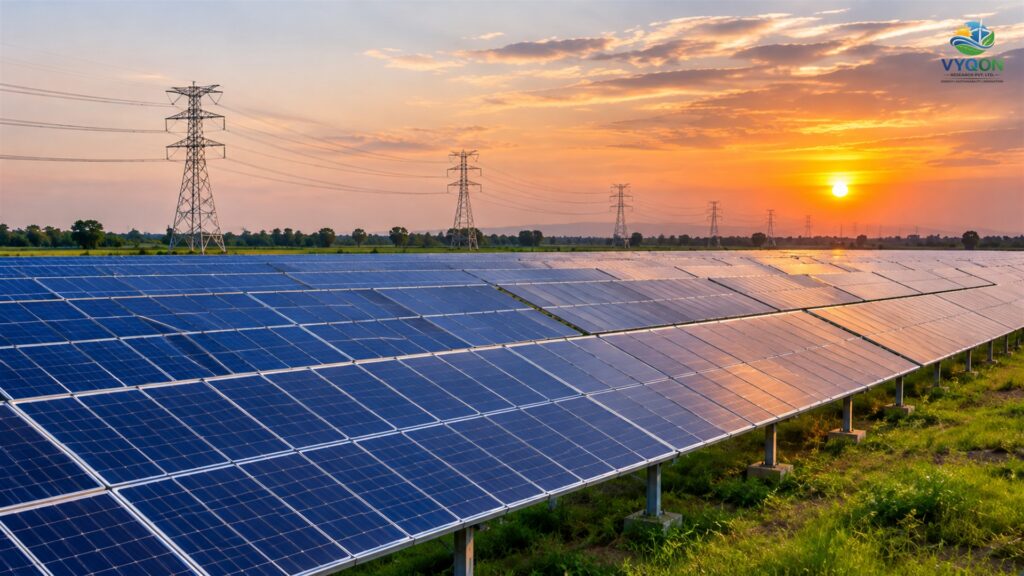
India’s installed solar capacity reached about 175 GW by 31 October 2026, according to a backgrounder issued by the Press Information Bureau (PIB) on 17 November 2026. The government says capacity has grown about 62-fold from 2.82 GW in 2014. In the current financial year, FY 2026-27, 24.29 GW of solar capacity has been added so far, according to PIB, which does not give a cut-off date for this figure. The document also reports that domestic solar module manufacturing capacity rose to 192 GW by June 2026.
Key Figures
The backgrounder sets out the following capacity and manufacturing data:
- Large solar projects: 133 GW, including the solar component of hybrid projects
- Grid-connected rooftop solar: 34.97 GW, with the rest of the capacity from off-grid systems
- Additions in FY 2025-26: 44.61 GW, against 23.83 GW in FY 2024-25
- Additions in FY 2026-27 so far: 24.29 GW
- Module manufacturing capacity: about 172 GW as of 31 March 2026 and 192 GW by June 2026, up from 2.3 GW in 2014
The document adds that total non-fossil fuel capacity reached 308.03 GW as of 30 September 2026. This comprised 299.25 GW of renewable energy capacity and 8.78 GW of nuclear capacity. The highest annual addition of non-fossil capacity, 55.29 GW, was recorded in FY 2025-26. Separately, Minister of State for Power and New and Renewable Energy Shripad Yesso Naik spoke at Singapore International Energy Week, held from 26 to 28 October 2026. He said India’s installed electricity capacity stood at 558.9 GW as of 30 September 2026, about 55% of it from non-fossil sources.
The backgrounder does not give a month-by-month split of FY 2026-27 additions or a state-wise capacity table. It also does not say whether the capacity figures are on an AC or DC basis.
Distributed Solar and Rural Schemes
Distributed solar contributed 16.3 GW, or 36%, of the 44.61 GW of solar added in FY 2025-26, according to PIB. Of this, 7.6 GW came from the Pradhan Mantri Kisan Urja Suraksha evam Utthaan Mahabhiyan (PM-KUSUM) and 8.7 GW from rooftop solar.
Under PM-KUSUM, nearly 11.91 lakh off-grid solar pumps had been installed and more than 17.18 lakh agricultural pumps covered through feeder-level solarisation as of 30 September 2026. Around 2,426 MW of decentralised solar capacity had been commissioned on farmers’ land. The scheme targets about 34,800 MW of solar capacity by 2026-27, with central financial support of ₹34,422 crore.
PM Surya Ghar: Muft Bijli Yojana, launched on 13 February 2024 with an outlay of ₹75,021 crore, supports household rooftop systems. PIB says ₹28,024 crore had been disbursed as central financial assistance under the scheme until July 2026.
Solar Parks and Floating Solar
As of October 2026, 56 solar parks with a combined sanctioned capacity of 39,461 MW had been approved, the document states. Gujarat has the largest sanctioned capacity, 12,150 MW across seven parks, followed by Rajasthan with 10,726 MW across 11 parks. Bhadla Solar Park in Rajasthan, spread across nearly 5,700 hectares, has an installed capacity of 2,245 MW.
The government approved the Pradhan Mantri Surya Sarovar Yojana (PM-SSY) on 31 July 2026, with an outlay of ₹5,070 crore. The scheme supports 5,000 MW of floating solar projects with co-located energy storage of at least two hours, or 10,000 MWh. It runs from FY 2026-27 to FY 2030-31 and aims to build on a current floating solar base of around 800 MW.
Policy Backdrop
The backgrounder links the growth to competitive bidding through electronic reverse auctions. Tariffs fell from around ₹18 per unit in 2010 to a record low of ₹1.99 per unit, achieved by Gujarat Urja Vikas Nigam Limited (GUVNL) in 2020. In 2025, the levelised cost of electricity from utility-scale solar in India stood at US$35 per MWh, against a global average of US$44 per MWh.
Renewable purchase obligations require distribution companies and other obligated entities to buy a set share of renewable power. The trajectory has been notified through 2029-30, and the target for 2026-27 is 35.95%.
On manufacturing, the production-linked incentive (PLI) scheme for high-efficiency solar modules was launched in 2021 with ₹4,500 crore and expanded in 2022 by ₹19,500 crore. The Approved List of Models and Manufacturers (ALMM), introduced in 2019, limits specified government-supported and competitively bid projects to listed modules and cells.
Context From the Summit
The backgrounder was issued after the Bharat Renewable Energy Summit & Expo (BRESE) 2026, held at Bharat Mandapam, New Delhi, from 2 to 5 November. PIB says the event drew participants from over 130 countries and an exhibition of more than 400 organisations. It was co-located with the ninth International Solar Alliance (ISA) Assembly and the fourth International Conference on Green Hydrogen. The Ministry of New and Renewable Energy (MNRE), which organised the summit, had said on 28 October 2026 that 13 states and union territories would take part.
According to PIB, India added 37 GW of solar capacity in 2025, surpassing the United States in annual additions. It describes India as the world’s second-largest solar growth market.
Outlook
Non-fossil capacity stood at 308.03 GW on 30 September 2026, against the target of 500 GW of non-fossil capacity by 2030 that India announced at the 26th UN Climate Change Conference (COP26) in Glasgow. The next data points to watch are the monthly additions for the rest of FY 2026-27 and progress on the 5,000 MW floating solar scheme. PIB also points to the Green Energy Corridor projects across ten states, planned to support the evacuation of around 44 GW of renewable energy.
Official Sources
- Press Information Bureau – PIB Backgrounder: India’s Solar Growth Enters a New Era (17 November 2026): https://www.pib.gov.in/PressReleasePage.aspx?PRID=2337251
- Press Information Bureau (Ministry of New and Renewable Energy) – PM to Inaugurate Bharat Renewable Energy Summit & Expo 2026 on 2nd November, 2026 (28 October 2026): https://www.pib.gov.in/PressReleasePage.aspx?PRID=2329695
- Press Information Bureau (Ministry of Power) – Shri Shripad Yesso Naik Leads Indian Delegation to Singapore International Energy Week 2026 (28 October 2026): https://www.pib.gov.in/PressReleasePage.aspx?PRID=2329438
Leave a Comment