
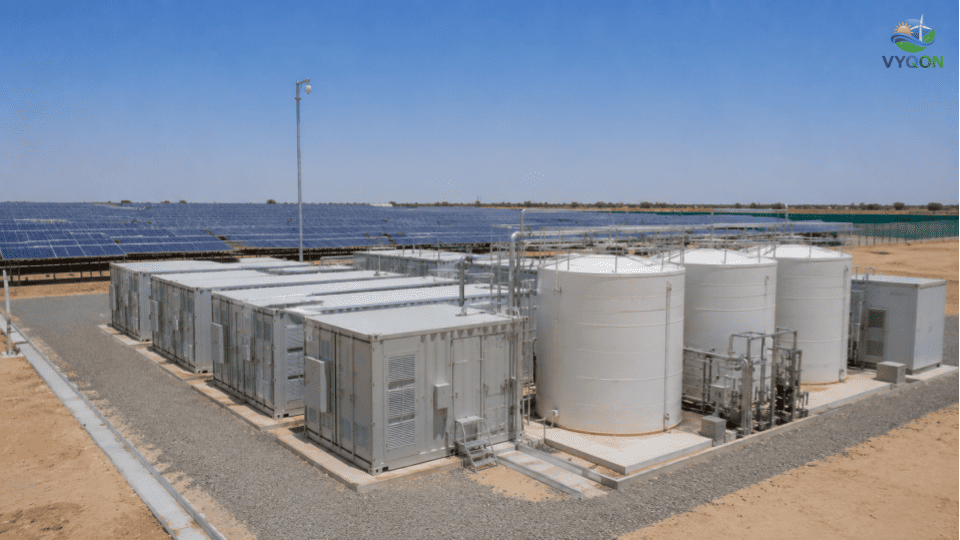
In July 2026, NTPC Renewable Energy Limited (NTPC REL) awarded the contract for a 100 MWh Vanadium Redox Flow Battery (VRFB) system to be installed at the Khavda Renewable Energy Park in Gujarat. The project represents India’s first utility-scale deployment of long-duration flow battery technology. The contract was issued to a consortium comprising Bondada Engineering Limited and Delectrik Systems Pvt. Ltd.
Contractual Framework and Awarded Entities
The project execution follows a partnership model between the engineering lead and the technology provider:
- Bondada Engineering Limited: Serving as the Engineering, Procurement, and Construction (EPC) Contractor, the firm is responsible for site infrastructure, procurement, and physical deployment.
- Delectrik Systems Pvt. Ltd.: Serving as the Technology Partner and manufacturer, the company will supply the proprietary vanadium flow chemistry and stack hardware.
- O&M Parameters: Following the commissioning phase, the contract stipulates an operations and maintenance (O&M) term of 10 years.
Project Execution and Deployment Timeline
The execution phase is scheduled to begin immediately following the July 2026 award, with a projected completion within the 2027 calendar year.
Project Milestone Schedule
| Milestone | Date/Timeline |
| Tender Float | February 2026 |
| Contract Award | July 2026 |
| Execution Timeline | 10 months from Notice of Award (NOA) |
| Scheduled Deployment/Commissioning | 2027 |
Technical Specifications: Vanadium Redox Flow Technology
The energy storage system is 100% designed, engineered, and manufactured in India by Delectrik Systems Pvt. Ltd. To achieve the 100 MWh capacity requirement, the project will utilize the modular integration of approximately 500 units of the RFB200 series architecture. Each unit provides a nominal capacity of 200 kWh.
System Mechanics and Profile
The system utilizes vanadium redox chemistry, storing energy in a dilute acid electrolyte. Power conversion occurs in a cell stack where the electrolyte is electrochemically oxidized and reduced. Per the procurement directive, the utility-scale solution is configured as a non-containerized installation.
- Cycle Life: Unlimited charge-discharge cycles without chemical degradation.
- Operational Life: 20+ years.
- Safety Profile: Non-flammable, aqueous electrolyte; lacks the thermal runaway risks associated with solid-state chemistries.
- Environmental Tolerance: Rated for durable operation in ambient temperatures up to 50°C.
- Efficiency: Round-trip DC-DC efficiency is rated between 70% and 75%.
Site Profile: Khavda Renewable Energy Park
The system will be deployed within the Khavda Renewable Energy Park in the Kutch district of Gujarat.
- Total Park Area: 72,600 hectares.
- Capacity Target: The park is scheduled to reach a total nameplate capacity of 30 GW by 2029.
- NTPC Allocation: NTPC holds a specific allocation of 9,500 hectares within the park, with a total permitted generation capacity of 4,750 MW.
Official Statements
Management at Bondada Engineering Limited has identified the Battery Energy Storage System (BESS) vertical as a primary driver for the company’s transition into high-margin energy infrastructure. During recent corporate disclosures, management characterized their entry into the BESS market as a shift toward stable, long-term revenue streams.
“Battery storage is the clearest new business line for the company. These projects are positioned as annuity-style contracts over a 12-year period after commissioning. Our existing order book in this vertical yields healthy margins, and we are guiding for stable-to-improving EBITDA margins as we push forward with BESS execution.”
Comparative Context
The VRFB architecture offers specific functional advantages for stationary utility-scale applications based on the following technical attributes:
- Independent Scaling: Unlike solid-state batteries, power (stack size) and energy (electrolyte volume) can be scaled independently to meet specific grid requirements.
- Zero Self-Discharge: Energy-bearing electrolytes are stored in separate tanks, preventing self-discharge during idle periods.
- Elimination of Cross-Contamination: The use of vanadium in both the negolyte and posolyte solutions eliminates the risk of cross-contamination and electrolyte degradation common in other flow chemistries, such as iron-chromium.
- Discharge Depth: The system supports 100% depth of discharge (DOD) without impacting the cycle life or mechanical integrity of the cell stacks.
Official Sources & References
- Vanitec (International Vanadium Association)
“Bondada Engineering Awarded India’s First 100 MWh Vanadium Flow Battery Energy Storage System Project by NTPC Renewable Energy Ltd.” (July 20, 2026).
View Official Announcement - Delectrik Systems Pvt. Ltd.
“Technical Specifications & Product Series: RFB200 – 25 kW, 200 kWh Vanadium Redox Flow Battery.” (Corporate Product Manual).
Visit Technology Partner Website,, - Technology Metals Australia Limited (ASX: TMT)
“ASX Announcement: MOU to supply vanadium to Indian battery manufacturer (Delectrik Systems).” (April 3, 2023).
View ASX Regulatory Filing,,
Leave a Comment