
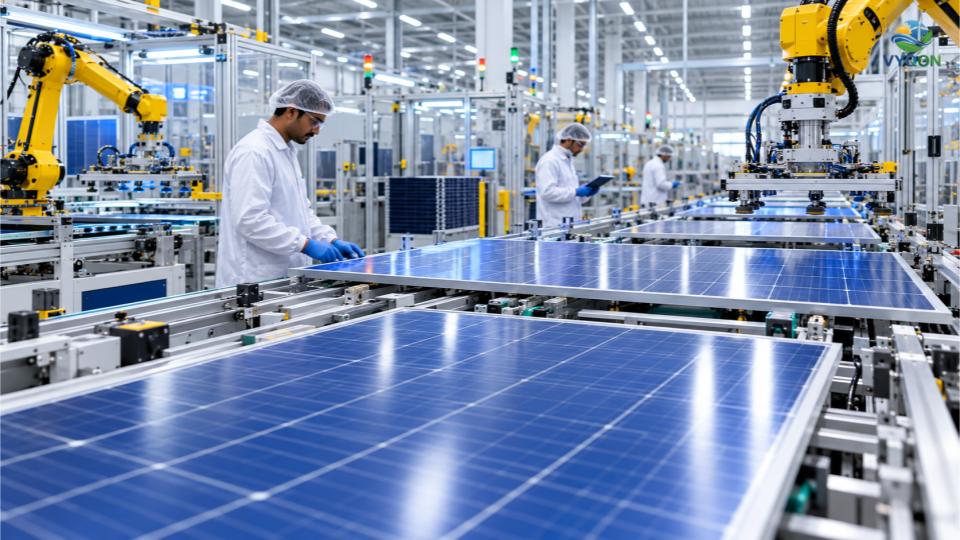
The latest equity investment in Shakti Energy Solutions supports an existing ₹1,200 crore solar manufacturing programme in Pithampur, aimed at strengthening domestic photovoltaic production and backward integration.
Shakti Pumps (India) Limited has disclosed a further ₹10 crore equity investment in its wholly owned subsidiary, Shakti Energy Solutions Limited (SESL), to support the development of a proposed 2.20 GW solar cell and photovoltaic module manufacturing facility at Pithampur, Madhya Pradesh. The investment was announced through a stock-exchange filing dated 12 October 2026, under Regulation 30 of the SEBI Listing Obligations and Disclosure Requirements Regulations. The planned facility is intended to manufacture high-efficiency solar cells and modules for applications requiring compliance with India’s Domestic Content Requirement (DCR) framework, strengthening the company’s participation in the domestic renewable energy manufacturing sector.
The latest investment represents another financing step within a manufacturing programme that Shakti Pumps had announced previously, rather than the launch of an entirely new project. The company had outlined its plans for the same 2.20 GW solar cell and module facility in 2025, when it raised approximately ₹292.60 crore through a Qualified Institutions Placement (QIP) to support its expansion strategy. Earlier company financing documents estimated the total investment requirement for the proposed manufacturing project at approximately ₹1,200 crore. The October 2026 announcement therefore reflects continuing capital allocation towards the project, although it does not establish that the factory has been commissioned or that commercial production has begun.
According to the latest regulatory disclosure, the ₹10 crore investment has been made through a cash subscription to equity shares of Shakti Energy Solutions Limited. The subsidiary, incorporated on 6 September 2010, is already engaged in solar structures, rooftop solar-related activities and associated businesses. Its reported turnover reached ₹239.11 crore in FY 2025–26, compared with ₹216.53 crore in FY 2024–25 and ₹139.59 crore in FY 2023–24. The proposed solar cell and module facility would expand the subsidiary’s activities into more technologically intensive stages of photovoltaic manufacturing. However, the investment announcement itself does not confirm the installation of manufacturing machinery, completion of factory infrastructure or a specific date for the commencement of commercial cell production.
₹1,200 Crore Manufacturing Programme and Funding Strategy
Shakti Pumps’ proposed investment in solar cell and module manufacturing forms part of its strategy to strengthen control over critical components used in renewable energy applications. In its July 2025 placement documentation, the company identified an estimated project cost of ₹1,200 crore for establishing the greenfield 2.20 GW manufacturing facility through Shakti Energy Solutions Limited. The financing plan outlined approximately ₹300 crore from issue proceeds and internal accruals, with the remaining ₹900 crore expected through project borrowings and/or internal accruals. These figures represent the company’s earlier project financing estimates and should not be interpreted as confirmation that the entire investment has already been deployed.
The company subsequently disclosed several equity investments in its subsidiary as part of the continuing manufacturing programme. In addition to the latest filing dated 12 October 2026, Shakti Pumps made a separate ₹10 crore subsidiary investment disclosure on 8 October 2026. Similar funding announcements have also been made at earlier stages of the programme. These transactions demonstrate continuing financial support for the proposed manufacturing development, but each disclosure must be assessed individually to avoid confusing a specific investment amount with the total capital expenditure of the project.
The strategic motivation for the manufacturing programme is linked to the company’s existing presence in solar-powered pumping systems and related electrical equipment. Shakti Pumps operates in a business where photovoltaic modules, controllers, motors, inverters and other components must be integrated into functioning solar pumping solutions. Access to reliable solar cells and modules can influence equipment availability, production planning, procurement costs and delivery schedules, particularly when domestic manufacturing requirements apply to government-supported projects.
By introducing in-house solar cell and module manufacturing capabilities, the company aims to improve supply-chain integration and reduce dependence on external suppliers. Backward integration can provide greater visibility into component availability, quality control and manufacturing costs, while potentially improving coordination between different stages of equipment production. However, the anticipated commercial advantages will depend on production efficiency, equipment utilisation, raw-material availability, financing expenses and the cost of manufacturing cells competitively once the facility becomes operational.
The earlier ₹1,200 crore estimate also highlights the capital-intensive nature of integrated photovoltaic manufacturing. Establishing solar cell production requires specialised process equipment, suitable factory infrastructure, reliable electricity and utility systems, manufacturing automation and quality-control facilities. Costs can vary significantly depending on technology selection, equipment origin, annual throughput, environmental management requirements and the degree of integration between cell fabrication and module assembly. Consequently, the latest ₹10 crore investment should be understood as a contribution towards the existing project rather than the full cost of creating a 2.20 GW manufacturing facility.
Strengthening India’s Domestic Solar Cell and Module Supply Chain
The proposed development is relevant to India’s efforts to expand domestic photovoltaic manufacturing and improve access to locally produced solar equipment. Solar cell fabrication and photovoltaic module assembly are separate industrial processes with different technical and investment requirements. A solar cell manufacturing line generally processes silicon wafers through stages such as surface texturing, junction formation, passivation, metallisation and electrical testing. These processes must be carefully controlled to achieve consistent electrical performance, high manufacturing yields and reliable product quality.
Photovoltaic module manufacturing, meanwhile, involves connecting finished solar cells and integrating them with glass, encapsulation materials, electrical interconnections, protective layers and junction boxes. The assembled modules then undergo appropriate inspection and testing to evaluate electrical output, insulation performance and manufacturing defects. For an integrated manufacturing facility, coordination between cell specifications and module design is important because variations in cell performance, dimensions or electrical characteristics can influence overall module reliability and manufacturing efficiency.
Shakti Pumps has identified a planned 2.20 GW manufacturing capacity covering DCR solar cells and photovoltaic modules. However, the October 2026 investment disclosure does not establish the separate rated capacity of every production stage or provide a complete equipment configuration. It would therefore be premature to assume that independent cell and module facilities, each with 2.20 GW of annual capacity, have already been installed. The published figure should be treated as the stated capacity of the proposed manufacturing programme until more detailed technical disclosures are available.
Domestic Content Requirement provisions are particularly important for manufacturers supplying applicable government-supported solar programmes. These requirements are intended to encourage the use of eligible domestically manufactured components in specified renewable energy applications. For companies involved in solar agricultural pumping and other government-linked procurement, reliable access to compliant photovoltaic equipment can be a significant commercial consideration.
However, a proposed domestic manufacturing facility does not automatically qualify its products for every government procurement programme. Compliance depends on the applicable domestic-content rules, manufacturing-origin evidence, product testing and other relevant regulatory requirements. Where the Approved List of Models and Manufacturers (ALMM) framework applies, manufacturers must also satisfy the relevant enlistment conditions. Manufacturing capacity, domestic origin and formal product eligibility should therefore be treated as separate considerations.
For Shakti Pumps, the proposed facility could eventually strengthen supply-chain traceability and provide closer coordination between component production and finished solar pumping systems. A vertically integrated operation may improve visibility into product specifications, quality testing and production scheduling, although these benefits will need to be demonstrated through actual factory performance and commercially available products.
Factory Development and Commercial Production Remain Key Milestones
Despite the latest funding announcement, the proposed Pithampur facility remains a manufacturing development programme whose operational status must be established through subsequent company disclosures. The October regulatory filing confirms the equity investment but does not provide a verified commercial production date or evidence that the proposed solar cell and module lines have reached their full rated output.
Bringing a photovoltaic manufacturing facility into operation requires several stages beyond capital allocation. These generally include final engineering design, procurement of manufacturing machinery, development of factory utilities, equipment installation, process commissioning, workforce training and production qualification. Cell manufacturing is especially sensitive to process consistency because variations in wafer quality, coating uniformity, electrical contacts and thermal processing can influence conversion efficiency and manufacturing yield.
The company will also need to establish suitable inspection and traceability systems for incoming materials, processed solar cells and completed photovoltaic modules. Commercial production depends not only on operating the installed equipment but also on achieving repeatable product quality and acceptable manufacturing yields. A facility may reach mechanical completion before it achieves stable output at its intended production rate.
In its latest investment disclosure, Shakti Pumps stated that no separate government or regulatory approvals were required for the equity investment transaction itself. This statement should not be interpreted as confirmation that every approval, certification or operating permission associated with the proposed manufacturing facility has already been obtained.
The next meaningful developments will include updates on project capital expenditure, construction progress, equipment installation, manufacturing technology, pilot production, product qualification and the commencement of commercial operations. These milestones will provide a clearer picture of when the planned facility begins contributing to India’s available solar cell and module supply.
Conclusion
Shakti Pumps’ additional ₹10 crore investment in Shakti Energy Solutions Limited represents a further financing milestone for its previously announced 2.20 GW solar cell and photovoltaic module manufacturing programme in Pithampur, Madhya Pradesh. The project, for which the company earlier estimated an investment requirement of approximately ₹1,200 crore, is intended to strengthen backward integration and expand access to domestically manufactured photovoltaic components.
The proposed development aligns with the increasing importance of local solar manufacturing capabilities, particularly for companies supplying renewable energy equipment under domestic-content requirements. However, the latest announcement confirms an equity investment rather than the completion of the manufacturing facility, and the planned 2.20 GW capacity should not yet be counted as operational production capacity.
Reference:
1. Shakti Pumps – Official NSE Investment Disclosure, 12 October 2026
2. Shakti Pumps – Official 2025 Placement Document
Leave a Comment