
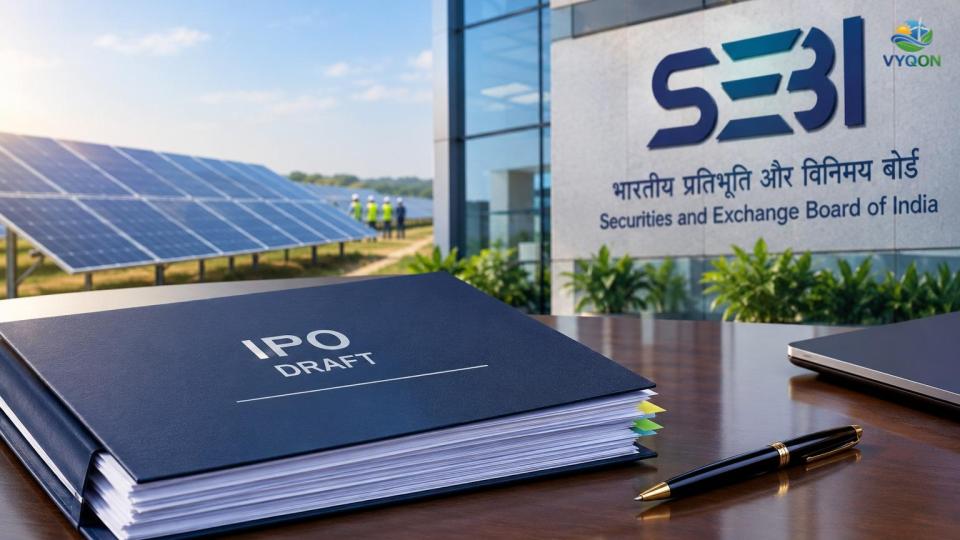
Ahmedabad-based solar engineering, procurement and construction (EPC) company Grace Renewable Energy Limited has filed its Draft Red Herring Prospectus (DRHP) with the Securities and Exchange Board of India (SEBI) for a mainboard initial public offering (IPO). The draft, dated September 30, 2026, was published by SEBI on October 7, 2026, and the shares are proposed to be listed on BSE and NSE.
Offer Structure
The IPO comprises a fresh issue of up to 84,15,000 equity shares and an offer for sale (OFS) of up to 27,85,000 equity shares, taking the total offer to up to 1,12,00,000 equity shares with a face value of ₹10 each. The price band and issue dates will be announced at the Red Herring Prospectus stage.
Under the OFS, promoter Manish Bagadia will sell up to 19,01,000 shares and promoter Karuna Bagadia up to 8,84,000 shares. Their weighted average cost of acquisition stands at ₹0.04 and ₹0.01 per share, respectively, as certified by the company’s statutory auditor. OFS proceeds will go to the selling shareholders and not to the company.
The offer is being made under Regulation 6(1) of the SEBI (Issue of Capital and Disclosure Requirements) Regulations, 2018. Marwadi Chandarana Intermediaries Brokers Private Limited is the sole book running lead manager, while KFin Technologies Limited has been appointed registrar to the offer.
Use of Proceeds
Of the net proceeds from the fresh issue, ₹79.31 crore has been earmarked for funding the company’s incremental working capital requirements. The balance will be used for general corporate purposes, which will not exceed 25% of the gross proceeds and will be finalised once the offer price is determined.
Business Profile
Incorporated in 2013, Grace Renewable Energy provides solar energy solutions to residential, commercial and industrial customers. Its operations are organised under three verticals: solar EPC, trading of solar and energy-related products, and battery energy storage solutions (BESS).
In the EPC segment, the company executes rooftop and ground-mounted systems as well as off-site solar farms on a turnkey basis under the capital expenditure (CAPEX) model, in which ownership of the completed plant remains with the customer. The trading arm deals in solar PV modules, inverters and related equipment, while the BESS vertical covers the manufacturing and distribution of storage products from its battery manufacturing unit. As of March 31, 2026, the company served customers across 11 Indian states and three countries.
Trading was the largest revenue contributor in FY2026 at ₹112.69 crore, or 54.75% of revenue from operations, with the sale of solar panels alone accounting for ₹110.90 crore. Commercial and industrial EPC contracts contributed ₹81.33 crore (39.51%), while residential EPC revenue declined to ₹10.39 crore from ₹19.24 crore in FY2024. The BESS business remains at an early stage, generating ₹0.35 crore from manufacturing and ₹0.18 crore from third-party contract manufacturing in FY2026.
Gujarat accounted for 91.36% of revenue in FY2026, up from 76.27% in FY2024. Indonesia was the largest overseas market, contributing 7.52% of revenue during the year.
Financial Performance
Revenue from operations grew 70.83% year-on-year in FY2026, while profit after tax nearly doubled, with borrowings remaining under ₹1 crore.
| Particulars (₹ crore) | FY2024 | FY2025 | FY2026 |
| Revenue from operations | 77.91 | 120.49 | 205.84 |
| EBITDA | 8.88 | 12.81 | 25.80 |
| EBITDA margin | 11.39% | 10.63% | 12.53% |
| Profit after tax | 5.79 | 9.77 | 18.67 |
| Net worth | 9.29 | 19.07 | 37.73 |
| Total borrowings | 3.24 | 1.32 | 0.93 |
Source: Restated financial statements as disclosed in the Draft Abridged Prospectus filed with SEBI.
Operational Metrics
Capacity commissioned rose to 29,545 kW in FY2026 from 14,661 kW in FY2025 and 12,310 kW in FY2024, even as the number of completed projects declined from 857 to 506 over the same period. Contracted capacity during FY2026 stood at 44,933 kW, valued at ₹144.27 crore. The solar EPC order book reached ₹47.89 crore as of March 31, 2026, compared with ₹3.77 crore a year earlier, with 15,388 kW of capacity under execution.
Growth Strategy
The company plans to expand its BESS manufacturing capabilities to address demand for integrated energy storage, widen its geographic footprint and improve operational efficiency. The industry report cited in the DRHP links rising storage demand to peak-demand management, grid stability and the growth of data centres.
Promoters and Management
Promoters Manish Bagadia, Karuna Bagadia and Harsh Bagadia together hold 99.60% of the pre-offer equity. Manish Bagadia, a chartered accountant with over 29 years of experience in the manufacturing, infrastructure and power system sectors, serves as Chairman and Managing Director. Whole-time Director Harsh Bagadia oversees the setup of the BESS manufacturing facility, including vendor evaluation and procurement of the cell-to-container assembly line.
Key Risks Disclosed
The DRHP highlights the following principal risks:
- High revenue concentration in Gujarat.
- Dependence on its top 10 suppliers, which accounted for 88.97% of purchases in FY2026.
- Channel partner restrictions on products, pricing and sales channels in the trading vertical.
- Reliance on suppliers in China for critical BESS components, along with the risk of under-utilised manufacturing capacity.
- The promoters’ limited prior experience in BESS manufacturing.
The company has disclosed three outstanding tax proceedings involving ₹1.10 million, with no criminal or material civil litigation pending against it. The IPO can proceed once SEBI issues its observations on the draft offer document.
Official Sources
- SEBI – Grace Renewable Energy Limited DRHP filing (October 7, 2026): https://www.sebi.gov.in/filings/public-issues/oct-2026/grace-renewable-energy-limited-drhp_105099.html
- SEBI – Draft Red Herring Prospectus (PDF): https://www.sebi.gov.in/sebi_data/attachdocs/oct-2026/1791449032035.PDF
- SEBI – Draft Abridged Prospectus (PDF): https://www.sebi.gov.in/sebi_data/commondocs/oct-2026/Grace%20Renewable%20Energy%20Limited%20DAP_p.pdf
Leave a Comment