In April 2026, the Grenoble-based cleantech company ROSI announced it has secured over €20 million (USD $23 million) in new funding. This capital is designated for the scaling of high-value photovoltaic (PV) module recycling facilities across Europe. A primary objective of this expansion is the development of a new industrial site in Teruel, Spain, designed to transform end-of-life solar panels into strategic raw materials.
Funding Structure and Lead Investors
The capital injection comprises a Series B fundraise alongside various French and European grants. These financial resources are intended to support the rollout of industrial projects aimed at high-purity material recovery.
The Series B round was led by a consortium of institutional and private investors:
- InnoEnergy
- CMA CGM
- European Innovation Council (EIC)
- G3T (a Spanish family office)
The funding round also included participation from new international investors and existing shareholders.
Operational Specifications: The Teruel Facility
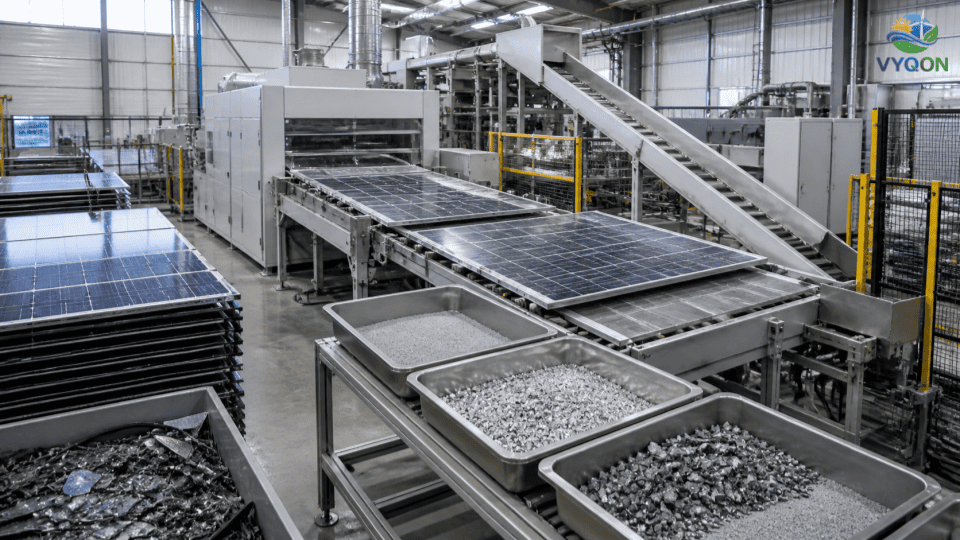
The development of the Teruel plant in Spain marks a significant phase in the industrialization of photovoltaic recycling. Designed for large-scale deployment, the facility serves as a “blueprint for a scalable circular model” within the European solar sector.
The plant’s technical and operational specifications include:
- Processing Capacity: 10,000 tonnes of PV modules per year.
- Technology: An integrated and highly automated processing line.
- Recovered Materials: Extraction of high-purity silver, silicon, copper, aluminum, and glass.
The strategic goal of the facility is to strengthen regional supply chains and reduce European reliance on imported critical raw materials by establishing a domestic source of high-purity recycled inputs.
Technological Context and Existing Operations
ROSI’s expansion builds upon its established industrial site, ROSI Alpes, located in France. To support operational excellence during this expansion, the company has appointed Thierry Galvez as the new director of ROSI Alpes. Galvez joins the company with 30 years of experience in the photovoltaic industry, primarily at Photowatt.
The company utilizes a specialized high-value recovery process that differentiates it from conventional low-value recycling streams. This process focuses on extracting the most valuable components of a solar cell that are typically lost in standard mechanical recycling. Key technological features include:
- High-Temperature Thermal Delamination: A process used to decompose polymers and release solar cells with high efficiency.
- “Soft Chemistry” Method: A chemical treatment used to separate silver from silicon wafers, ensuring high purity for both materials.
- Kerf Recovery: The ability to recover fine silicon particles and sawing liquid (kerf) from the wafer manufacturing process. This silicon is purified for use in ingot slicing and photovoltaic silicon production. This specific recovery process has demonstrated a 15% increase in efficiency in existing plants.
Industrial Outlook and Strategic Ambition
The company’s trajectory is driven by the necessity to manage a projected surge in solar waste. Global solar panel waste is expected to reach approximately 78 million metric tonnes by 2050, with the UK alone forecast to generate up to 1.2 million tonnes.
Dr. Yun Luo, President and co-founder of ROSI, stated that the company’s ambition is to build a European-scale industrial platform for circular management, transforming end-of-life solar panels into a reliable source of materials for future European industries.
This strategic direction is supported by the company’s investors. Romain Girard, investment manager at CMA CGM, noted that ROSI provides a clear path to industrial scale and contributes to strategic resource resilience while reducing the carbon footprint of the photovoltaic value chain. The platform is positioned to provide a circular alternative that retains the value of strategic materials within the European economy as legacy installations reach their end-of-life.
Leave a Comment