
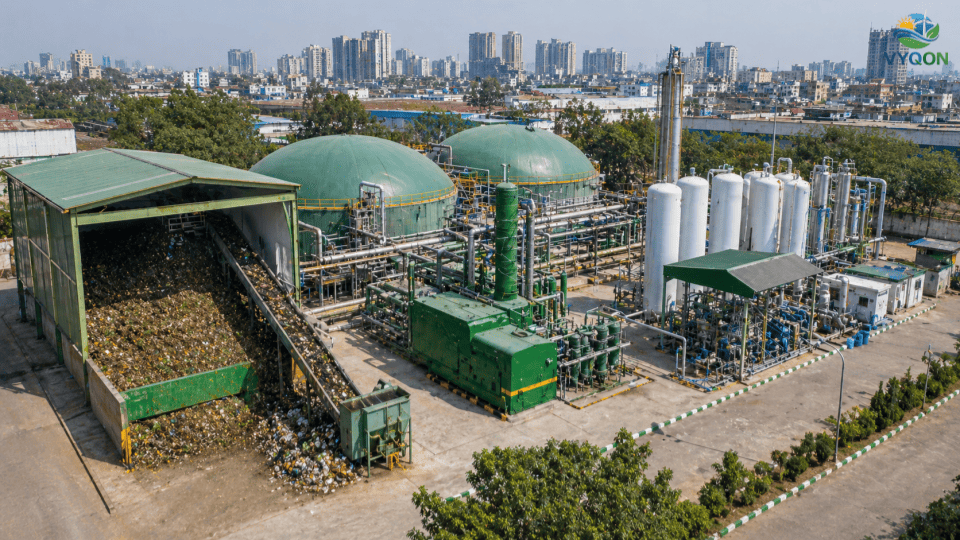
In a strategic move to accelerate Maharashtra’s transition toward ODF+ and ODF++ status, the State Cabinet, chaired by Devendra Fadnavis, has formally approved the Maharashtra State Compressed Biogas (CBG) Policy 2026. This framework serves as a critical de-risking mechanism designed to unlock the potential of India’s waste management sector—projected to be worth US$14 billion by 2025—while bolstering clean fuel generation across the state. The government has earmarked a core financial commitment of ₹500 crore for the 2026–27 financial year to anchor the initial phase of implementation.
Financial Allocation and Investment De-risking
The ₹500-crore outlay functions as viability gap funding (VGF), providing the fiscal stability required to attract private developers to large-scale waste-to-energy projects. By ensuring a stable cash flow, the policy directly addresses the “infrastructure and HR investment risks” that have historically left private sector participation in sanitation subdued.
The funding is specifically structured to mitigate three primary industry bottlenecks:
- Feedstock Availability: Addressing uncertainties in the consistent supply of biodegradable waste and agricultural residues.
- Market Linkage Instabilities: Reducing risks associated with the distribution and sale of produced biogas and organic manure.
- High Initial Capital Requirements: Lowering the barrier to entry for sophisticated CBG infrastructure through capital support.
Implementation Framework: PPP and Hybrid Annuity Models
To modernize state infrastructure, the policy utilizes Public-Private Partnership (PPP) and the Hybrid Annuity Model (HAM). The adoption of HAM is particularly significant; the model was introduced to “rejuvenate PPP” by addressing the backlog of stalled projects that have historically contributed to Non-Performing Assets (NPAs) within the banking system.
Under the HAM framework:
- Construction Cost Sharing: The government—typically via the Urban Local Body (ULB)—and the private partner share construction costs in a 40:60 ratio.
- Capital Reimbursement: The 60% capital cost initially funded by the private partner is reimbursed by the state through annuity payments during the operations and maintenance (O&M) period.
Technical Implementation Strategy
| Feature | Description | Practitioner Impact |
| Shared Risk | Distribution of financial and operational risks between public and private entities. | Lowers HR and infrastructure investment risks for the private partner. |
| Bankability | Reduced financial burden on the private developer during the construction phase. | Mitigates NPA risks and makes projects more attractive to lending institutions. |
| Private Expertise | Leveraging private sector innovation in whole-life costing and technical design. | Improves operational efficiency and technical reliability of CBG plants. |
| Operational Efficiency | Performance-linked payments and specialized O&M. | Ensures high service standards through incentivized performance metrics. |
Waste Management Mandates and Scale of Operations
The policy introduces rigorous mandates for Maharashtra’s 423 Urban Local Bodies (ULBs), requiring strict source segregation of waste to ensure that wet waste is diverted efficiently to scientific processing facilities.
A standout feature of the 2026 Policy is the promotion of cluster mapping. This strategy allows smaller municipalities, which may lack sufficient individual waste volumes, to pool their resources. By coordinating waste supply across clusters, the policy enables the development of centralized CBG plants that benefit from economies of scale and improved financial feasibility.
Environmental Impact and National Integration
Aligned with the central government’s GOBARdhan initiative, the Maharashtra CBG Policy seeks to create a sustainable “waste-to-wealth” ecosystem. This involves the scientific processing of organic manure and the integration of feedstock supplements. In the Marathwada region, the framework specifically explores the use of Napier grass as a reliable agricultural residue to ensure a steady supply for biogas production.
Key environmental takeaways include:
- Methane Emission Abatement: Capturing greenhouse gases from biodegradable waste before they are released into the atmosphere.
- Landfill Diversion: Significantly decreasing the physical burden on municipal landfills by processing waste at the source.
- Agricultural Residue Management: Providing a sustainable route for managing agricultural byproducts while producing high-quality organic fertilizer.
Governance and Steering Framework
The policy’s implementation is governed by a two-tier committee structure to ensure localized coordination and state-level oversight:
- State-Level Steering Committee: Led by the Chief Secretary, this body manages high-level implementation, policy adjustments, and strategic inter-departmental coordination.
- District-Level Committees: Headed by District Collectors, these units are responsible for ground-level execution, specifically the allocation of land and the management of waste supply chains to ensure centralized plants maintain consistent feedstock intake.
Leave a Comment