
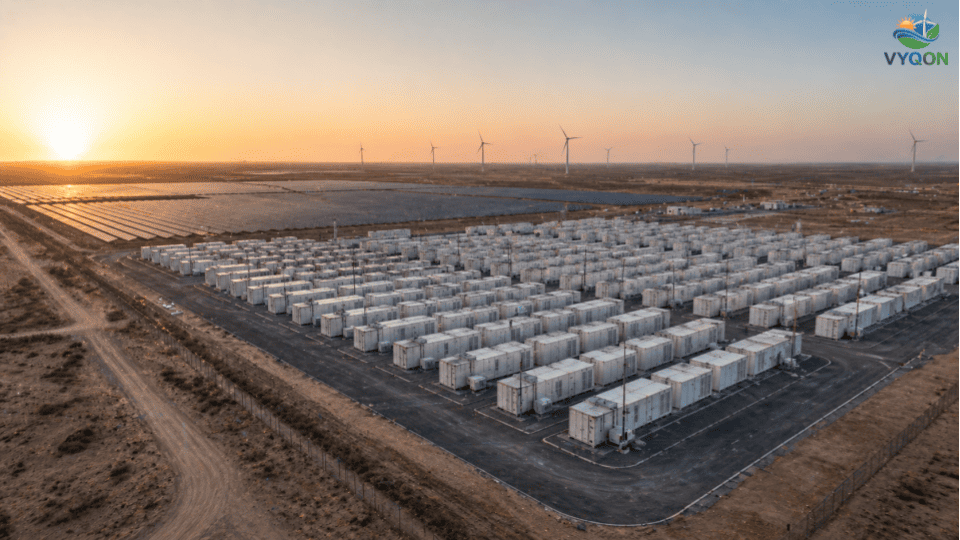
Adani Green Energy Limited (AGEL) has operationalized a landmark 1,126 MW Battery Energy Storage System (BESS) at its Khavda Renewable Energy park in Gujarat. Commissioned as of March 2026, the installation marks India’s definitive entry into the “gigawatt-hour scale” storage era, addressing critical grid evacuation constraints in the Kutch district. By shifting solar and wind generation to meet peak demand, the project enables round-the-clock power availability while positioning AGEL as a dominant player in a maturing storage sector increasingly defined by industrial execution rather than experimental technology.
Technical Specifications
The project marks a strategic shift toward standardized, high-capacity infrastructure designed for durability and performance in harsh environments. The technical profile includes:
- Power Capacity: 1,126 MW.
- Energy Capacity: 3,530 MWh (total project scale), with an initial 1,376 MWh operationalized to drive immediate revenue realization.
- Infrastructure Scale: Deployment of more than 700 BESS containers.
- Discharge Duration: Approximately 3-hour discharge cycle, optimized for peak load management.
- Storage Technology: Advanced Lithium-Iron-Phosphate (LFP) battery chemistry, integrated with sophisticated Energy Management Systems (EMS) for real-time monitoring.
- Project Execution: Spearheaded by Adani Infra India Ltd (AIIL) for project management and Adani Infra Management Services Pvt Ltd (AIMSL) for long-term O&M.
Global Standing and Regional Context
Ranked as the world’s third-largest single-location BESS installation, the project is situated within the Khavda RE park in Gujarat’s Kutch district, located near the India-Pakistan border. The site spans 538 sq. km—an area roughly five times the size of Paris—on the challenging, barren terrain of the Rann of Kutch.
The location was strategically selected for its superior natural resources, featuring solar irradiation of approximately 2,060 kWh/m2 and consistent wind speeds averaging 8 meters per second. This concentration of resources makes Khavda an ideal hub for giga-scale renewable integration, though its remote location necessitated the deployment of large-scale storage to mitigate regional infrastructure limitations.
Strategic Function and Grid Impact
The Khavda BESS is not merely an addition to capacity but a necessary solution to persistent grid evacuation constraints and delays in transmission augmentation caused by seasonality and right-of-way challenges. In the current market, battery storage is evolving into a standardized infrastructure business where competitive advantage is derived from capital access and execution at scale.
The installation serves several vital functions in resource-adequacy planning:
- Price Arbitrage: By storing electricity during periods of high generation and low demand, AGEL can dispatch power during peak hours, significantly improving revenue realization.
- Mitigation of Solar Curtailment: Captures energy that would otherwise be lost due to transmission bottlenecks.
- Grid Stability: Enhances reliability by easing peak load pressures and reducing transmission congestion across the regional grid.
- Market Transition: Reflects a shift toward commoditized storage hardware, where value is generated through system integration and software-driven dispatch logic.
Operational Milestone and Portfolio Growth
The commissioning of the Khavda BESS marks AGEL’s strategic pivot into large-scale energy storage, a sector expected to require 236 GWh of capacity in India by 2032. As of April 2026, the wider Khavda RE park hosts 9.4 GW of operational solar, wind, and hybrid capacity, contributing to AGEL’s total operational portfolio of 19.3 GW.
AGEL remains on a clear trajectory to achieve its 50 GW renewable target by 2030, with Khavda planned to reach 30 GW by 2029. In the near term, the company is scaling its storage ambitions, targeting a total BESS capacity exceeding 10,000 MWh (15 GWh) by the end of FY27.
Key Project Metrics
| Metric | Value |
| BESS Capacity | 1,126 MW / 3,530 MWh |
| BESS Container Count | 700+ |
| Khavda Park Total Area | 538 sq. km (5x the size of Paris) |
| Planned Park Capacity | 30 GW by 2029 |
| Total Operational Portfolio (FY26) | 19.3 GW |
| Storage Scale-up Target (FY27) | 15 GWh (>10,000 MWh) |
| Regional Irradiance | ~2,060 kWh/m2 |
Leave a Comment