
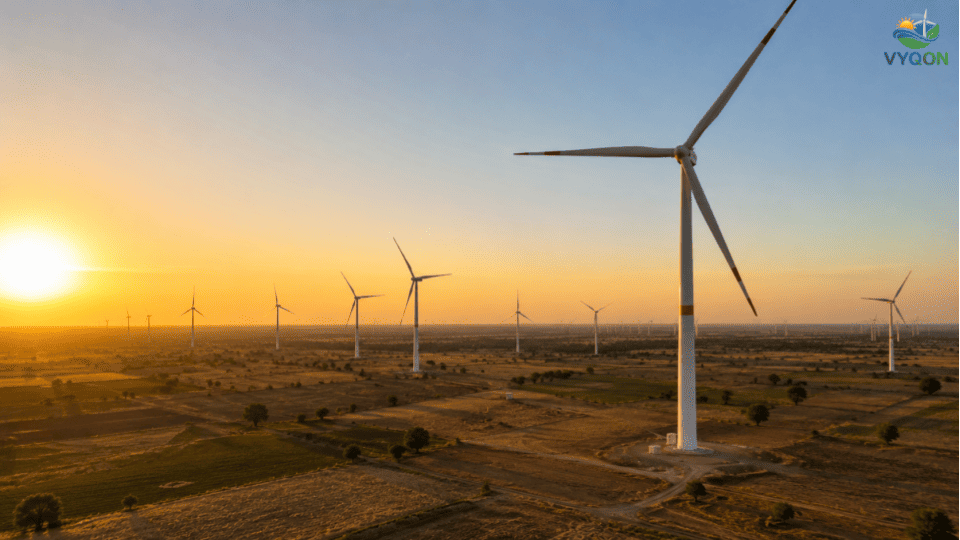
In a final order issued on May 5, 2026, the Karnataka Electricity Regulatory Commission (KERC) established a new generic ceiling tariff for wind power projects. This regulatory benchmark serves as the upper limit for electricity procurement by the state’s distribution companies (ESCOMs) through competitive bidding processes. The newly mandated tariff regime is applicable for the control period spanning Financial Year (FY) 2026–27 to FY 2028–29.
Tariff Comparison and Control Period
The Commission has reduced the ceiling tariff from previous levels to reflect maturing technology and evolving market dynamics. This levelised tariff is based on a standard project life of 25 years. The control period for this order remains in effect for three years, having officially commenced on April 1, 2026.
| Tariff Category | Rate (₹/kWh) |
| New Ceiling Tariff (FY 2027–2029) | ₹3.24/kWh |
| Previous Ceiling Tariff | ₹3.34/kWh |
Technical and Operational Parameters
To arrive at the final levelised cost, the Commission adopted specific technical assumptions that account for recent advancements in turbine efficiency. In a notable regulatory adjustment, KERC increased the benchmark capital cost from its initially proposed ₹6.50 crore/MW to address vehement developer concerns regarding inflationary pressures and rising material costs.
Key operational parameters include:
- Revised Benchmark Capital Cost: ₹7.25 crore/MW. This figure is inclusive of all evacuation infrastructure expenses.
- Capacity Utilization Factor (CUF): 33%, a figure predicated on the deployment of high-efficiency turbines.
- Operations & Maintenance (O&M) Costs: ₹10 Lakh/MW for the base year of the control period (FY 2026–27).
- O&M Escalation: An annual increase of 5% throughout the 25-year project life.
- Technological Advancement: The Commission cited industry trends where hub heights are now reaching 140 meters, significantly improving energy capture and performance.
Financial Framework and Investment Norms
KERC has established the following financial norms for the levelised tariff computation, ensuring project viability while protecting consumer interests:
- Debt-Equity Ratio: Maintained at 70:30, in alignment with established national tariff-setting guidelines.
- Interest on Debt: Calculated at 9.50%, reflecting current lending rates within the renewable energy financing sector.
- Return on Equity: Set at 14% to ensure adequate investor compensation.
- Depreciation Rate: Established at 4.67% per annum for the initial 15 years of the project.
- Tax Treatment: Income tax is to be treated as a pass-through cost, ensuring developers are not burdened by shifting tax regimes.
Stakeholder Process and Rationale
The finalization of this order concluded a rigorous stakeholder engagement process. Following the release of a discussion paper in March 2026, the Commission invited comments and objections from ESCOMs and industry participants. The submission phase for these stakeholders concluded on April 9, 2026.
In finalizing the order, the Commission noted that the downward revision of the tariff is supported by substantial cost declines in the wind sector. Data from the International Renewable Energy Agency (IRENA) indicates that onshore wind project costs fell by nearly 55% between 2010 and 2024. Furthermore, KERC’s rationale was supported by a detailed technical analysis of 52 wind power projects recently commissioned within Karnataka.
Effective Date and Implementation
The new generic ceiling tariff became effective on April 1, 2026. Beyond its primary role in guiding competitive bidding, this ₹3.24/kWh ceiling will serve as the mandatory purchase price for surplus banked energy purchased by ESCOMs from wind generators. This framework provides much-needed pricing clarity for the state’s wind energy sector over the next three fiscal years.
Leave a Comment