NEW DELHI — May 6, 2026 — The Government of India and the European Union (EU) have formally operationalized a ₹1.69 billion (€15.2 million) joint research and innovation initiative aimed at revolutionizing the electric vehicle (EV) battery recycling landscape. Launched on May 5, 2026, under the framework of the India-EU Trade and Technology Council (TTC) Working Group 2 on Green and Clean Energy Technologies, the coordinated call for proposals is designed to secure critical raw material (CRM) supply chains and accelerate the transition toward a cross-continental circular economy.
Funding Framework and Bilateral Governance
The initiative is supported by a sophisticated financial structure and bilateral governance model. The funding is allocated as follows:
- Total Funding Pool: Approximately ₹169 crore (€15.2 million).
- EU Contribution: €9.40 million via the Horizon Europe program.
- Indian Contribution: ₹65 crore via the Ministry of Heavy Industries (MHI).
- Technical Identifier: The call is formally categorized under HORIZON-CL5-2026-09-D2-04.
Bilateral oversight is maintained by a Joint India–EU Scientific Evaluation Panel. Notably, the recruitment for this panel concluded on April 15, 2026, ensuring that independent experts were vetted and registered prior to the official intake of project proposals.
Technical Scope and Research Objectives
The call seeks to advance recycling efficiencies beyond the current state-of-the-art, specifically targeting the recovery of lithium, graphite, and cobalt. Research must utilize advanced processes including pyrometallurgy, hydrometallurgy, and direct recycling. The initiative focuses on four priority areas:
- High Recovery Rates: Advanced extraction of lithium and other materials to a purity level suitable for Cathode Active Material (CAM).
- Mixed Chemistry Handling: Development of flexible processes capable of treating current and future chemistries, including NMC, LFP, and LTO.
- Logistics & Inclusion: Implementation of digitalized waste collection systems toward “zero-risk” safety, with a focus on integrating the informal sector into the formal value chain.
- Safety & Second Life: Advanced diagnostics for second-life usage, including State of Health (SoH) monitoring and safe, cost-efficient deactivation/discharging systems.
The India-EU Joint Pilot Line
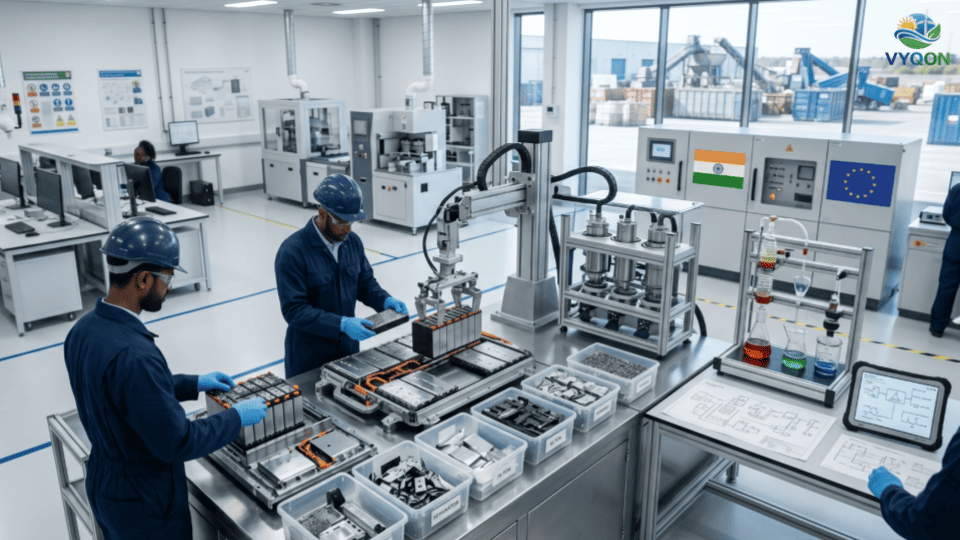
A cornerstone of this collaboration is the establishment of a joint India-EU pilot-scale demonstration line to be operated on Indian soil. This facility will serve as a real-world validation site for innovative processes, moving beyond laboratory-scale research to industrial deployment. The pilot line is tasked with processing “black mass”—the intermediate product of battery shredding—and refining it into battery-grade (CAM-ready) purity. This infrastructure is intended to demonstrate that a closed-loop system can achieve higher recycling efficiency and lower environmental impact than current global benchmarks.
Eligibility and Consortia Requirements
To ensure a balanced technological exchange, the initiative mandates that all proposals be jointly developed by EU and Indian consortia. Independent or non-aligned projects that do not feature coordinated activities between both regions are ineligible.
Eligible participants include private companies, SMEs, startups, research institutions, and universities. All projects are required to target a Technology Readiness Level (TRL) of 7–8 by completion. This represents a significant strategic shift from applied research toward pre-commercial demonstration, ensuring that the resulting innovations are ready for immediate industrial adoption.
Strategic Context and Expert Commentary
The initiative addresses a massive looming demand for resource management; by 2030, India alone is projected to have 128 GWh of recyclable battery capacity. By recovering CRMs domestically, the partnership seeks to establish a “virtual mine” to mitigate the volatility and import dependency of the mineral market.
Prof. Ajay Kumar Sood, Principal Scientific Adviser to the Government of India, noted:
“The launch of this joint call marks a pivotal moment in the India-EU strategic partnership. As India’s EV market continues its rapid expansion, creating a robust domestic recycling ecosystem is essential for our resource security and environmental commitments. By integrating advanced digital solutions and engaging the informal sector, this collaboration will turn battery waste into a high-value resource, fostering an innovation-led ‘virtual mine’.”
H.E. Mr. Hervé Delphin, Ambassador of the European Union to India, stated:
“Batteries sit at the core of the green transition, with their components far too strategic to be discarded after a single use. The goal is to translate the innovations from the development phase to real-world deployment; thereby, directly investing in mineral security and shared climate goals.”
Project Timeline and Deadlines
The initiative follows a strict timeline to ensure timely evaluation and deployment.
| Milestone | Date |
| Expert Registration Deadline (for Evaluation Panel)* | April 15, 2026 |
| Call Official Opening | May 5, 2026 |
| Final Proposal Submission Deadline | September 15, 2026 |
*Note: Recruitment of the joint evaluation panel precedes the opening of the call to ensure administrative readiness.
Leave a Comment