
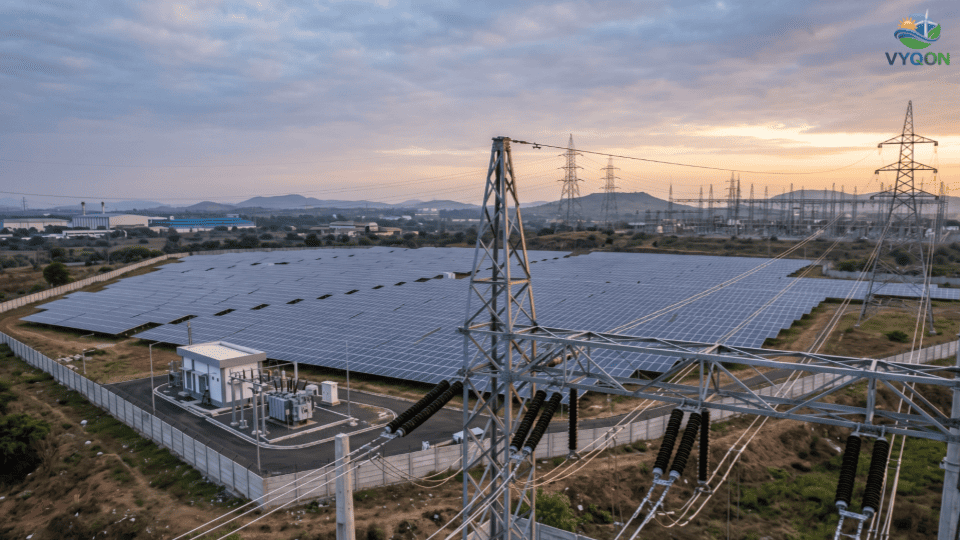
The Central Electricity Regulatory Commission (CERC) issued a draft order in May 2026 (Petition No. 11/SM/2026) proposing a regulatory framework to manage stranded grid connectivity for renewable energy projects in India. This mechanism addresses instances where transmission resources are blocked indefinitely because developers with connectivity grants have not signed Power Purchase Agreements (PPAs) within 12 months of receiving their Letters of Award (LoAs).
Background: The Challenge of Stranded Transmission Capacity
The CERC identifies grid connectivity as a scarce national resource that must be allocated to developers demonstrating a commitment to project execution. According to the commission, transmission assets are currently underutilized due to stalled projects, which creates an expensive outcome for the national power system.
Data indicates that approximately 45 GW of renewable energy projects are currently stalled due to delays in signing PPAs. Market drivers for these delays include relatively slow growth in electricity demand during 2025–26, surplus power availability during solar hours, and assured power availability for distribution companies (discoms) after 2028–29. Furthermore, approximately 60 GW of connectivity applications are affected by transmission planning constraints under the General Network Access (GNA) Regulations, 2022. These constraints are centered around substation clusters in Rajasthan, specifically at Barmer-III, Bhadla-IV, Ramgarh-II, and Jalore.
Proposed Technical Pathways for Developers
The draft framework provides three specific technical pathways for developers holding connectivity without signed PPAs to either advance their projects or exit the grid without financial penalty.
1. Land Route Conversion
Developers may transition from the LoA-based route to a land-acquisition-based route to retain connectivity. Requirements include:
- Submission of a Performance Bank Guarantee (PBG) of ₹10 lakh per MW.
- Submission of land-related documents as per acquisition milestones.
- Adherence to a strict 18-month timeline for financial closure and project commissioning.
2. PPA Substitution
Developers may replace a non-progressing LoA with a valid PPA secured through a different renewable energy tender. The new PPA can be from the same or a different Renewable Energy Implementing Agency (REIA), including SECI, NTPC, NHPC, or SJVN. Projects utilizing this pathway must meet a revised commissioning deadline of 30 months.
3. Surrender of Connectivity
Developers may opt to return their connectivity rights entirely. To utilize this pathway:
- Developers must obtain a No Objection Certificate (NOC) from the relevant implementing agency.
- Upon successful surrender, existing bank guarantees will be returned to the developer.
Capacity Reallocation and Auction Mechanism
The Central Transmission Utility of India Limited (CTUIL) is tasked with managing the reallocation of released capacity. The process follows a two-step hierarchy designed to reduce speculative booking of transmission resources.
Vacant capacity is first offered to other projects within the same substation cluster. Any remaining capacity will be allocated via a transparent auction. The auction base price is set at ₹3 lakh per MW, a figure specifically linked to the value of bank guarantees that would otherwise be encashed upon connectivity revocation.
Auction winners must adhere to strict commissioning timelines: 12 months for projects utilizing operational infrastructure and 24 months for those tied to under-construction transmission schemes.
Stakeholder Response and Industry Impact
The proposal has generated varied feedback from the renewable energy sector. The Ministry of Power previously constituted a committee to recommend solutions for legacy projects, leading to the draft’s provision for one-time relief via connectivity surrender.
Vaibhav Pratap Singh, executive director at the Climate and Sustainability Initiative, noted that the mechanism presents a planning challenge, stating that while re-auctioning appears efficient, a sudden reset of connectivity assumptions risks unsettling investor confidence.
Additional industry feedback includes:
- Bank Guarantee Concerns: Some developers oppose the requirement for additional PBGs, citing increased financial pressure on smaller renewable energy companies.
- Priority Allocation: Stakeholders have suggested that surrendered capacity be prioritized for green hydrogen and green ammonia projects with confirmed offtake agreements.
- Anti-Competitive Risks: Some industry bodies have characterized the auction model as potentially tariff-inflating and anti-competitive.
Stakeholder Feedback Timeline
The CERC regulatory process remains open for consultation, with a deadline for stakeholder comments and suggestions set for May 21, 2026.
REIAs, including SECI, NTPC, and NHPC, are required to submit project details for all instances where PPAs have remained unsigned for more than one year. The commission will conduct a public hearing to evaluate all feedback and finalize the mechanism before its formal implementation.
Leave a Comment