
Transition to Hardcoded Systemic Enforcement
In a decisive move to strengthen administrative oversight and ensure statutory compliance within the rooftop solar sector, the Ministry of New and Renewable Energy (MNRE) has announced the termination of discretionary interim relaxations regarding solar equipment serial numbers. According to an Office Memorandum dated May 11, 2026, the Ministry will no longer accept manual legal undertakings for installations involving repeated module or inverter serial numbers.
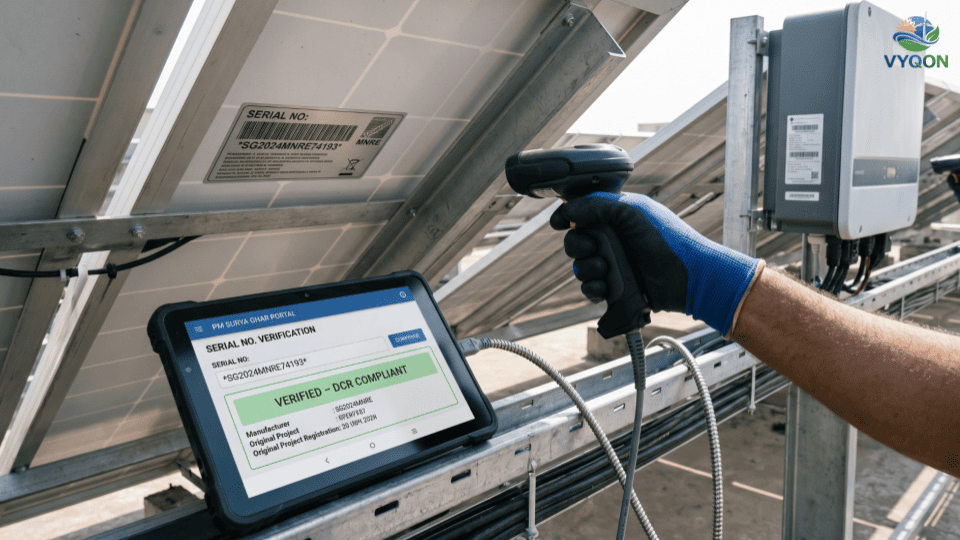
Effective May 26, 2026, the PM Surya Ghar: Muft Bijli Yojana will transition to a non-discretionary, automated verification framework. This regulatory tightening is designed to safeguard the integrity of the National Portal by eliminating the “undertaking mechanism” that previously allowed vendors to bypass duplication flags. The shift aims to eradicate the proliferation of non-BIS certified panels, mismatched model numbers, and grey-market imports that have surfaced during recent industry audits.
Technical Integration: Automated Retrieval vs. Manual Entry
The core of this enforcement strategy lies in the deep technical integration between the PM Surya Ghar National Portal and the Domestic Content Requirement (DCR) verification portal managed by the National Institute of Solar Energy (NISE). Stakeholders must now navigate a bifurcated verification workflow:
- Solar Modules (Automated Retrieval): Vendors are now required to generate a unique 16-digit “Business-to-Consumer” (B2C) DCR certificate for every specific installation via the NISE portal. Upon entering this 16-digit ID into the National Portal, the system automatically fetches verified module serial numbers and capacity details directly from the NISE database. This eliminates manual entry and prevents the “intentional duplication” of module data.
- Inverters (Manual Entry with Hardcoded Blocking): Unlike modules, inverter serial numbers still require manual entry by the vendor. However, the National Portal now employs an automated duplication-blocking logic. Any attempt to submit a serial number already residing in the database will trigger an immediate system flag, barring the submission without the possibility of a manual override or undertaking.
Strategic Alignment with DCR Mandates
This update reinforces the rigorous Domestic Content Requirement (DCR) mandate, which stipulates that solar modules must be manufactured in India using domestically produced solar cells. This systemic tightening follows a series of historical compliance milestones:
- Verification Deadline: Since December 1, 2024, any module lacking portal-verified DCR credentials has been strictly ineligible for the PM Surya Ghar, CPSU Phase-II, and PM-KUSUM schemes.
- Data Archiving: Stakeholders were previously mandated to upload all historical installation data from January 1, 2024, onwards to create a comprehensive baseline for the NISE traceability engine.
Impact on Vendor Workflow and DISCOM Safeguards
The discontinuation of the April 2025 temporary relaxations necessitates a more disciplined installation and reporting workflow. The administrative consequences for non-compliance are now hardcoded:
- Correction Protocols: Applications currently flagged for repeated serial numbers will be returned to vendors for mandatory data correction. Vendors must then use the B2C DCR certificate to fetch accurate module data before resubmission.
- DISCOM Re-verification: Distribution Companies (DISCOMs) are now tasked with a “Re-verification Flag” workflow. A critical component of this process is the mandatory entry of the net metering date. This serves as a vital regulatory safeguard, ensuring that consumers are not double-charged or penalized for delays caused by the vendor’s need to correct and resubmit flagged applications.
Enhanced Quality Control and Two-Way Audit Protocols
To maintain the sanctity of the National Portal, the MNRE has instituted a robust audit protocol. A mandatory 1% third-party inspection will be triggered for flagged cases. Critically, this is a “two-way audit” that covers both the new flagged application and the original application from which the serial number was purportedly duplicated. This ensures that the entire chain of custody is examined for fraudulent activity or equipment “flipping.”
These measures address specific safety concerns highlighted by recent pilot programs (such as the SNV-2026 discussions), targeting the removal of ERASED or duplicate serial numbers that compromise performance warranties and consumer safety.
Key Takeaways for Stakeholders
- Effective Date: May 26, 2026 (Hard ban on repeated serial number submissions).
- Mandatory Identifier: 16-digit B2C DCR Certificate number (Unique to each end-consumer).
- Module Verification: Fully automated retrieval via NISE integration; manual entry disabled.
- Inverter Verification: Manual entry remains, but subject to automated duplication blocks.
- Consumer Protection: Mandatory net metering date entry by DISCOMs to prevent improper billing during re-verification.
- Audit Scope: 1% third-party inspections of the entire duplicate chain (new and original submissions).
Official Entities
- MNRE: Ministry of New and Renewable Energy (Primary Regulatory Authority).
- NISE: National Institute of Solar Energy (Custodian of the DCR Verification Portal).
- REC Ltd: National Programme Implementing Agency (NPIA) for PM Surya Ghar.
- DISCOMs: Local Power Distribution Companies (Executing Re-verification and Net Metering).
Leave a Comment