
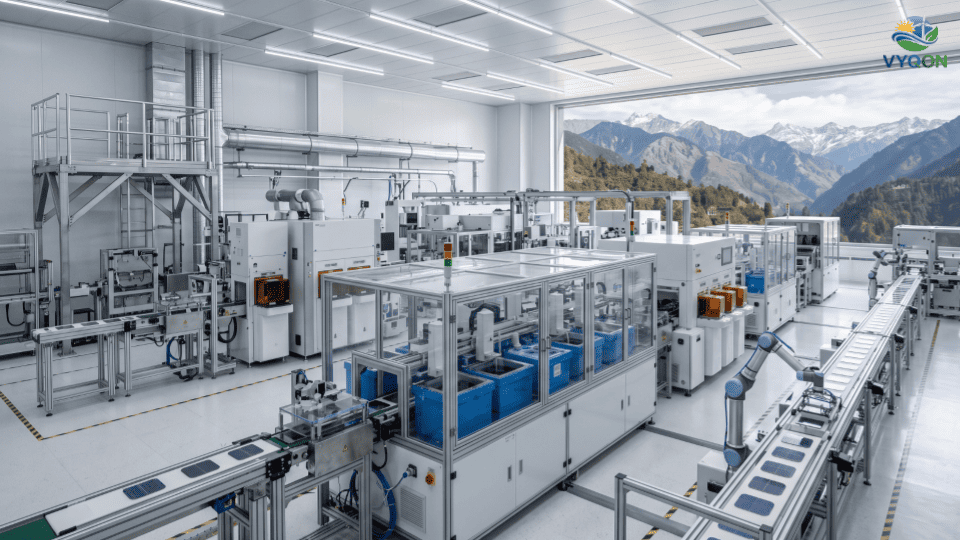
Kolkata-based Jupiter International has reached a pivotal inflection point in its manufacturing roadmap with the commissioning of Unit IV at its Baddi campus in Himachal Pradesh. The new 1.25 GW facility, representing a capital outlay of ₹550 crore, marks the company’s formal transition into high-efficiency N-type TOPCon (Tunnel Oxide Passivated Contact) solar cell production. This expansion elevates Jupiter’s total operational capacity to 3.25 GW, positioning the firm as a critical domestic supplier ahead of tightening regulatory mandates for the Indian solar ecosystem.
Strategic De-risking and the Baddi Expansion
The activation of Unit IV is a calculated move to address the acute shortage of domestic TOPCon cells, a primary pain point for Indian project developers navigating the shift toward high-performance modules. By successfully concluding machinery testing and trial runs this quarter, Jupiter has effectively de-risked its supply chain before the impending July 1, 2026, ALMM cell mandate.
Baddi Manufacturing Campus Metrics:
- Capacity Trajectory: Scaled from an initial 2 GW to 3.25 GW total installed capacity.
- Technological Evolution: Transitioned from the 1 GW mono PERC capacity (Unit III) commissioned earlier this year to 1.25 GW of N-type TOPCon technology (Unit IV).
- Capital Investment: ₹550 crore dedicated specifically to the Unit IV infrastructure.
- Operational Status: Active commercial production following the successful validation of advanced automation and process controls.
Technology Roadmap: From Baddi to Nagpur
Jupiter’s strategic pivot toward TOPCon reflects a broader industry trend favoring performance-led procurement. As conversion efficiency benchmarks rise, the company is utilizing the Baddi facility as a “technology platform” to refine its manufacturing excellence before scaling to even higher specifications.
Dhruv Sharma, CEO of Jupiter International, characterized the commissioning as a defining milestone: “By bringing 1.25 GW of TOPCon capacity into production, we are scaling next-generation cell technology that raises the bar on efficiency and long-term performance. This facility serves as the foundational platform on which Jupiter is scaling up to build a 3 GW TOPCon++ performance fab in Nagpur.”
Forward Outlook: The Butibori Integrated Mega-Project
The Baddi Unit IV serves as a operational blueprint for the company’s ambitious expansion in Maharashtra. Jupiter International has signed a ₹10,900 crore Memorandum of Understanding (MoU) with the Maharashtra government to establish a state-of-the-art, vertically integrated facility in Butibori, Nagpur.
This “performance fab” is slated for commissioning by the end of 2026 and represents a significant leap in domestic value chain integration. Unlike standalone cell units, the Nagpur site will encompass the full manufacturing spectrum—including wafers, cells (TOPCon++), and module assembly. Beyond its technical capacity, the project is a major economic driver, projected to create 8,300 employment opportunities and strengthen India’s self-reliance in the upstream solar segment.
Operational and Economic Data Summary
The following table outlines Jupiter International’s current and projected manufacturing footprint:
| Facility Location | Current/Planned Capacity | Technology Type | Status |
| Baddi Campus (Total) | 3.25 GW | Mono PERC & TOPCon | Active/Operational |
| Butibori, Nagpur | 3 GW (Performance Fab) | TOPCon++ | Under Development (MoU Signed) |
Key Financial and Infrastructure Benchmarks:
- ₹550 Crore: Investment for the Baddi Unit IV TOPCon expansion.
- ₹10,900 Crore: Total projected investment for the Nagpur integrated value chain (including 3 GW Wafers, 3 GW Cells, and 3 GW Modules).
- 8,300 Jobs: Estimated employment generation at the Butibori, Nagpur site.
Regulatory Imperative: ALMM List-II and Market Access
Jupiter’s aggressive capacity ramp-up is intrinsically linked to the Ministry of New & Renewable Energy (MNRE) regulatory calendar. The company has secured formal inclusion in the Approved List of Models and Manufacturers (ALMM) List-II, the specialized register for domestic solar cells.
The significance of this listing cannot be overstated: effective July 1, 2026, all new solar projects in India must utilize cells from ALMM List-II to remain eligible for central government incentives. By operationalizing 1.25 GW of TOPCon capacity now, Jupiter is capturing an early-mover advantage in a market where ALMM-listed cell capacity currently accounts for only a fraction of certified module capacity. This alignment ensures the company is well-positioned to service the massive utility-scale pipeline and the burgeoning PM Surya Ghar residential program.
Leave a Comment