
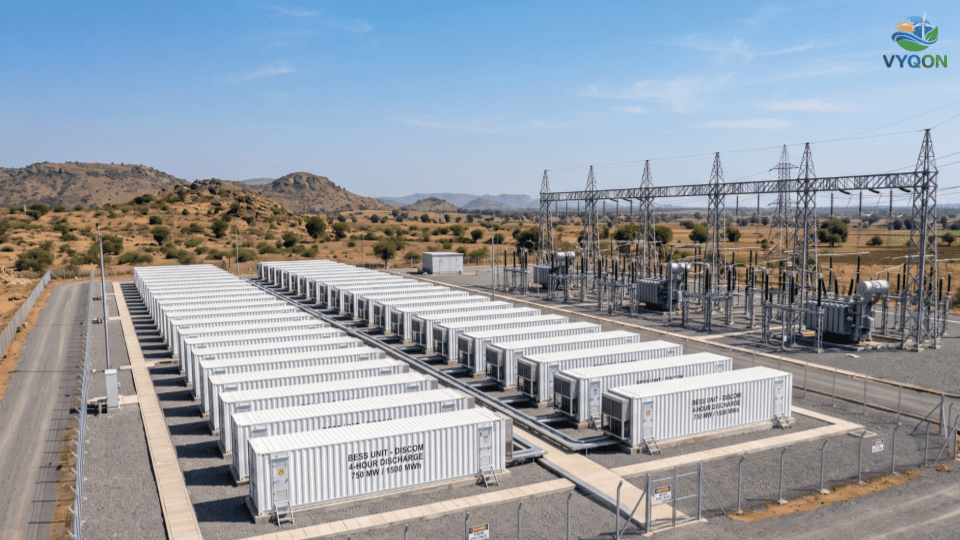
The Telangana Green Energy Regulatory Commission (TGERC) has issued a common order approving the state’s first utility-scale standalone Battery Energy Storage System (BESS) projects, totaling 1,500 MWh of storage capacity. The order, issued under the leadership of Chairman Dr. Justice Devaraju Nagarjun, approved the adoption of tariffs under Section 63 of the Electricity Act, 2003, resolving two specific petitions related to tariff adoption and procurement approval. Telangana Power Generation Corporation (TGGENCO) acted as the nodal agency for the global competitive bidding process, which is designed to manage excess solar generation during daytime hours and reduce dependence on high-cost power purchases during peak demand periods.
Detailed Project Allocation and Winning Bids
The total capacity was awarded to two developers following a global competitive bidding process and an e-reverse auction conducted via the Bharat Portal. Both projects require interconnection at the 400 kV/220 kV substation level to meet technical grid requirements.
| Developer | Project Location | Capacity (MW/MWh) | Discovered Tariff (per MW/month) | Estimated Project Cost |
| Sarus Infrastructures Private Limited | Maheshwaram 400 kV/220 kV Substation | 187.5 MW / 750 MWh | ₹2,98,000 | ₹10.15 Billion |
| Coal India Limited | Choutuppal 400 kV/220 kV Substation | 187.5 MW / 750 MWh | ₹3,14,000 | ₹10.57 Billion |
Operational Specifications and Technical Mandates
The Commission has mandated specific technical requirements to ensure the reliability of the standalone storage assets:
- Discharge Window: Systems must support a 4-hour discharge duration.
- Operational Cycle: Requirement for one complete charge-discharge cycle per day.
- Technical Granularity: The BESS must be capable of being charged or discharged in blocks of either 60 MW/240 MWh or 67.5 MW/270 MWh, up to the total rated capacity.
- Availability & Efficiency: Minimum annual system availability is set at 95%, with a required monthly AC-to-AC round-trip efficiency of 85%.
- C-rate: The system must maintain a charge and discharge C-rate of 0.25.
- Indigenous Software: The Energy Management System (EMS) application software must be developed within India.
- Refurbishment Ban: The use of refurbished battery cells is strictly prohibited.
Commercial Framework and Financial Support
Project Model The projects will be implemented via a 15-year Build-Own-Operate (BOO) model.
Viability Gap Funding (VGF) Financial support is provided by the Union Ministry of Power through the Power System Development Fund (PSDF). The VGF is capped at ₹18 lakh per MWh and is disbursed in three tranches: 20% at financial closure, 50% at the commencement of commercial operation, and 30% one year post-commissioning following successful certification.
Land Lease TGTRANSCO and TGGENCO will provide the necessary land on a right-to-use basis. Developers are subject to a nominal lease charge of ₹1 per acre per year.
Trading Margin The trading margin for TGGENCO as the intermediary procurer is capped at 0.5% of the capacity charges. This margin was reduced from an initially proposed 7 paise per unit following renegotiations intended to minimize the financial impact on end consumers.
Implementation Timeline and Regulatory Oversight
The project rollout is governed by the following deadlines and oversight mandates:
- Contract Execution: The Battery Energy Storage Purchase Agreement (BESPA) must be signed within 30 days of the issuance of the Letter of Award (LOA).
- Commissioning Timeline: Full project commissioning is required within 18 months from the effective date of the agreement.
- Resource Adequacy Integration: This initiative aligns with the TGERC (Framework for Resource Adequacy) Regulations, which require distribution licensees to develop 10-year rolling Resource Adequacy (RA) plans to ensure long-term supply reliability.
- Performance Monitoring: The State Load Despatch Centre (SLDC) is mandated to monitor the systems’ round-trip efficiency, battery degradation, and overall financial benefits. Periodic reports on these metrics must be submitted to the Commission to verify grid-level advantages.
Leave a Comment