
Executive Summary
On June 17, 2026, Power Grid Corporation of India Limited (POWERGRID) executed a JPY 80 billion (~₹4,700 crore) loan agreement to fund a critical high-voltage direct current (HVDC) link between Khavda, Gujarat, and Nagpur, Maharashtra. This facility, part of the Japan Bank for International Cooperation (JBIC) “GREEN” operations, aims to facilitate the power evacuation of renewable energy to industrial hubs. This infrastructure is a linchpin in India’s national master plan to develop 191,000 ckm of transmission lines by 2032. The deal, co-financed with private Japanese lenders, utilizes JBIC guarantees to de-risk the investment and lower the cost of capital for India’s central transmission utility.
Financial Details and Co-Financing Architecture
The financing structure is a strategic co-financing arrangement where JBIC serves as the lead lender while providing a comprehensive guarantee for the portion provided by commercial institutions. This de-risking mechanism is essential for the long-term viability of massive infrastructure builds.
| Financing Breakdown | Amount/Details |
| Total Facility Amount | JPY 80 billion (~₹4,700 crore / ~$493 million) |
| JBIC Contribution | JPY 48 billion |
| Private Financial Institutions Contribution | Remaining portion (Guaranteed by JBIC) |
Participating Private Financial Institutions:
- Sumitomo Mitsui Banking Corporation (SMBC)
- Kansai Mirai Bank, Limited
- Kiraboshi Bank, Ltd.
- The Joyo Bank, Ltd.
The facility is classified under JBIC’s “GREEN” (Global action for Reconciling Economic growth and Environmental preservation) operation, a mandate focused on mitigating global warming through the deployment of advanced clean-energy technologies.
Technical and Project Scope
The project serves as the backbone for the large-scale integration of intermittent renewable sources into the national grid.
The Khavda-Nagpur HVDC Link
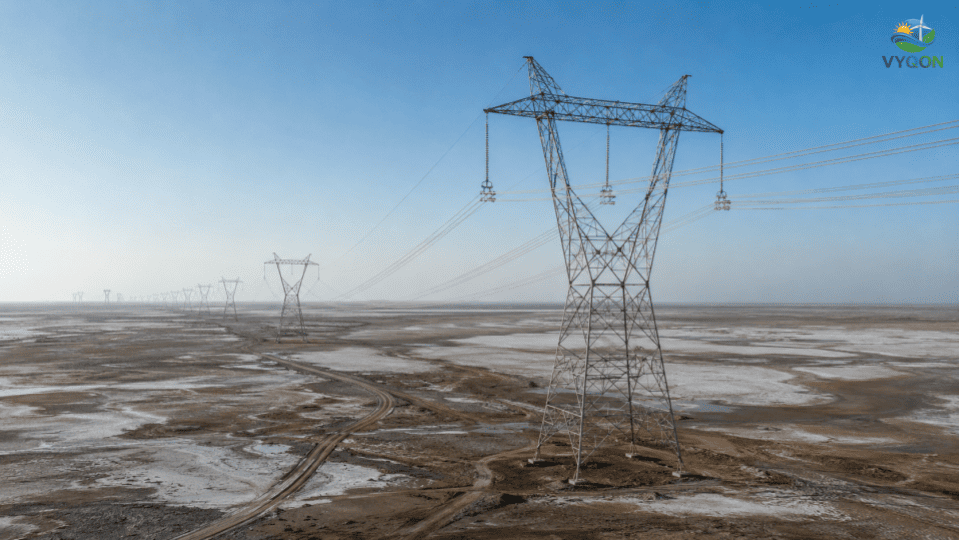
This HVDC link is designed for the efficient power evacuation of electricity from the Khavda Renewable Energy Park in Gujarat to the high-demand regions surrounding Nagpur, Maharashtra. Recognized as one of the world’s largest HVDC initiatives, the project is essential for intermittency mitigation, ensuring that the surge of solar and wind energy does not destabilize the central grid. PGCIL, as the primary transmission utility, will manage this link to support the evacuation of power generated by entities such as Adani Green Energy Limited (AGEL) and NTPC.
Khavda Renewable Energy Park Context
The Khavda hub is a massive greenfield development with a total project cost of approximately INR 1.5 Lakh crore (USD 18.7 billion).
- Scale and Scope: Spanning 72,400 hectares (five times the size of Paris).
- Total Capacity: Planned for 30 GW (26 GW solar, 4 GW wind).
- Impact Metrics: The park will power 16.1 million homes and avoid 58 million tonnes of CO2 emissions annually.
- Interconnection: Power is channeled to the central grid via a robust 765 kV transmission line.
Bilateral Framework Alignment
This loan is a tangible output of the deepening Indo-Japanese strategic partnership, specifically the Partnership on Wide Energy and Resources Resilience Asia (POWERR Asia) initiative launched in April 2026.
Beyond capital infusion, the loan serves the strategic objectives of the Revised JFC Act (2010) by:
- Network Strengthening: Stabilizing India’s transmission network to support a 500 GW renewable target by 2030.
- HVDC Standardization: Promoting the adoption of high-efficiency Japanese HVDC equipment in the Indian power sector.
- Industrial Synergy: Creating long-term business opportunities for Japanese infrastructure companies within India’s energy supply chain.
Compliance with Environmental Standards (J-MRV)
To maintain its “GREEN” status, the project must adhere to the J-MRV (Measurement, Reporting, and Verification) process, ensuring transparent quantification of greenhouse gas (GHG) reductions.
- Methodology No. 1: The project utilizes “Methodology for Renewable Energy Projects.” Annual emission reductions (ER_y) are calculated by the formula ER_y = BE_y – PE_y.
- Emission Parameters: Under this methodology, the Baseline Emissions (BE_y) are defined by the average emission rate of all power plants in the host country. For power transmission projects, the Project Emissions (PE_y) are basically considered zero as they do not consume fossil fuels in the transmission process.
- Project Boundary: In accordance with J-MRV Guideline Section 2(2), the project boundary is determined by the specific transmission infrastructure supported by JBIC’s JPY 80 billion involvement, rather than the entire 30 GW park.
Official Attribution and Source Information
The loan agreement was officially signed on June 17, 2026. This follows the formal approval from the Power Grid Corporation of India Limited (PGCIL) board earlier in June 2026, which specifically authorized the raising of the loan from JBIC and its co-financing partners. All technical data regarding the Khavda Park and India’s 2032 transmission targets are sourced from official Power Peak Digest and Blackridge Research assessments.
Leave a Comment