
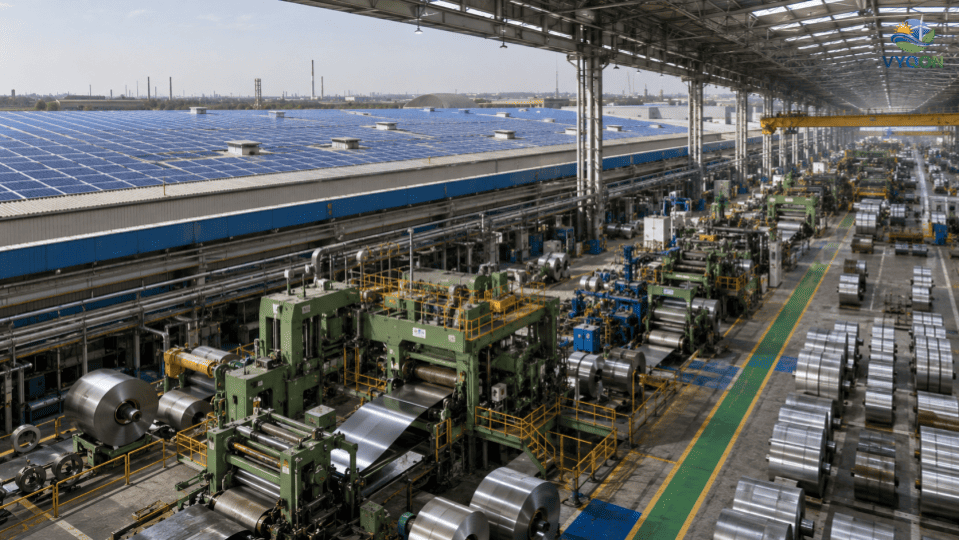
In a ruling issued on June 23, 2026, the Haryana Electricity Regulatory Commission (HERC) directed state power utilities to grant a full No Objection Certificate (NOC) to Jindal Stainless Limited (JSL) for the procurement of 100 MW of renewable power. The ruling upholds the priority of long-term open access over temporary arrangements, allowing JSL to source interstate-connected, round-the-clock (RTC) captive renewable energy for its manufacturing facility in Hisar, Haryana.
Case Background and Regulatory Dispute
The dispute originated when the state transmission utility, Haryana Vidyut Prasaran Nigam Limited (HVPNL), and the Grid Co-ordination Committee refused to issue a full NOC for JSL’s requested power transfer. The utilities cited operational constraints during summer peak demand months (June, July, and August), which are projected to reach 16,500 MW due to agricultural and cooling requirements.
The utilities argued that granting long-term access would create transmission bottlenecks, increase Deviation Settlement Mechanism (DSM) charges, and limit the state’s capacity to utilize Temporary General Network Access (T-GNA) for emergency power imports. JSL contested these grounds, submitting that renewable procurement serves to replace existing grid consumption rather than adding new demand to the state network. JSL further alleged that the denial was a discriminatory practice intended to compel the procurement of higher-cost electricity from state distribution companies.
The HERC Ruling: Order Details and Legal Justification
In its order dated June 23, 2026, the Commission determined that blanket restrictions during summer months lacked legal justification under the Electricity Act, 2003. The Commission’s findings emphasized the principle of non-discriminatory open access and established several regulatory precedents:
- Priority of Access: The ruling affirmed that long-term open access holds statutory priority over temporary arrangements like T-GNA under national regulatory frameworks.
- National Decarbonization Targets: The Commission noted that the denial of open access for renewable projects hinders progress toward India’s national target of 500 GW of non-fossil fuel capacity by 2030.
- Regulatory Directive: HVPNL is ordered to issue the full NOC within two weeks. The utility is specifically tasked with developing the necessary operational procedures, undertakings, and mechanisms required to implement JSL’s voluntary curtailment and DSM commitments.
Operational Framework and JSL Commitments
To mitigate grid reliability concerns raised by state utilities, JSL provided specific voluntary commitments that are to be integrated into the final operational framework:
- Uncompensated Curtailment: JSL will accept complete curtailment of the full 100 MW supply during grid constraints without seeking financial compensation from the state.
- Risk and Cost Assumption: The company will assume all financial risks and costs associated with DSM charges.
- Technical Infrastructure: The power will be drawn from a 315.6 MW hybrid project developed in partnership with Oyster Renewable Energy. The project, representing a total investment of over ₹2,000 crore (with ₹132 crore committed by JSL), utilizes bifacial solar modules with tracker systems and Suzlon 3.15 MW wind turbines.
- Power Sources: The energy is generated by captive wind-solar hybrid facilities located in Gujarat and Madhya Pradesh (Agar-Malwa).
Financial and Environmental Impact Analysis
According to testimony provided by JSL to the Commission, the transition to captive renewable energy is estimated to generate annual savings for Haryana distribution companies (DISCOMs) ranging from ₹65 crore to ₹100 crore. These projected savings are attributed to a reduced requirement for DISCOMs to procure expensive short-term power during peak periods.
Regarding environmental impact, the 315.6 MW hybrid project associated with this procurement has an estimated carbon abatement potential of approximately 6.5 lakh tonnes of emissions annually. This supports the broader decarbonization of energy-intensive industrial operations.
Corporate Context: Jindal Stainless’ Sustainability Roadmap
Jindal Stainless Limited currently operates with a melt capacity of 3 MTPA, with active plans to reach 4.2 MTPA by FY27. This regulatory approval aligns with the company’s stated goal to meet all incremental power requirements through renewable sources. JSL’s broader climate commitments include:
- Achievement of Net Zero emissions by 2050.
- A 50% reduction in emissions intensity by 2035, utilizing FY 2021-22 as the baseline year.
- The implementation of “first-of-its-kind” initiatives in India, including the stainless steel sector’s first green hydrogen plant at the Hisar unit.
Sources & Citations
- Haryana Electricity Regulatory Commission (HERC) Order dated June 23, 2026.
- Jindal Stainless Sustainability Report FY 2023-24.
- Joint Press Release by Oyster Renewable Energy and Jindal Stainless (March 27, 2026).
Leave a Comment