
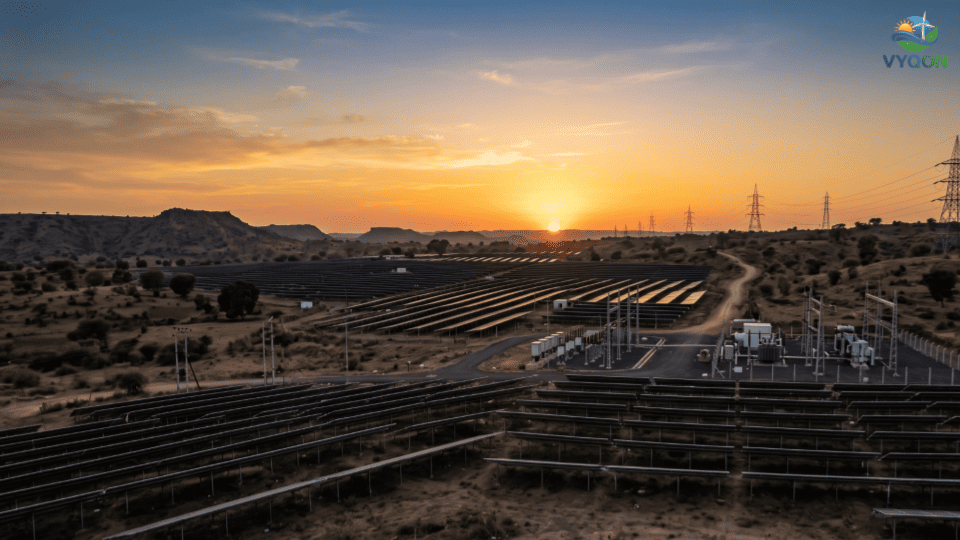
In a decisive judgment delivered on July 3, 2026, the Appellate Tribunal for Electricity (APTEL) overturned a 2018 order by the Madhya Pradesh Electricity Regulatory Commission (MPERC), ruling that ReNew Solar Energy (TN) Pvt. Ltd. must be billed on a “net-off” basis as stipulated in its Power Purchase Agreement. The Tribunal categorically rejected the utility’s attempt to classify non-solar night hours as a “shutdown period,” a move that had been used to justify charging separate, high-tariff retail rates for auxiliary consumption. This ruling restores the contractual integrity of the project’s billing formula and provides critical regulatory clarity on the operational definition of solar plant inactivity.
Project Profile and Background
The dispute concerns a major solar installation integrated into the Madhya Pradesh state grid. The project was developed under the “Case-1 RE” bidding procedure, a tariff-based competitive bidding process that established the long-term financial framework for the plant. Key details include:
- Project Developer: ReNew Solar Energy (TN) Pvt. Ltd.
- Capacity: 50 MW.
- Location: Villages of Hulpur and Ladpura, Sheopur District, Madhya Pradesh.
- PPA Date: Signed June 5, 2014, with Madhya Pradesh Power Management Company Limited (MPPMCL) at a tariff of Rs. 6.97 per kWh.
- Commissioning Timeline: Achieved in three phases on May 7, 2015; June 6, 2015; and November 27, 2015.
The contractual foundation for the project’s energy accounting is Article 7.01 of the PPA, which mandates that the State Load Despatch Centre (SLDC) calculate billable energy using a specific “net-off” formula: Net Power (kWh) = Export Units – Import Units Here, “Export Units” refers to the energy supplied by the developer to the grid, while “Import Units” refers to the auxiliary energy drawn from the grid during non-generating hours.
Origin of the Dispute: The Unilateral Billing Shift
From the date of commissioning until early 2016, billing functioned seamlessly under the agreed net-off arrangement. However, the commercial landscape shifted on January 29, 2016, when MPPMCL issued a letter seeking the “removal of difficulties” by withdrawing previous procedural guidelines. This letter unilaterally cancelled the net-energy billing exception previously granted to competitive-bid solar projects.
In May 2016, MPPMCL instructed the Central Discom (Madhya Pradesh Khestra Vidyut Vitran Company Limited) to force the developer to revise its invoices based on gross generation. Consequently, the developer was no longer allowed to net-off its auxiliary consumption. Instead, it was charged separately for imported power at the “Temporary HT Industrial Category” tariff—a significantly higher retail supply rate that fundamentally altered the project’s economic viability.
The Core Legal Conflict: Opposing Interpretations of “Shutdown”
The legal dispute centered on whether the natural cycle of a solar plant could be governed by Regulation 10 of the 2010 MPERC Co-generation Regulations, which allows for temporary retail billing during “shutdowns.”
| Comparison of Legal Arguments | MPPMCL / MPERC Argument | ReNew Solar Counter-argument |
| Interpretation of Non-Solar Hours | Under Regulation 10, the absence of generation at night constitutes a “shutdown period” or “emergency,” necessitating separate billing. | The absence of sunlight is a natural daily cycle, not a mechanical shutdown. The plant remains operational and ready to generate power as soon as radiation is available. |
| Tariff Application | Energy consumed during these “idle” hours must be billed at the higher retail “Temporary HT Industrial” rate. | Billing must adhere to Article 7.01 of the PPA, which provides a specific contractual mandate for netting imported units against exported units. |
| Nature of Power | Exported solar power is “infirm” (variable), while imported grid power is “firm,” justifying different tariff treatments. | The PPA does not distinguish between firm and infirm power for billing; it defines “Net Power” strictly through the Export minus Import formula. |
APTEL’s Ruling and Legal Interpretation
The APTEL bench, comprising Officiating Chairperson Seema Gupta and Judicial Member Virender Bhat, rejected the respondents’ attempts to broaden the definition of a mechanical shutdown. The Tribunal provided a precise legal distinction regarding solar operations:
Tribunal Definition of “Shutdown”: “The term ‘shut down’ used in Regulation 10… means when the whole power plant is turned off and is unable to generate power not because of unavailability of the resources (which is the sunlight in case of solar power plant) but because the machinery of the plant had been turned off and the plant is inactive.”
The Tribunal further clarified two critical legal doctrines:
- Ejusdem Generis: APTEL ruled that the phrase “shut down period or during other emergencies” in Regulation 10 must be read together. Since night hours are a predictable, natural cycle, they cannot be classified alongside “emergencies,” which are exceptional and unforeseen mechanical failures.
- Contractual vs. Jurisdictional Distinctions: The Tribunal dismissed the respondents’ reliance on the GMR Gujarat and Malwa Solar precedents.
- In GMR Gujarat, the PPA explicitly contained a provision for charging standby power at temporary HTP rates; ReNew’s PPA contained no such provision, instead mandating net-off billing.
- In Malwa Solar, the developer was supplying power outside the state through SECI, meaning there was no local Discom relationship to facilitate a “net-off.” ReNew, conversely, supplies power directly to the Madhya Pradesh Discom.
Final Directives and Immediate Outcomes
Setting aside the MPERC’s previous stance, the Tribunal issued the following commands:
- Set Aside MPERC Order: The order dated December 6, 2018, passed by the Madhya Pradesh Electricity Regulatory Commission, is hereby quashed.
- Restoration of PPA Terms: The billing mechanism defined under Article 7.01 of the PPA must be reinstated, allowing for the full netting of import and export units.
- Restraint on High-Tariff Billing: MPPMCL is restrained from charging the developer separately under retail or temporary industrial tariffs for auxiliary consumption.
This ruling is a significant victory for the renewable energy sector. By affirming that natural resource cycles do not constitute operational “shutdowns,” APTEL has protected the financial models of competitively bid projects from arbitrary regulatory reinterpretation and ensured that utilities cannot use generic regulations to bypass specific, negotiated PPA clauses.
Leave a Comment