
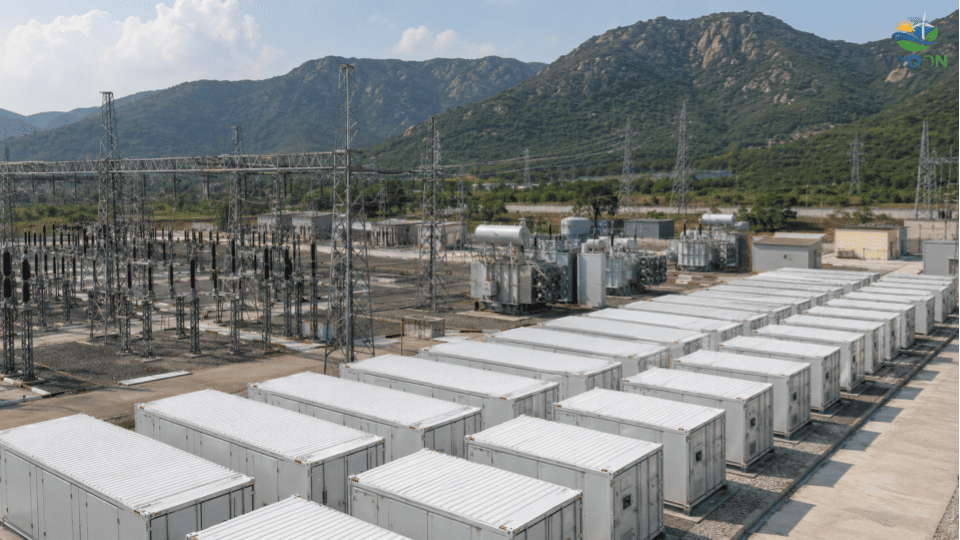
Regulatory Approval and Pricing Benchmarks
In a landmark move for India’s energy storage landscape, the Andhra Pradesh Electricity Regulatory Commission (APERC) has formally approved the tripartite Battery Energy Storage Purchase Agreements (BESPAs) for 1,000 MWh (500 MW x 2 hours) of standalone capacity. Awarded under the NHPC Tranche-II BESS auction, the project establishes a significant pricing benchmark with an L1 tariff of ₹2.08 lakh/MW/month.
The initiative involves NHPC Limited acting as the Battery Energy Storage Implementing Agency (BIA), facilitating the contractual framework between selected developers and the state’s buying entities, the Andhra Pradesh Power Distribution Companies (APDISCOMs), with the state nodal agency APTRANSCO managing grid integration.
Project Framework and Technical Specifications
The capacity was awarded through a Tariff Based Competitive Bidding (TBCB) process on a Build-Own-Operate (BOO) basis. To ensure the project meets the state’s stringent grid-balancing requirements, the following technical and performance mandates have been established:
- Contractual Term: 12-year long-term storage agreement.
- Connectivity: Intra-State Transmission System (InSTS) connected standalone BESS.
- Storage Depth: 2-hour discharge depth per cycle.
- Operational Cycle: Mandatory two full charging/discharging cycles daily to mitigate morning and evening peak demand.
- Availability Metric: Minimum 95% monthly system availability.
- Efficiency Standard: Minimum 85% monthly AC-to-AC round-trip efficiency.
- Commissioning: Projects must be operational within 18 months of BESPA execution.
Viability Gap Funding (VGF) Mechanism
To mitigate the high capital expenditure associated with utility-scale storage, the projects are supported by the CPSU Component under the Scheme for Viability Gap Funding.
- Support Ceiling: Eligible developers will receive VGF of ₹27 lakh/MWh or 30% of the project’s capital cost, whichever is lower.
- Financial Rationale: This Central Financial Assistance is designed to bridge the gap between high technology costs and the off-take requirements of state DISCOMs, ensuring the discovered tariffs remain commercially sustainable.
Auction Results: Developer Allocations and Discovered Tariffs
The Tranche-II auction saw aggressive bidding, particularly at the Jammalamadugu and Kuppam substations. Patel Infrastructure emerged as the L1 bidder for the largest single-site allocation.
| Developer | Capacity (MW/MWh) | Substation Location | Monthly Capacity Charge (₹ Lakh/MW/Month) |
| Patel Infrastructure | 225 MW / 450 MWh | Jammalamadugu | ₹2.08 |
| ACME Solar | 50 MW / 100 MWh | Kuppam | ₹2.10 |
| ACME Solar | 225 MW / 450 MWh | Ghani | ₹2.22 |
Commercial Structure and Intermediary Nodal Roles
The project utilizes a tripartite agreement structure involving the BESS Developer (BESSD), NHPC (as the BIA), and the APDISCOMs (as the Buying Entities).
- Offtake Guarantee: APDISCOMs have committed to 100% of the awarded capacity to ensure grid reliability.
- NHPC Trading Margin: As the intermediary agency, NHPC’s trading margin is capped at 0.5% of the capacity charges.
- Charging Power: The responsibility for providing power to charge the BESS resides with the Buying Entities (APDISCOMs).
Regulatory Review: Stakeholder Scrutiny vs. Commission Rationale
During the hybrid public hearing, APERC addressed critical concerns regarding the long-term economic viability of the BESPAs in a rapidly evolving technological market.
| Stakeholder Objections | Commission’s Response & Justification |
| Technological Obsolescence: Concerns over 12-year lock-ins as battery prices drop (cited at USD 55/kWh as of May 2025). | Resource Adequacy: Immediate deployment is essential to meet state reliability targets and manage the intermittency of the existing RE mix. |
| Falling Capex vs. Fixed Tariffs: Objections that fixed monthly charges do not reflect the downward trend in global battery costs. | Project Bankability: A 12-year term is required to provide the revenue certainty needed for developers to secure non-recourse financing. |
| Fire Safety & Reliability: Requests for stringent safety protocols for large-scale Li-ion deployments. | Policy Alignment: The 12-year term aligns with the Andhra Pradesh Integrated Clean Energy Policy 2024, ensuring long-term grid stability. |
Strategic Grid Context
This 1,000 MWh deployment is a cornerstone of Andhra Pradesh’s strategy to integrate 160 GW of renewable capacity. By connecting these assets to the Intra-State Transmission System (InSTS), the state moves closer to its target of 25 GWh of battery storage by 2029-30. The project serves as a critical proof-of-concept for standalone BESS as a commercially viable alternative to traditional fossil-fuel peaking plants in the Indian grid.
Leave a Comment