
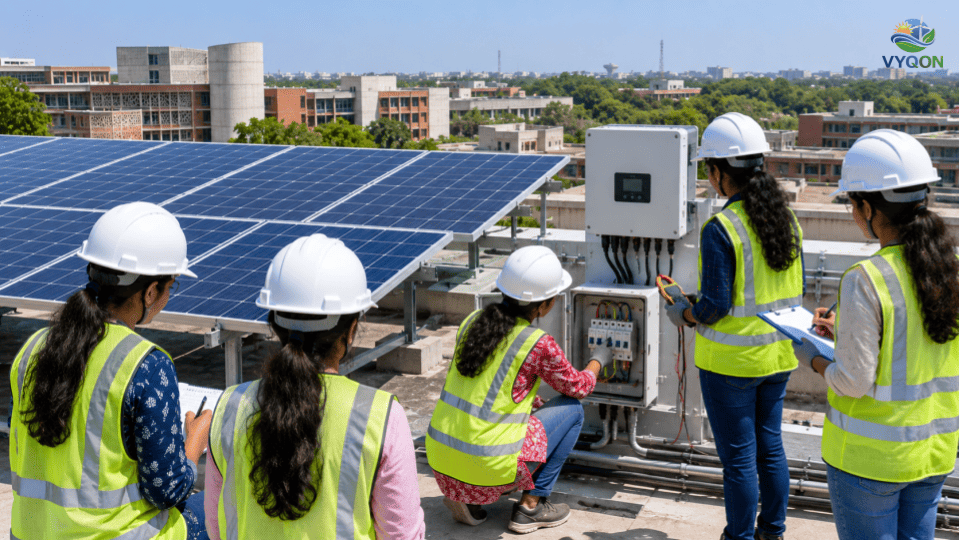
Pandit Deendayal Energy University (PDEU) has announced the establishment of a specialized training initiative for women at its Ahmedabad campus, designed to address the stark technical gender imbalance in India’s rapidly expanding clean energy workforce. This strategic move serves as a direct response to the findings of the CEEW-NRDC report, “Driving Energy Transition: Workforce, Skills, and Gender in India’s Renewable Energy Sector,” which identifies a significant concentration of female talent in non-technical administrative roles. Utilizing the university’s unique technical infrastructure, the initiative aims to transition female participants into high-value technological functions, specifically within the labor-intensive rooftop solar sub-sector.
Project Background & Bilateral Context
The initiative arrives as India reaches a watershed moment in its energy transition. In 2025, the nation achieved its target of meeting 50% of cumulative electric power installed capacity from non-fossil sources—milestone reached five years ahead of the 2030 schedule. This momentum is evidenced by the addition of approximately 6.5 lakh (657,845) workers to the clean energy workforce between FY23 and FY26.
Conceived as a collaborative effort to support the national vision of “Viksit Bharat” by 2047, the training program was developed under the guidance of Hon’ble Cabinet Minister (MNRE) Pralhad Joshi and the Secretary of the Ministry of New and Renewable Energy. By focusing on domestic skill-building, the initiative directly supports India’s 500 GW non-fossil capacity target and the National Green Hydrogen Mission, which are collectively projected to generate millions of jobs.
Collaborations & Framework
The program is managed through a multi-institutional governance structure designed to align academic training with industrial requirements. Key collaborating organizations include:
- Ministry of New and Renewable Energy (MNRE): Providing primary technical guidance and regulatory oversight.
- Council on Energy, Environment and Water (CEEW): Contributing workforce analytics and trend data.
- Natural Resources Defense Council (NRDC): Integrating international policy frameworks and climate strategies.
- Skill Council for Green Jobs (SCGJ): Defining standards for certification and competency levels.
The university maintains robust industrial relations to facilitate internships and project placements, partnering with entities such as the Gujarat Energy Development Agency (GEDA), GERMI, Adani Renewables, GoldiSolar, Topson, and Megawatt Solutions.
Operational & Practical Scope
The curriculum leverages the specialized facilities of PDEU’s Solar Research & Development Center (SRDC), including advanced laboratories funded by GEDA. Trainees gain hands-on experience with sophisticated instrumentation, including:
- Field Emission Scanning Electron Microscopy (FESEM): For topographical and elemental analysis at magnifications up to 1,000,000x.
- X-Ray Diffraction (XRD) Labs: For high-precision spectroscopy of thin-film specimens.
- Thin-Film Processing & Non-Vacuum Fabrication: Utilizing spray pyrolysis and spin coating systems.
Technical modules distinguish between core PV Design and the Balance of Energy Systems (BOS), where students perform real-time data analysis using PV emulator modules and grid-tied trainer systems. Practical training is anchored by the university’s 1MWp Solar PV power plant—the only university-owned facility of its kind in Asia—where participants learn site surveying, commissioning, and troubleshooting.
Certification is mapped to the National Skills Qualifications Framework (NSQF), prioritizing the transition of workers into semi-skilled and highly-skilled tiers:
- Low-skilled (Level 1–2): Repetitive trade tasks.
- Semi-skilled (Level 2.5–5.5): Technical vocational roles with problem-solving requirements.
- Highly-skilled (Level 6 and above): Engineering and management roles requiring advanced degrees.
The program’s focus on the rooftop sector is justified by its superior labor intensity compared to utility-scale projects:
Rooftop solar generates 44.68 full-time equivalent (FTE) job-years per megawatt (MW), making it the most significant engine for local employment within the solar ecosystem.
Workforce and Gender Analysis
The initiative addresses specific disparities noted in the 2024-25 clean energy assessments. While 44% of surveyed companies reported at least one woman on their board of directors, the general workforce representation remains low.
| Sector / Metric | Women’s Representation |
| Average Across All RE Sectors | 11% |
| Rooftop Solar Sub-sector | 15% |
| Concentration in Non-Technical Roles | 62% |
| Wind Manufacturing | 6% |
The CEEW-NRDC data identifies women as “underutilized talent” in the technical sphere. To counter this, PDEU’s initiative incorporates recommendations for improved workplace safety provisions and flexible working conditions to encourage participation in core technological and leadership roles.
Future Roadmap
The university intends to scale the program through subsequent training batches, targeting students from technical institutes and professionals seeking to transition from traditional fossil-fuel sectors. As the clean energy sector matures, approximately 80% to 90% of manufacturing roles are expected to require semi-skilled or highly-skilled workers, a demand this initiative is positioned to meet.
By 2030, India’s national clean energy targets are estimated to generate over 44 lakh (4.4 million) FTE jobs. PDEU’s strategic focus on gender-inclusive technical training serves as a blueprint for ensuring that this workforce expansion is both equitable and technically robust, reinforcing the nation’s journey toward long-term energy security.
Leave a Comment