
Executive Summary
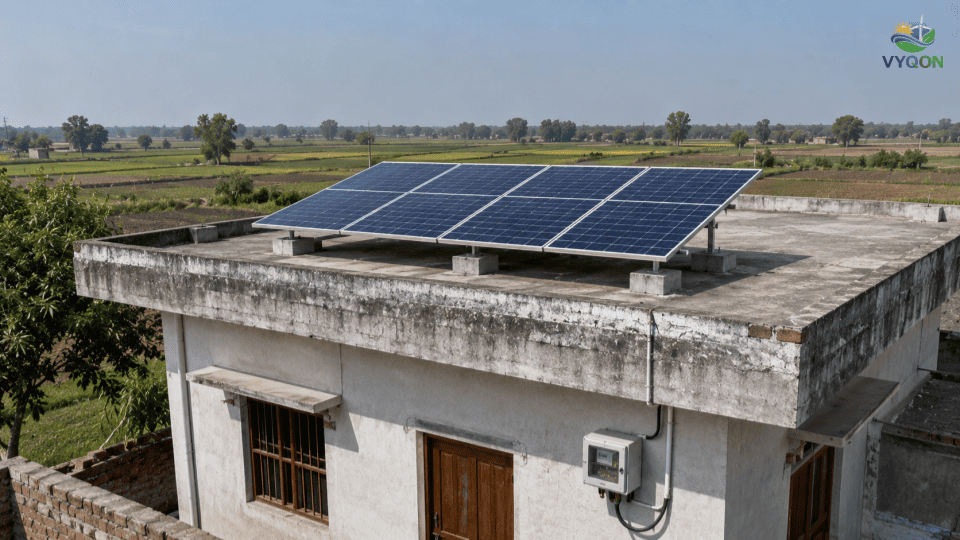
The Bihar Electricity Regulatory Commission (BERC) has issued a landmark approval for the Power Purchase Agreement (PPA) and billing framework governing a 275 MW rooftop solar programme. Specifically targeting 2.5 lakh Kutir Jyoti consumers—representing the state’s economically weaker families—the initiative formalizes the regulatory architecture required to integrate decentralized renewable energy under the PM Surya Ghar: Muft Bijli Yojana. This decision establishes a discovered tariff of ₹2.82/kWh and provides the technical basis for one of India’s most ambitious social-sector energy transitions.
Key Policy & Tariff Details
The following specifications were approved following competitive bidding processes and the submission of True-up petitions by the state’s distribution companies.
Core Programme Specifications
| Parameter | Details |
| Tariff Rate | ₹2.82/kWh (Discovered through competitive bidding) |
| PPA Duration | 10 years |
| Total Programme Capacity | 275 MW |
| Primary Beneficiaries | 2.5 Lakh Kutir Jyoti (economically weaker) households |
| Project Cost | ₹1,512 crore |
| Contracting Entities | SBPDCL and NBPDCL (Under MYT Regulations 2024) |
The Revised Billing Formula & Technical Breakdown
The BERC has deconstructed the standard residential billing cycle to accommodate the output of standardized 1.1 kW rooftop solar systems. The revised framework explicitly links solar generation to Bihar’s existing social welfare policy, which provides 125 units of free electricity to domestic consumers.
The technical mechanics of the energy accounting mechanism are defined as follows:
- Distributed Solar Credit: A specific regulatory accounting unit assigned to the generation from the 1.1 kW rooftop system, used to offset the consumer’s gross grid consumption.
- Net Generation Offset: The billing formula determines that solar-generated units are first applied against the consumer’s consumption. The state government acts as the mandatory buyer for any surplus electricity generated specifically once the 125-unit household consumption threshold is exceeded.
- Aggregate Revenue Requirement (ARR) Impact: The Commission has accounted for these credits within the broader ARR of the Discoms to ensure the financial viability of the “distributed buyer” model.
“The Commission has approved the proposed energy accounting mechanism and revised power purchase agreement to ensure clean, affordable, and sustainable energy for economically weaker families while promoting the systematic expansion of renewable energy across the distribution network, as per the parameters established in Case Nos. 50/2025 and 51/2025.”
Operational and Implementation Framework
The implementation phase is now active, with South Bihar Power Distribution Company Limited (SBPDCL) and North Bihar Power Distribution Company Limited (NBPDCL) assuming responsibility for the technical execution and management of the PPAs. Their roles are governed by the BERC Multi-Year Distribution Tariff (MYT) Regulations 2024, ensuring that the rollout aligns with the state’s long-term Aggregate Revenue Requirement (ARR) projections.
The rollout follows an aggressive timeline established by the Chief Minister’s office to coincide with key administrative milestones:
- Regulatory Effective Date: April 1, 2026.
- Phase 1 Target: Completion of 2.5 lakh installations by November 20, 2026.
- Long-term Goal: Scaling to 25 lakh households by November 20, 2027 (marking the completion of two years of the current NDA government).
Regulatory and Subsidy Context
The BERC decision is situated within a high-intensity fiscal landscape. Bihar currently provides ₹23,000 crore in power sector subsidies—a significant figure when contrasted with Uttar Pradesh, which, despite having double Bihar’s population, provides approximately ₹6,000 crore in annual energy subsidies. This aggressive fiscal stance is intended to manage a demand profile that has surged from 500 MW in 2005 to over 9,000 MW today.
The scale of the energy transition is further evidenced by the state’s simultaneous launch of ancillary energy sector development projects worth ₹1,278 crore. As Bihar’s consumer base has expanded from 17 lakh connections in 2005 to an projected 2.22 crore by the end of 2026, the transition to decentralized solar is viewed as a critical mechanism for stabilizing the grid and reducing the state’s total subsidy burden through the PM Surya Ghar: Muft Bijli Yojana. All approved figures remain subject to future True-up petitions to ensure alignment with actual distribution costs and revenue realizations.
Official Sources & Regulatory Portals
- Bihar Electricity Regulatory Commission (BERC) The statutory body responsible for determining electricity tariffs and approving power purchase agreements in the state.
- Official Website: www.berc.co.in
- Key Orders:
- Case No. 26/2026: Approval of revised PPA and Energy Accounting Framework for 275 MW Rooftop Solar Project.
- Case No. 51/2025: Determination of Retail Tariff for FY 2026-27 (SBPDCL).
- Case No. 50/2025: Determination of Retail Tariff for FY 2026-27 (NBPDCL).
- South Bihar Power Distribution Company Limited (SBPDCL) The nodal state utility for the implementation of the 275 MW rooftop solar programme.
- Official Website: www.sbpdcl.co.in
- PM Surya Ghar: Muft Bijli Yojana The National Portal for the central government’s flagship rooftop solar subsidy scheme.
- National Portal: pmsuryaghar.gov.in
- Bihar State Power Holding Company Limited (BSPHCL) The holding company governing the state’s power utilities and tenders.
- Official Website: bsphcl.bihar.gov.in
Leave a Comment