
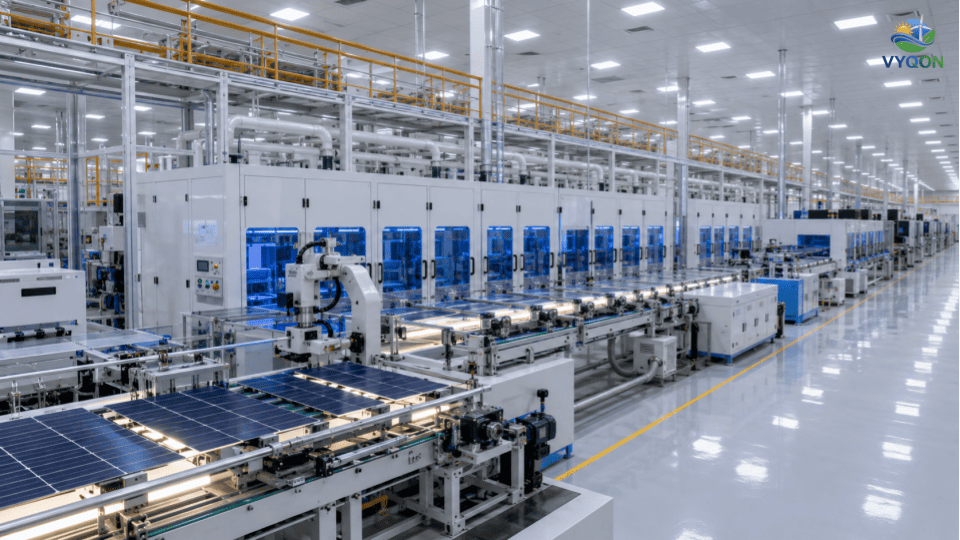
Avaada Electro, the manufacturing arm of the Avaada Group, has announced the commissioning of its first 3 GW N-type Tunnel Oxide Passivated Contact (TOPCon) solar cell production line. Located at the Butibori Industrial Area in Nagpur, Maharashtra, the facility represents the first phase of a planned 6 GW solar cell manufacturing complex. The operationalization of this line marks a critical pivot in India’s domestic manufacturing landscape, transitioning toward high-efficiency N-type chemistries to support large-scale utility projects and reduce long-term dependence on imported photovoltaic components.
FACILITY SCALE AND INVESTMENT DETAILS
The Nagpur facility is a core component of Avaada’s integrated manufacturing campus, which represents a total capital commitment of approximately ₹13,000 Crore. According to ICRA financial disclosures, the 3,000-MW (3 GW) integrated solar PV cell and module capacity phase was established at a project cost of approximately ₹2,427 Crore. This investment was structured with a debt-equity ratio of 3:1, comprising ₹1,820 Crore in sanctioned debt and a ₹607 Crore promoter contribution from Avaada Ventures Private Limited (AVPL).
The Butibori site is designed as a fully integrated ecosystem to mitigate supply chain volatility and reduce the industry’s reliance on foreign-sourced raw materials like glass, back sheets, and aluminum frames. The campus will eventually house production facilities for:
- Ingots and Wafers
- Solar Cells and Modules
- Solar Glass
The following table details the capacity milestones and strategic orientation for the Nagpur site:
| Capacity Milestone | Scale (GW) | Operational Status |
| Current Operational Capacity | 3 GW | Commissioned (July 2026) |
| Current Ramp-up Capacity | 3 GW | Phase 1 Completion Underway |
| Total Site Capacity (Nagpur) | 6 GW | Planned Facility Total |
| Group Project Pipeline | 12 GW | Avaada Energy 4-Year Target |
TECHNICAL SPECIFICATIONS
The Nagpur facility utilizes N-type TOPCon technology, which is rapidly superseding P-type PERC (Passivated Emitter Rear Contact) as the industry benchmark for utility-scale efficiency. This technological shift is driven by TOPCon’s superior material properties, including an inherent resistance to Boron-Oxygen Light-Induced Degradation (LID).
Key technical benchmarks for the facility include:
- Conversion Efficiency: Commercial-grade cells and modules produced at the facility target the 23% to 24.4% efficiency range, aligning with current global N-type standards.
- Temperature Coefficient: The TOPCon architecture provides a coefficient of -0.29% to -0.30%/°C, ensuring significantly higher energy yields in the high ambient temperatures typical of Indian project sites compared to PERC technology.
- Bifaciality Factor: The cells achieve a bifaciality factor of 80–85%, optimizing energy capture from Albedo-reflected light on the rear side of the modules.
- 720Wp Module Output: The plant produces 720Wp (Watt peak) modules, an industry-first in India. These high-output modules are engineered to reduce Balance of System (BOS) costs and land requirements, offering a clear economic advantage for utility-scale developers.
PROJECT LOCATION AND INFRASTRUCTURE
Situated in the Butibori Industrial Area within Maharashtra’s Vidarbha region, the facility leverages a strategic manufacturing hub with advanced logistics and industrial support. The production environment is highly digitized, utilizing automated assembly lines, robotics, and AI-driven quality control systems to ensure product reliability and traceability.
Regulatory and Economic Status:
- ALMM Inclusion: The facility’s modules are listed on the Approved List of Models and Manufacturers (ALMM) by the Ministry of New and Renewable Energy (MNRE). Furthermore, following government proposals, solar PV cells from this facility are expected to be eligible for ALMM inclusion from April 1, 2026.
- Infrastructure Agreements: The facility operates on land secured through a formal lease agreement with the Maharashtra Industrial Development Corporation (MIDC).
- Employment: At full operational capacity, the integrated complex is projected to generate employment for over 3,000 personnel across engineering, quality control, and logistics roles.
CORPORATE AND STRATEGIC CONTEXT
Avaada Electro functions as a wholly-owned subsidiary of Avaada Ventures Private Limited (AVPL). The group’s manufacturing expansion is supported by robust financial backing, including a $1 billion investment from the Brookfield Energy Transition Fund. This capital infusion provides the “staying power” required for capital-intensive backward integration.
Vineet Mittal, Chairman and Whole-Time Director of Avaada Electro, stated that the establishment of the 6 GW solar cell capacity at Butibori is a significant step toward India’s “green industrial age and complete technology independence.”
By integrating cell, wafer, and ingot production under one roof, Avaada is executing a backward integration strategy intended to insulate the company from the pricing volatility of imported solar cells and components. This vertical alignment is essential for strengthening the domestic solar supply chain and achieving the national objective of 500 GW of renewable capacity by 2030.
Official Sources and Reference Materials
- Avaada Group Sustainability Report FY 2024-25
- Official Company Blog: How Avaada’s Butibori Plant Is Shaping the Next Generation of Solar Technology
- ICRA Institutional Credit Rating Report: Avaada Electro Private Limited
- HKEXnews Official Regulatory Disclosure
Leave a Comment