
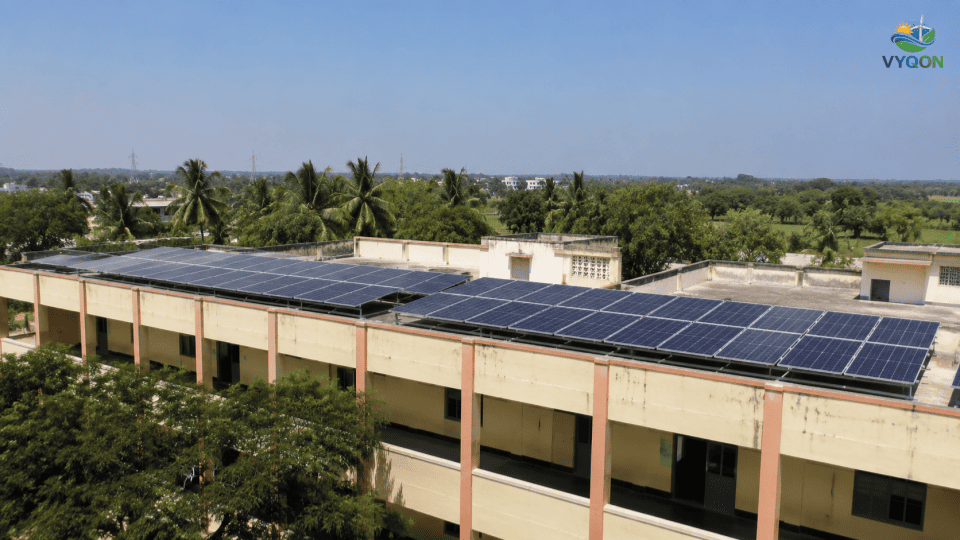
As of July 20, 2026, the Andhra Pradesh School Education Department has completed the aggregate installation of 3.5 MW of rooftop solar capacity across 415 government schools under the Pradhan Mantri Schools for Rising India (PM SHRI) program. This deployment is part of a state-wide initiative to modernize institutional infrastructure and reduce grid-dependence through decentralized renewable energy.
Project Specifications and Governing Framework
The project is structured under the PM SHRI program, utilizing a combination of central and state funding to establish sustainable energy infrastructure. The New & Renewable Energy Development Corporation of Andhra Pradesh (NREDCAP) serves as the nodal agency responsible for the processing and release of Ministry of New and Renewable Energy (MNRE) and State Government subsidies.
- Institutional Scope: The installations cover Tribal schools, Social Welfare hostels, Gurukuls, Model schools, Residential schools, and Zilla Parishad schools.
- Capacity Range: Individual systems are sized between 3 kWp and 25 kWp based on site-specific demand and feasibility.
- Maintenance Protocol: Contractors are under a mandatory five-year maintenance agreement to ensure operational efficiency.
- Tender Outcome: While the initial project estimate was INR 21.78 crore, the contract was awarded at 1.8% below the estimated cost.
Financial Summary
| Parameter | Metric |
| Total Project Estimate | INR 21.78 crore |
| Procurement Discount | 1.8% below estimate |
| Installation Cost per Unit | INR 59,000 per kWp |
| Subsidy Administration | NREDCAP |
Execution Phase: Vendor Metrics and Technical Stack
A sub-allocation of the project, totaling 1.05 MW, was executed by Eshaan Energy, a Vijayawada-based MSME. The firm completed installations across 113 schools within six districts under the jurisdiction of three separate electricity distribution companies (DISCOMs). The implementation was achieved within a 99-day timeline, overcoming logistical constraints including buildings with restricted terrace access and varied structural conditions.
Eshaan Energy Execution Metrics
| Category | Performance Data |
| Schools Completed | 113 |
| Capacity Installed | 1.05 MW |
| Operational Districts | 6 (Under 3 DISCOMs) |
| Timeline | 99 days |
| Technical Stack | RenewSys solar modules; Polycab inverters and cables; chlorinated polyvinyl chloride (CPVC) components |
Operational Impact and Regulatory Context
The solarization of the educational sector is expected to result in a 55% reduction in grid electricity consumption for participating institutions. The project operates under the Net Metering framework as regulated by the Andhra Pradesh Electricity Regulatory Commission (APERC).
Under this framework, energy generated is adjusted against DISCOM consumption on a monthly basis. Any excess generation injected into the grid is carried forward monthly until quarter end. At the conclusion of the quarter, financial settlement for surplus energy is conducted on an Average Cost of Supply (ACoS) basis, also referred to as the Cost to Serve Price. This transition shifts schools from recurring expenditure models toward institutional energy self-sufficiency.
Long-Term Power Sector Alignment
The deployment aligns with the strategic objectives identified in the Center for Study of Science, Technology and Policy (CSTEP) “Andhra Pradesh Power Sector: A Roadmap Till 2040.”
Strategic Alignments:
- RTPV Capacity Targets: The project contributes toward the state’s long-term target of reaching 2,271 MW of rooftop photovoltaic (RTPV) capacity by FY 40.
- Deficit Mitigation: Institutional solarization serves to mitigate the 1.1% energy deficit (726 MU) recorded in FY 22 by reducing pressure on the centralized grid.
- Demand Optimization: The adoption of solar in the institutional sector functions as a policy lever to reduce the projected Business-As-Usual (BAU) demand, which is forecasted to reach 194,847 MU by FY 40.
- Supply Mix Adjustment: The initiative supports the state’s roadmap to increase the renewable energy share in the total supply mix from 24% in FY 22 to a projected range of 47%–55% by FY 40.
Official Government Sources
- Andhra Pradesh Solar Power Policy 2018
- Issued by: Energy, Infrastructure & Investment Department, Government of Andhra Pradesh.
- Description: The primary policy framework for solar capacity addition, incentives, and land allotment in the state.
- Link: Andhra Pradesh Solar Power Policy 2018
- Grid Connected Solar Rooftop Net Metering Guidelines
- Issued by: New & Renewable Energy Development Corporation of Andhra Pradesh Ltd (NREDCAP).
- Description: Official technical requirements and administrative procedures for consumers installing rooftop solar systems.
- Link: NREDCAP Net Metering Guidelines
- Andhra Pradesh Power Development Statistics 2021-22
- Issued by: Transmission Corporation of Andhra Pradesh (APTRANSCO).
- Description: Official historical data on installed capacity, transmission losses, and energy demand across the state.
- Link: APTRANSCO Power Sector Reports
- Andhra Pradesh Electric Mobility Policy 2018-23
- Issued by: Industries & Commerce Department, Government of Andhra Pradesh.
- Description: The state’s strategic roadmap for EV penetration and infrastructure development.
- Link: AP Electric Vehicle Policy
- Andhra Pradesh Electricity Regulatory Commission (APERC) – Resource Plans
- Issued by: APERC.
- Description: Regulatory approval for state load forecasts, distribution plans, and power procurement tranches.
- Link: APERC Load Forecasts & Resource Plans
Leave a Comment