
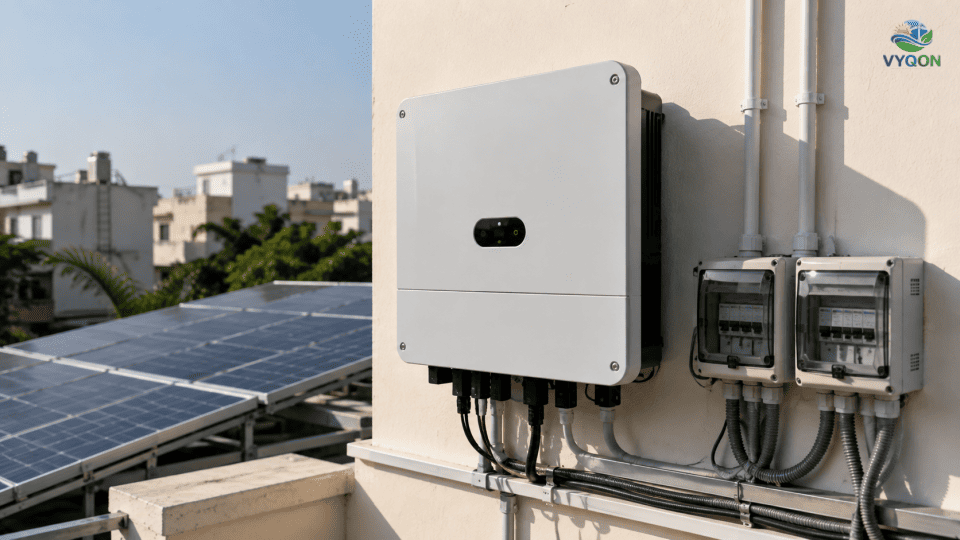
In a decisive move to accelerate the rollout of the PM Surya Ghar: Muft Bijli Yojana (PMSG: MBY), the Ministry of New and Renewable Energy (MNRE) issued a technical advisory in March 2026 to all distribution companies (DISCOMs) and state electricity departments. The directive permits a capacity tolerance of up to 10% for the Direct Current (DC) capacity of rooftop solar installations during the net-metering approval process. While the advisory provides flexibility for the solar module array, it maintains a strict requirement that the inverter’s Alternating Current (AC) capacity must not exceed the consumer’s sanctioned load or the maximum permissible limits established by local regulatory frameworks.
Context and Administrative Drivers
The issuance of this circular follows sustained representations from solar vendors and industry associations regarding the high rate of technical rejections for residential net-metering applications. Previously, several DISCOMs returned applications for minor deviations between the total DC module capacity and the sanctioned load. A primary administrative hurdle involved configurations such as a 3.24 kWp DC system paired with a 3.0 kW AC inverter, which were frequently rejected despite being technically viable and standard for industry performance.
The MNRE identified a “practical challenge” stemming from the industry’s shift toward high-wattage Mono-PERC modules. As commercially available modules now commonly feature ratings in the 540 Wp+ range, installers face significant difficulty in matching the total DC array capacity precisely to the sanctioned load. The advisory acknowledges that modules are manufactured in specific wattage increments, making exact alignment with kilowatt targets nearly impossible without a regulatory margin.
Technical Specifications and Directives
To ensure uniform implementation across all State Implementation Agencies (SIAs), the MNRE has defined the following regulatory window for project approvals:
- The 10% Rule: DISCOMs are advised to permit the total DC system capacity (the aggregate Kilowatt-peak or kWp rating of the solar modules) to be up to 10% higher or 10% lower than the applied-for capacity.
- AC Inverter Capping: The AC output capacity of the solar inverter (kW) must remain non-negotiable and shall not exceed the sanctioned load of the consumer or the maximum inverter capacity permitted under state-specific regulations.
- CFA Calculation Basis: For the purpose of calculating Central Financial Assistance (CFA) or subsidies, the commissioned plant capacity will be determined by the lower of the two values: the total DC module array capacity (kWp) or the AC inverter capacity (kW).
- Operational Objective: These revisions are designed to eliminate administrative bottlenecks, prevent the unnecessary return of applications, and speed up the commissioning of residential rooftop assets.
Illustrative Technical Scenarios
The following scenarios demonstrate how the 10% tolerance rule applies to standard installations using 540 Wp modules:
| Applied System Capacity (Sanctioned Load) | Module Specification | Permissible Configurations (DC Capacity) | Inverter Capacity Limit (AC) |
| 5 kW AC | 540 Wp Modules | 9 Modules (4.86 kWp) OR 10 Modules (5.40 kWp) | Must not exceed 5 kW AC |
| 10 kW AC | 540 Wp Modules | 18 Modules (9.72 kWp) OR 19 Modules (10.26 kWp) | Must not exceed 10 kW AC |
Scheme Background: PM Surya Ghar: Muft Bijli Yojana
This advisory is a critical refinement to the PM Surya Ghar: Muft Bijli Yojana, which received cabinet approval on February 29, 2024. The scheme represents the government’s flagship effort to decentralize energy production across India.
- Financial Outlay: The program operates with a total financial outlay of Rs 75,021 crore.
- National Target: The initiative aims to achieve 1 crore rooftop solar installations in the residential sector by the conclusion of FY 2026-27.
- Implementation Hierarchy: The scheme is managed at the national level by REC Ltd., acting as the National Programme Implementation Agency (NPIA). At the state level, implementation is spearheaded by SIAs, primarily comprising DISCOMs and state renewable energy departments.
Administrative Oversight and Implementation Scope
The circular, issued under the authority of Scientist-D Anubhav Uppal, has been formally distributed to ensure compliance and standardized implementation across the national power grid. The distribution list includes:
- Heads of all DISCOMs and State Electricity Departments.
- State Electricity Regulatory Commissions (SERCs).
- State Energy Secretaries and Programme Directors.
- The Chairman and Managing Director (CMD) of REC Ltd.
The objective of this widespread distribution is to harmonize the approval process, ensuring that consumers in different jurisdictions face consistent technical requirements for net-metering.
Associated Technical Standards
The 10% tolerance advisory coincides with a broader push for technical standardization within the MNRE. On March 27, 2026, the Ministry also issued comprehensive testing guidelines for Inverter Remote Monitoring Systems (RMS) and dataloggers. These standards mandate the use of MQTT protocols for efficient data transfer and Transport Layer Security (TLS) certificates for secure authentication. Furthermore, all monitoring hardware must now feature hard IMEI-based identification to ensure data transparency and facilitate the integration of rooftop assets into the National Portal.
Official Sources and Citations
- Ministry of New and Renewable Energy (MNRE), Government of India
- Official Website: mnre.gov.in
- PM Surya Ghar: Muft Bijli Yojana National Portal
- Official Portal: pmsuryaghar.gov.in
- Lab Policy, Standards and Quality Control Documents (MNRE)
- Official Documentation Repository: mnre.gov.in/en/lab-policy-standard-quality-control-documents/
- Operational Guidelines for Implementation of PM-Surya Ghar: Muft Bijli Yojana (Service Charge Component)
- Office Memorandum No. 318/17/2024-Grid Connected Rooftop (Part-13), issued by the Mission Directorate, Dated 08.10.2024.
- MNRE Advisory on 10% DC Capacity Tolerance for Rooftop Solar Net Metering
- Advisory issued to all DISCOMs and State Electricity Departments regarding DC:AC capacity flexibility under PM Surya Ghar: Muft Bijli Yojana, Dated March 2026.
- IS 18968:2025: India’s National Standard for DER Interconnection
- Published by the Bureau of Indian Standards (BIS) as a modified adoption of IEEE Std 1547-2018, Dated January 2025.
- Testing Guidelines for Inverter Remote Monitoring Systems (RMS) and Dataloggers
- Ministry of New and Renewable Energy (MNRE) Memorandum for PM Surya Ghar scheme compliance, Dated 27 March 2026.
- Clarification on Eligibility of CFA and Declaring Commissioned Plant Capacity w.r.t. Installed Inverter Capacity
- MNRE Office Memorandum F. No. 03/88/2015-16/GCRT, Dated 28.08.2017.
Leave a Comment