
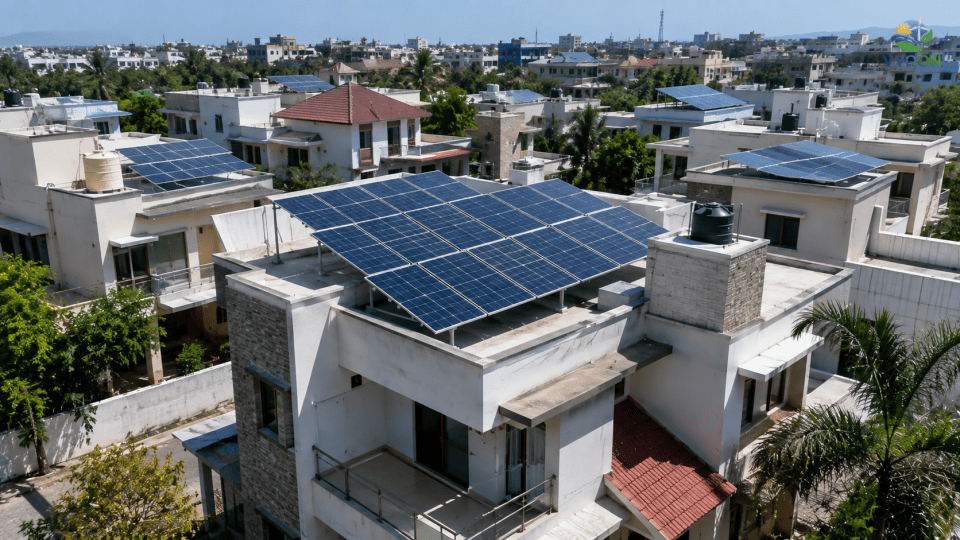
The Asian Development Bank (ADB) has formally approved an $850 million policy-based loan to execute Subprogram 2 of the “Accelerating Affordable and Inclusive Rooftop Solar Systems Development Program.” This strategic financing directly underpins the Government of India’s flagship PM Surya Ghar: Muft Bijli Yojana, a transformative initiative aimed at redefining the nation’s residential energy landscape.
This second subprogram focuses on de-risking upfront capital for households and mobilizing private investment while simultaneously institutionalizing the technical skills required for a decentralized energy transition. By enhancing household resilience against energy price volatility, the ADB-supported reforms are designed to catalyze a people-centered energy shift that integrates clean energy access with robust workforce development.
Financial Architecture and Technical Objectives
The $850 million loan serves as a phased intervention to scale residential solar adoption. The program’s technical and financial targets are delineated below:
- Targeted Adoption: The ADB financing is specifically structured to support rooftop solar (RTS) installations for at least 3.5 million households.
- National Trajectory: This support aligns with India’s overarching mission to solarize 10 million low- and middle-income households, aiming for 30 gigawatts (GW) of cumulative residential capacity by fiscal year (FY) 2027.
- Sequential Policy Reform: While Subprogram 1 (approved in November 2025) established the essential policy, digital, and market foundations, Subprogram 2 focuses on improving incentives, grid readiness, and utility engagement to ensure mass-market viability.
- Decarbonization Impact: The initiative is projected to yield a reduction of 28.8 million tons of carbon dioxide equivalent emissions over the program’s lifecycle.
Digital Transformation and Grid Modernization: The Operational Pillars
The program addresses structural barriers through a multi-pronged approach to infrastructure and market readiness. A central component is the ₹500 crore allocation for “Innovative Projects,” which aims to fund proof-of-concepts for advanced Distributed Energy Resources (DER) management. This includes:
- Technological Innovations: Deployment of blockchain-based peer-to-peer (P2P) solar trading, digital solutions for RTS management, smart building materials, and “Rent-A-Roof” business models.
- Grid Resilience: Engaging Distribution Companies (DISCOMs) to transition toward “renewable energy-ready” automated grids that can effectively manage bi-directional power flows.
- Consumer Access: Reducing high entry costs via collateral-free, low-interest loans and streamlining the application process through the national digital portal.
Domestic Value Chain and Sustainability Protocols
In alignment with India’s industrial policy, the loan supports the development of domestic clean energy value chains. By incentivizing the local manufacturing of solar components, the program seeks to reduce import dependency and ensure long-term energy security.
Furthermore, the program mandates rigorous environmental safety measures, specifically targeting the safe handling and recycling of solar photovoltaic (PV) panels and battery waste. This sustainability framework also extends to technology convergence, supporting the integration of rooftop solar with behind-the-meter energy storage and Electric Vehicle (EV) charging infrastructure.
Workforce Development and Green Job Creation
A cornerstone of the ADB’s development finance approach is the certification of a local workforce. The program sets a specific mandate to train and certify at least 6,000 individuals, with a strict requirement that one-third of these trainees must be women to promote gender equity in the green economy.
These efforts integrate with the broader Skill Development Component managed by the Ministry of Skill Development and Entrepreneurship (MSDE). To meet the national requirement for 3 lakh (300,000) personnel—including 1 lakh technicians and 2,000 trainers—the training methodology employs a rigorous curriculum consisting of 45 hours (5 days) of classroom-based institutional training followed by 15 hours (2 days) of On-the-Job Training (OJT). Eligibility is targeted at final-year or pass-out trainees from ITIs in the Electrician, Electronic Mechanic, and Electrician-Power Distribution trades.
Official Positioning and Market Momentum
ADB Country Director for India, Mio Oka, emphasized the strategic depth of the partnership, stating that the program “supports a people-centered energy transition by reducing exposure to energy price and supply shocks, strengthening distribution systems, creating green jobs, and building stronger domestic clean energy value chains.”
The “Muft Bijli” (Free Electricity) branding of the scheme has already translated into tangible financial outcomes. As of July 22, 2026, over 48 lakh households have benefited from the scheme, with nearly 39.7 lakh systems installed. Notably, 18.93 lakh households have reported “zero electricity bills” in some months—a direct result of self-consumption and efficient net metering enabled by the program’s digital and technical reforms.
Program Governance and Implementation Ecosystem
The PM Surya Ghar: Muft Bijli Yojana is primarily implemented by the Ministry of New and Renewable Energy (MNRE). The national scheme operates with a total financial outlay of Rs 75,021 crore through FY 2026–27.
The capacity-building and skill-development ecosystem is governed by a network of nodal agencies, including:
- The Ministry of Skill Development and Entrepreneurship (MSDE)
- The Directorate General of Training (DGT)
- The National Instructional Media Institute (NIMI)
- The National Institute for Entrepreneurship and Small Business Development (NIESBUD)
- The Indian Institute of Entrepreneurship (IIE)
- The Skill Council for Green Jobs (SCGJ)
Official Sources
- Asian Development Bank (ADB) News Release: ADB Approves $850 Million Loan to Accelerate Affordable Rooftop Solar Adoption for Households in India
- Asian Development Bank (ADB) Official Report: Accelerating Affordable and Inclusive Rooftop Solar Systems Development Program: Report and Recommendation of the President
- Ministry of New and Renewable Energy (MNRE), Government of India: Grid Connected Rooftop Solar Programme Official Page
- Ministry of New and Renewable Energy (MNRE) – Scheme Portal: PM-Surya Ghar: Muft Bijli Yojana National Portal
- Ministry of Skill Development & Entrepreneurship (MSDE), Government of India: Guidelines for PM-Surya Ghar: Muft Bijli Yojana (Skill Development Component)
Leave a Comment