
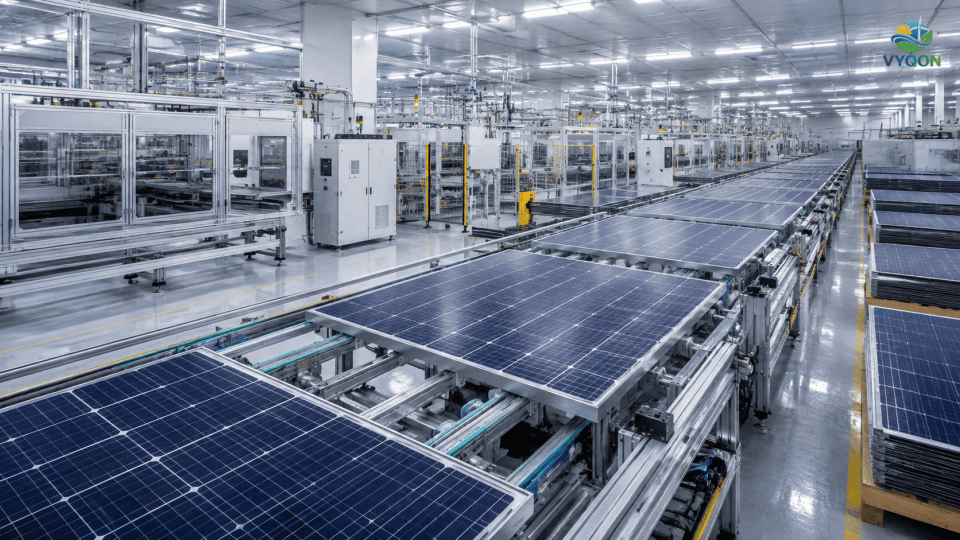
Vikram Solar reported revenue from operations of ₹15.63 billion (₹1,563 crore) for the first quarter of fiscal year 2027 (ended June 30, 2026), a 38% increase over the same period last year. However, the robust top-line growth was overshadowed by a punishing 85% collapse in net profit, as the company struggled with rising input costs and a lack of backward integration. Investors responded swiftly to the margin erosion, sending shares down 5.53% to ₹164.34 following the announcement. Despite the profitability crunch, operational volume remained strong, with module sales reaching 1,006 MW (~1 GW) and the total order book standing at 7.9 GW.
Quarterly Financial Performance Breakdown
The results underscore a widening gap between India’s surging solar demand and the profitability of manufacturers reliant on external supply chains. While sequential revenue improved by 8% from Q4 FY 2026 (₹1,453 crore), the bottom line suffered as the profit after tax (PAT) margin plummeted to just 1%.
Key Financial Metrics: Q1 FY 2027 vs. Q1 FY 2026
| Metric | Q1 FY 2027 | Q1 FY 2026 |
| Revenue from Operations | ₹1,563 Crore | ₹1,134 Crore |
| EBITDA | ₹126 Crore | ₹244 Crore |
| EBITDA Margin (%) | 8% | 21% |
| Profit After Tax (PAT) | ₹20 Crore | ₹133 Crore |
| Gross Margin (%) | 19% | 31% |
Operational and Input Cost Drivers
The primary headwind for Vikram Solar remains its vulnerability to external price cycles. A 63% year-over-year surge in the Cost of Goods Sold (COGS), which hit ₹1,268 crore, outpaced revenue gains and highlighted the risks of sourcing solar cells from the open market rather than in-house.
Management identified the following core cost drivers:
- Base Metal Inflation: Significant price spikes in aluminum and copper, exacerbated by global supply chain disruptions.
- Crude-Linked Inputs: Higher costs for Ethylene Vinyl Acetate (EVA), a critical material for module encapsulation.
- Inventory Dynamics: Elevated cell costs resulting from inventory closeouts and high-priced spot market purchases.
The company also reported a 56% rise in employee costs (₹55 crore) and a 91% jump in depreciation (₹64 crore), both tied to the commissioning of new facilities and scaled manufacturing. Notably, while total finance costs rose to ₹49 crore, they actually declined on a per-watt basis, indicating improved capital efficiency as production volume scaled.
Order Book Status and Market Channels
Vikram Solar is currently targeting a full-year delivery of 9 to 9.5 GW, supported by an order book of 7.9 GW. The execution strategy is split across three distinct channels, with the mid-market segment showing the most explosive momentum.
Large Accounts (Utility/Large Scale) This remains the dominant segment with 7.1 GW of the order book. Revenue grew 21.3% YoY, driven by long-cycle utility projects. Demand in this segment is increasingly tied to the ALMM (Approved List of Models and Manufacturers) mandate, which favors domestic players.
Mid-Market (Commercial & Industrial) The mid-market segment reached 0.8 GW but recorded a staggering 212.5% YoY revenue growth. This surge is specifically fueled by the rising power needs of data centers and heavy industrial consumers seeking to lock in lower tariffs compared to grid power.
Distribution Channel This channel accounts for 16.5% of total revenue. It is anchored by a massive network of 757 dealers and 119 distributors, covering more than 500 districts across 24 Indian states.
A significant bright spot was the delivery of 76 MW of Domestic Content Requirement (DCR) modules in Q1 FY27 alone—a figure that already exceeds the company’s total DCR sales for the entirety of FY26.
Strategic Infrastructure and Capacity Roadmap
To break the cycle of margin compression, Vikram Solar is aggressively pursuing backward integration. The centerpiece of this strategy is the Gangaikondan integrated manufacturing hub in Tamil Nadu. Designed as a “single-fence” facility, the hub aims to house module, cell, and eventually wafer production in one location to eliminate inter-plant logistics and minimize transit breakage.
The company’s current module manufacturing capacity stands at 15.5 GW. Future integration targets include:
- Solar Cell Production: 9 GW capacity currently under construction; first output is targeted for Q4 FY 2027 to insulate the company from external cell price volatility.
- Upstream Integration: Plans to establish 9 GW of wafer and ingot capacity by FY 2029.
- Storage Expansion: A target of 15 GWh of battery energy storage systems (BESS) by FY 2030 to tap into the projected 321 GWh Indian storage market.
Vikram Solar’s immediate outlook is defined by its ability to transition from a module assembler to a vertically integrated manufacturer. Management expects DCR module volumes—which command higher premiums—to increase 2 to 2.5 times in the coming quarters, potentially providing a much-needed tailwind for margins. To fund this ambitious roadmap, the company has committed to a capital expenditure plan of approximately ₹5,000 crore for fiscal 2027, to be financed through a 75/25 debt-to-equity structure.
Official Corporate Documents and Regulatory Filings
- Vikram Solar Limited – Q1 FY 2027 Investor Results Presentation
- Details: Official presentation detailing the surge in revenue to ₹1,563 crore, module dispatches of 1,006 MW, and the strategic roadmap for vertical integration.
- Vikram Solar Limited – Unaudited Standalone Financial Results (Q1 FY 2027)
- Details: Financial statements approved by the Board on 6 August 2026, and subsequently published in accordance with SEBI Regulations.
- Tata Power Company Limited – Annual Reports (FY 2012–2026)
- BSE India Corporate Announcements and Filings (Tata Power)
- Earnings Call Transcript (Q1 FY 2027): Formal record of the analyst discussion regarding quarterly performance.
- Investor and Analyst Meeting Schedule (Aug 2026): Official intimation of engagement with institutional investors in Singapore, Hong Kong, and Mumbai.
- Press Release – 800 MW Andhra Pradesh RE Project: Announcement regarding the ₹5,750 crore investment by TPREL.
- MERC Tariff Dispute Judgment (APTEL): Favorable legal outcome regarding a ₹268 crore tariff claim.
- Acquisition of RPTL (Notification): Regulatory filing confirming the 100% acquisition of RPTL for ₹10.87 crore.
Leave a Comment