
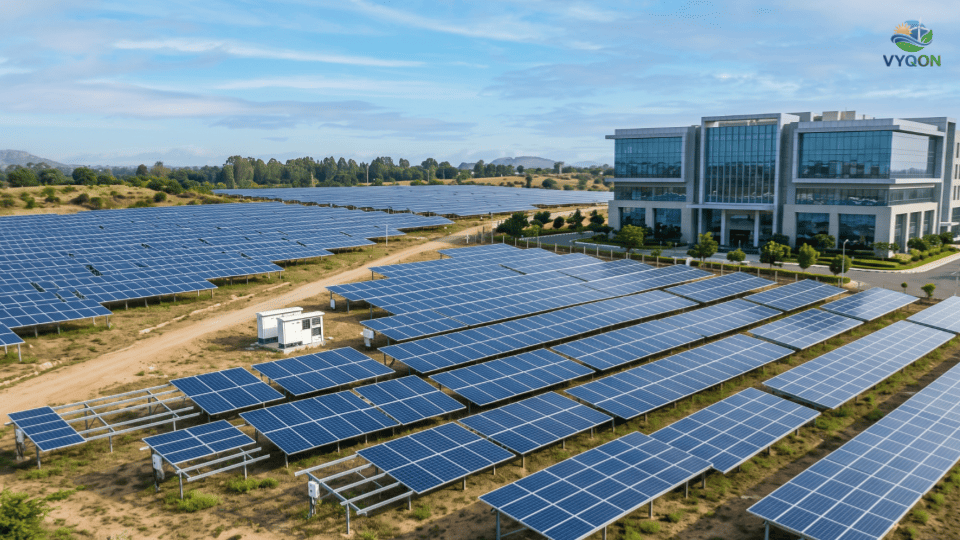
The Uttar Pradesh Electricity Regulatory Commission (UPERC), in its order dated April 6, 2016 (Petition No. 1050 of 2015), has formally adopted the solar tariffs discovered through a competitive bidding process conducted by UPNEDA. This adoption, pursuant to Section 63 of the Electricity Act, 2003, grants regulatory approval for the execution of Power Purchase Agreements (PPAs) for 105 MW of grid-connected solar PV projects. A central feature of the ruling is the Commission’s authorization of project execution through Special Purpose Vehicles (SPVs) and the establishment of a bifurcated commercial framework for the projects’ 25-year operational life.
Background and Regulatory Framework
The procurement process was initiated by the Uttar Pradesh New and Renewable Energy Development Agency (UPNEDA), the designated nodal agency under the Solar Power Policy-2013. In accordance with MNRE guidelines for single-stage tariff-based competitive bidding, UPNEDA sought to procure 300 MW of solar capacity via the Case-1 long-term route. The process was supported by M/s Medhaj Techno Concept Pvt. Ltd., who served as the consultant for managing the bidding and assisting the Bid Evaluation Committee (BEC).
The bidding timeline progressed as follows:
- July 2014: Publication of the Request for Proposal (RFP).
- July 31, 2014: Conduct of the pre-bid meeting.
- August 2014: Publication of the modified RFP based on stakeholder feedback.
- September 2014: Opening of non-financial bids. While the process sought 300 MW, only six bids totaling 110 MW were received. One bidder, Elecomponics Technology India Pvt. Ltd. (5 MW), was disqualified for being technically non-responsive as its corroborative experience documentation failed to meet RFP requirements.
- October 2014: Financial bids were opened for the five remaining technically qualified bidders.
The final recommendations were reviewed by the BEC and subsequently approved by the Empowered Committee, chaired by the Chief Secretary of the Government of Uttar Pradesh (GoUP), with final state government approval granted on January 30, 2015.
UPERC Decision: SPV Execution and Legal Precedents
A pivotal issue in the petition was the legal transition from the bidding companies to Special Purpose Vehicles (SPVs). The Commission cited clause 2.10.2.2iii of the RFP, which explicitly permitted shortlisted companies to execute projects through an SPV. Consequently, the UPERC approved the legal standing of the PPAs signed on April 6, 2015, with the respective SPVs.
In adopting the tariffs, the Commission addressed its jurisdictional scope under Section 63. While acknowledging the APTEL ruling (Appeal No. 82 of 2011) that limits a Commission’s right to look into the fairness of discovered tariffs if the process was transparent, the UPERC also emphasized the Rajasthan High Court precedent (Special Appeal 604/2014). This precedent underscores the Commission’s “mandated obligation” to protect consumer interests by ensuring PPA terms are balanced and not prejudicial.
Summary of Approved PPAs and Tariffs
The following table summarizes the developers, their designated SPVs, and the final commercial parameters. Locations were firmed up within the mandatory period following the Letter of Intent (LOI) from tentative sites originally proposed.
| Original Bidder | Special Purpose Vehicle (SPV) | Capacity (MW) | Tariff (Rs/kWh) | Location |
| M/s Sukhbir Agro Energy Ltd. | Universal Saur Urja Pvt. Ltd. | 30 | 9.33 | Vill: Kanpua, Kulphar, Distt: Mahoba |
| M/s Jakson Engineers Ltd. | Green Urja Pvt. Ltd. | 30 | 9.24 | Vill: Lodipura, Distt: Mahoba |
| M/s K.M. Consortium | K.M. Energy Pvt. Ltd. | 5 | 9.25 | Vill: Ravai, Kulphar, Distt: Mahoba |
| M/s Jatadhari Merchandise Pvt. Ltd. | Sun N Wind Infra Energy Pvt. Ltd. | 10 | 9.27 | Vill: Pathabhanpur, Tehsil: Mehauli, Distt: Lalitpur |
| M/s ACME Solar Energy Pvt. Ltd. | Nirosha Power Pvt. Ltd. | 30 | 8.93 | Vill: Dhavar, Kulphar, Distt: Mahoba |
Key Provisions and Technical Mandates
The Commission’s order imposes several specific regulatory conditions to ensure grid discipline and commercial fairness:
- Tariff Horizon and Settlement: In alignment with GoUP order no. 804/45-V-2013-8(10), the discovered tariffs are fixed for the first 12 years. For years 13 through 25, the Commission intervened to prevent an “injustice” where sellers previously held unilateral power to sell at the Average Power Purchase Cost (APPC). Instead, the Commission will determine the tariff based on the then-prevailing regulations, including Return on Equity (RoE), O&M expenses, and interest on working capital.
- Exclusion of Capital Recovery Costs: For the year 13–25 settlement, interest on loan and depreciation are strictly excluded. The Commission’s legal rationale is that developers are presumed to have recovered approximately 90% of capital costs during the initial 12-year period.
- Commissioning Mandate: Successful trial runs must be conducted at a minimum 10% capacity (with an initial minimum of 5 MW), verified by the State Load Despatch Centre (SLDC), before commercial operation is declared.
- BEC Composition Compliance: The Commission noted that the “external” members of the BEC were representatives from the GoUP (Finance and Law departments). The UPERC ruled that these members were “affiliates of the procurer,” violating the spirit of MNRE guidelines. The Commission advised UPPCL and UPNEDA that future committees must include members truly external to the procurer and its affiliates.
The disposal of Petition 1050 of 2015 provides a stable regulatory framework for 105 MW of solar capacity in Uttar Pradesh. By formally adopting these tariffs and validating the SPV structures, the UPERC has provided the necessary legal certainty for project implementation while establishing a precedent for post-12-year tariff determination. This ruling balances the commercial requirements of developers with the long-term protection of the state’s consumers and the financial health of UPPCL.
Uttar Pradesh State Authorities & Regulators
- UPERC Official Portal: Uttar Pradesh Electricity Regulatory Commission (UPERC) Home Page
- UPERC Tariff Order: UPERC Tariff Order for FY 2024-25
- Invest UP Official Portal: Invest UP — Government of Uttar Pradesh Investment Promotion Agency
- UPPTCL Open Access Portal: Uttar Pradesh Power Transmission Corporation Limited (UPPTCL) Open Access Regulations
- UPPTCL 2019 Principal Regulations: UPPTCL Open Access Regulations, 2019 Gazette Notification
Official Policy & Framework Documents
- UP Solar Energy Policy 2022 (English): Uttar Pradesh Solar Energy Policy 2022 Official English Document
- UP Solar Energy Policy 2022 (Hindi): Uttar Pradesh Solar Energy Policy 2022 Official Hindi Document
- UPERC CRE Regulations 2024: UPERC Captive and Renewable Energy (CRE) Generating Plants Regulations, 2024 Gazette Copy
National Level Regulatory & Legislative Documents
- MNRE Official Portal: Ministry of New and Renewable Energy (MNRE) Home Page
- The Electricity Act, 2003: Central Electricity Regulatory Commission (CERC) Electricity Act, 2003 (with Amendments)
Leave a Comment