
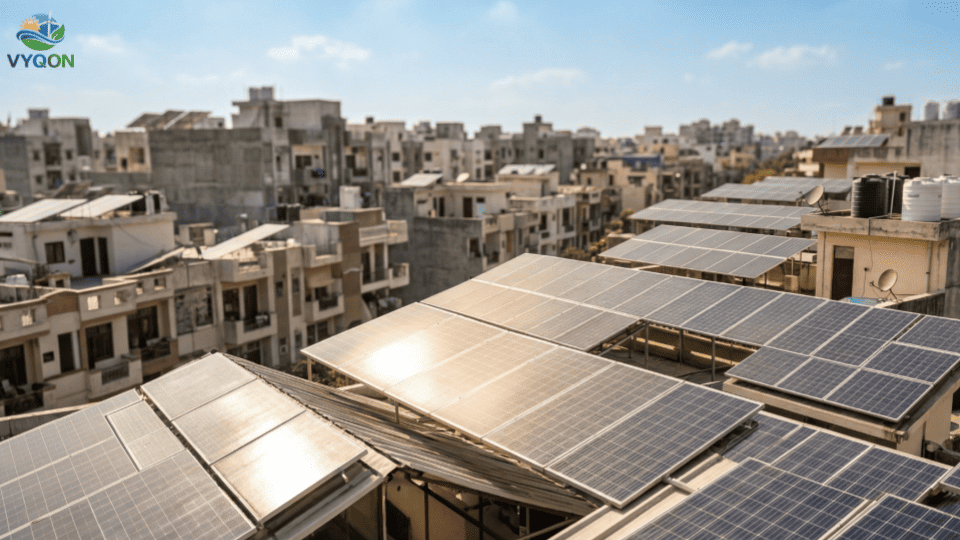
In a significant high-level intervention in March 2026, the Ministry of New and Renewable Energy (MNRE) officially urged the Maharashtra government to withdraw “regressive” rooftop solar capacity restrictions. The MNRE warns that these state-level barriers are inconsistent with national guidelines and create unnecessary friction for the PM Surya Ghar: Muft Bijli Yojana.
Policy Shift: Sanctioned Load vs. Past Usage
The dispute centers on a new MSEDCL rule that caps solar capacity based on a consumer’s average electricity consumption over the last 12 months. Previously, installations were allowed up to the sanctioned load. This shift is a major hurdle for the PM Surya Ghar flagship scheme, which targets 1 crore household installations and a national rooftop capacity of 30 GW by 2026-27.
The “Regressive” Impact on Future-Proofing
Analysts label the “past usage” rule regressive because it effectively penalizes energy-efficient consumers. By ignoring seasonal usage patterns—such as high summer cooling demands—the 12-month average results in undersized systems. Furthermore, the rule prevents forward-looking prosumers from sizing systems for future loads, specifically Electric Vehicles (EVs) and new appliances. The cap also severely limits the efficacy of Virtual Net Metering (VNM) and Group Net Metering (GNM), which were intended to empower housing societies under the MERC Second Amendment 2024.
Institutional and Judicial Pushback
The MNRE asserts that MSEDCL‘s restrictions conflict with the Electricity (Rights of Consumers) Rules, 2020. This regulatory stance aligns with recent judicial action; the Bombay High Court recently directed the automatic approval of systems up to 10 kW to bypass procedural bottlenecks.
Key Takeaways for Developers
- Reduced Eligible Capacity: Linking system size to historical usage shrinks the market for residential and VNM-based society projects.
- Investor Uncertainty: While MERC finalized the surplus power tariff at ₹2.82/kWh for FY 2025-26, capacity caps make long-term returns harder to project, dampening private investment.
- National vs. State Conflict: Developers must navigate the widening gap between central PM Surya Ghar guidelines and restrictive state DISCOM regulations.
Current Status
The industry is currently awaiting a formal response from the Maharashtra government. While state-level friction persists, the PM Surya Ghar scheme remains the primary driver of India’s decentralized energy transition through 2027.
Leave a Comment