
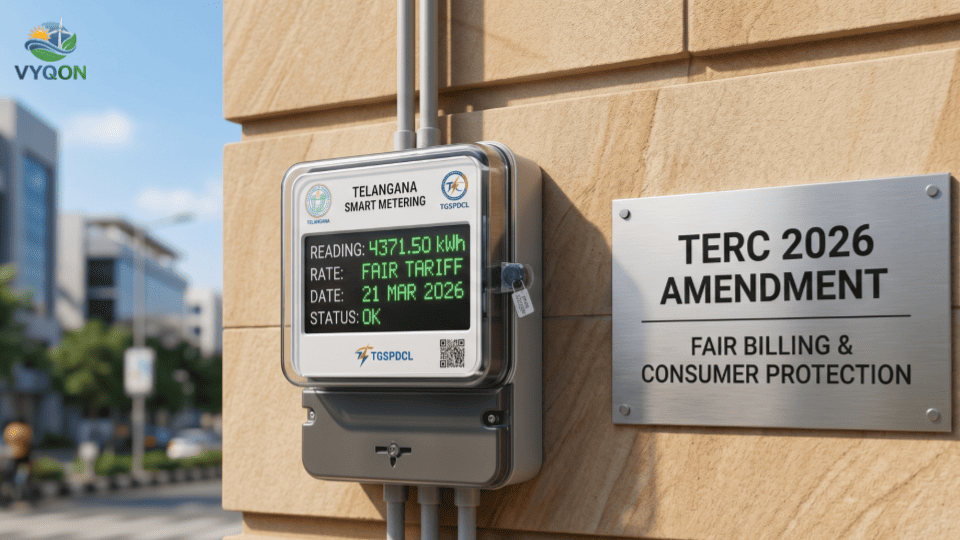
On April 13, 2026, the Telangana Electricity Regulatory Commission (TERC) issued a public notice regarding the “Draft Third Amendment to the Electricity Supply Code Regulation, 2026.” The proposal seeks to modernize the state’s regulatory framework to ensure billing equity and eliminate financial disparities between electricity consumers and the state’s power distribution companies (TGDISCOMs). The primary objective is to standardize the interest rates applied to billing adjustments and payment extensions, ensuring a balanced financial relationship between the utility and the consumer.
Context: Origin and Rationale of the Proposal
The draft amendment originated from a formal proposal submitted by the Southern Power Distribution Company of Telangana (TGSPDCL). It targets the “Principal Regulation” (Regulation No. 5 of 2004), which serves as the foundational code for electricity supply services in Telangana. While this regulation was previously updated in 2006 and 2013 and subsequently adopted by the Commission following the state’s formation in 2014, the utility identified a lingering systemic imbalance.
Currently, a disparity exists between the interest charged on “outstanding bills on grant of installments” and the interest payable to consumers on account of erroneous billing. Under the existing framework, TGDISCOMs recover interest at a rate of 18% per annum when consumers are granted installments for outstanding amounts. However, consumers have historically received significantly lower or no interest when billing errors lead to excess payments. The Commission’s proposal aims to rectify this by establishing a reciprocal financial obligation, ensuring “uniformity and fairness” for both the licensee and the consumer.
Proposed Changes: Technical Breakdown of Clause 4.7.3
The technical core of the draft amendment involves a specific modification to Clause 4.7.3 of the Principal Regulation. The proposed changes establish a strict protocol for resolving billing disputes and compensating consumers:
- Revised Billing Protocol: In instances where a licensee determines that a bill was issued incorrectly, the company is mandated to issue a revised bill to the consumer.
- Revised Payment Window: To ensure the consumer is not penalized for the utility’s error, the corrected bill must include a revised due date. Consumers must be granted a window of at least seven days from the date of receipt of the revised bill to make the payment.
- Interest Rate Parity: To eliminate the identified financial disparity, the licensee must pay interest at a rate of 18% per annum to the consumer on any excess amounts paid due to erroneous billing. This rate is intentionally aligned with the 18% interest currently charged by the utility for late payments and installments.
- Overpayment Recovery: Any excess amounts paid by the consumer must be adjusted by the licensee in future billing cycles until the surplus is fully accounted for.
Next Steps for Stakeholders
The Commission has formally invited feedback, suggestions, and objections from consumers, power utilities, and industry stakeholders. To facilitate an organized review, the public notice requests that submissions follow a specific format, including columns for Serial Number, Clause Number, the existing provision in the draft, and the stakeholder’s specific comments or objections.
The deadline for submitting stakeholder feedback is May 4, 2026. Following the consultation period, the “Third Amendment to the Electricity Supply Code Regulation, 2026” will be finalized. The regulation will become legally effective across the state of Telangana immediately upon its official publication in the state gazette.
Leave a Comment