
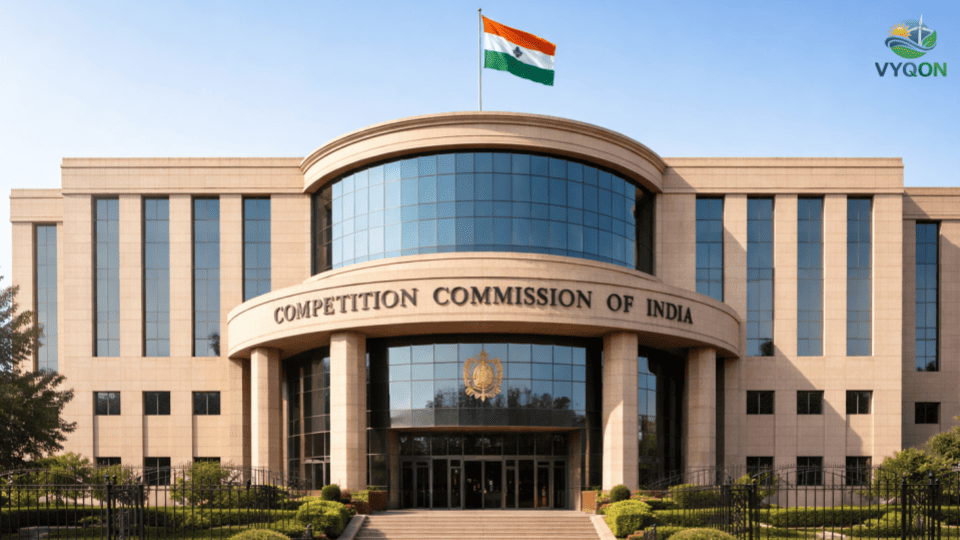
In a decisive ruling that dismantles allegations of systemic market manipulation and corruption, the Competition Commission of India (CCI) has quashed Case No. 36 of 2024 at the preliminary stage. The Commission found no prima facie evidence of contravention of Sections 3 (anti-competitive agreements) and 4 (abuse of dominant position) of the Competition Act, 2002, by the Adani Group or Azure Power. The dismissal, issued under Section 26(2) of the Act by a bench led by Chairperson Ravneet Kaur, signals a landmark clarification for India’s energy sector: that industrial scale and group synergies in large-scale infrastructure projects do not, in themselves, constitute a “sin” against competition law.
Background: The 2019 SECI Solar Tender
The case centered on a Request for Selection (RfS) issued by the Solar Energy Corporation of India (SECI) on June 25, 2019. This high-stakes tender was designed to catalyze India’s domestic manufacturing capability by linking the setup of 7 GW of ISTS-connected solar PV power projects with 2 GW per annum of solar manufacturing capacity.
Demonstrating the complexity of the procurement process, SECI revealed that the tender was floated three times and annulled twice to ensure the design met market requirements and incentive schemes. The tender featured two distinct bidding packages:
- Package A: Solar manufacturing plants for Cells (500 MW) and Modules (500 MW).
- Package B: Manufacturing plants for Ingots (500 MW) and Wafers (500 MW).
With a maximum ceiling price of ₹2.93 per kWh, the e-reverse auction ultimately saw three qualified bidders: Adani Green Energy Four Limited (AGEFL), Azure Power India Private Limited, and Navayuga Engineering. The final discovered tariff was initially recorded at ₹2.92 per kWh.
The Informant’s Allegations
The informant, Ravi Sharma, alleged that the entire tender framework was a pre-arranged sham designed to favor industrial giants at the expense of competition. The key allegations included:
- Tender Favoritism: Claims that SECI structured the RfS specifically to exclude smaller players and ensure a duopoly for the Adani Group and Azure Power India Private Limited.
- Misuse of Clauses: Allegations that the “Green Shoe Option” and “Transferred Capacity” provisions were weaponized to consolidate project capacity within the hands of top players.
- Proxy Bidding and Collusion: The assertion that Azure Power acted merely as a “proxy” for the Adani Group. The informant pointed to Azure’s subsequent surrender of project capacity—specifically 1,799 MW and 700 MW blocks—which were later reallocated to AGEFL as evidence of a pre-planned transfer.
- Market Dominance: Claims that the Adani Group holds a dominant market share (alleged to be between 16% and 40% depending on the definition) used to foreclose competition via infrastructure gatekeeping and cross-subsidization.
- Bribery and Corruption: Citing a US Department of Justice indictment, the informant alleged that bribes were authorized to Indian officials to secure Power Sale Agreements (PSAs) with state utilities (OP-7 to OP-12) to “obtain and retain business.”
The CCI’s Reasoning: Market Dominance and “Relevant Market”
The Commission dismantled the ‘abuse of dominance’ claims by first correcting the informant’s narrow view of the energy sector. The CCI observed that the “relevant market” must be defined as the broader Indian power generation sector, encompassing both renewable and conventional (thermal) sources such as coal, wind, hydro, and nuclear.
In this expansive market, the CCI found the Adani Group is not a dominant player, highlighting a crowded field of formidable public and private competitors, including:
- NTPC Limited
- Power Grid Corporation of India Limited
- Tata Power Limited
- Torrent Power Limited
- Reliance Power Limited
- JSW Energy Limited
- Suzlon Energy Limited
The Commission emphasized that “group synergies”—including access to capital, economies of scale, and supply chain integration—are legitimate business advantages. The ruling clarified that unless exclusionary conduct is proven, such advantages do not constitute an abuse of market position.
The CCI’s Reasoning: Tender Design and Consumer Benefit
In reviewing the RfS, the Commission upheld the sacrosanct right of the procurer (SECI) to determine tender conditions and technical specifications based on its own requirements. The CCI noted that the informant failed to provide “cogent evidence” that the tender was designed with anti-competitive intent.
Crucially, the Commission identified a “smoking gun” that undermined the collusion claims: rather than acting as a static proxy, Azure Power India Private Limited voluntarily reduced its tariff from ₹2.92 per kWh to ₹2.54 per kWh. The CCI noted that this downward revision, subsequently adopted by the CERC, was inherently pro-consumer and competitive, directly contradicting the theory of a pre-arranged, high-tariff bid-rigging conspiracy.
The Commission further clarified that allegations of bribery and corruption fall under the jurisdiction of criminal and anti-corruption laws, remaining outside the ambit of Section 4 of the Competition Act.
Final Case Status
The CCI has ordered the immediate closure of the matter under Section 26(2) of the Competition Act. By dismissing the case at the preliminary stage, the regulator has effectively removed the cloud of regulatory uncertainty that had hung over this specific SECI solar tender and the Electricity Act, 2003 frameworks under which it operates. The ruling affirms that in the race for India’s green energy transition, the pursuit of scale and efficiency through competitive bidding remains a legally sound and encouraged practice.
Leave a Comment