
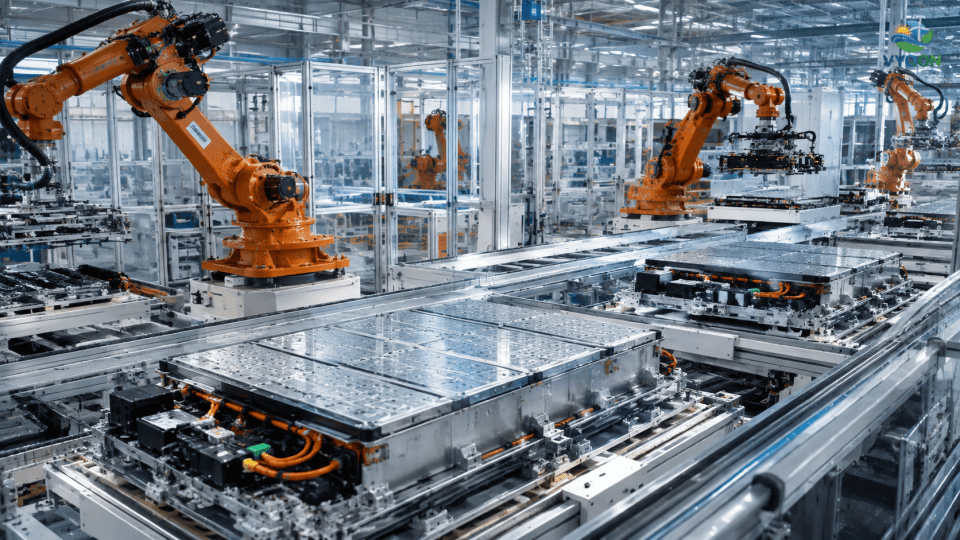
In a move that underscores the rapid acceleration of India’s energy storage sector, Powertrac Group has announced the establishment of a giga-scale 10 GWh automated Battery Energy Storage System (BESS) container production line in Ahmedabad, Gujarat. This expansion targets the burgeoning Commercial and Industrial (C&I) and utility-scale markets, positioning the company as a primary beneficiary of Gujarat’s maturing storage policy landscape. By scaling its capacity tenfold, Powertrac is positioning itself to meet the critical demand for grid stability and renewable energy firming as India pursues its ambitious 2030 national storage targets.
Advanced Manufacturing and Technical Adaptation
The new Ahmedabad facility represents a sophisticated technical evolution for the group, specifically through the porting of high-density assembly techniques originally pioneered for the electric vehicle (EV) sector into stationary storage applications. The production line will feature fully robotic automation and Automated Guided Vehicle (AGV) technology to achieve a 50% increase in production efficiency.
A central pillar of this facility is the implementation of Cell-to-Pack (CTP) and Pack-to-Container (PTC) technologies. By bypassing traditional modular assembly steps, Powertrac addresses the “manufacturing precision” challenge, ensuring consistent quality across large-scale cell volumes. Adapting these EV-grade architectures for stationary containers allows the company to solve space utilization and component complexity issues that have historically hindered utility-scale deployments.
CTP Technology Performance Impact
| Feature | Performance Impact |
| Space Utilization | 15–50% increase in usable volume |
| Parts Reduction | Up to 40% fewer components |
| Energy Density | 10–15% improvement in mass and volume density |
| Manufacturing Time | Significantly reduced assembly steps and 50% increase in production efficiency |
Strategic Context and Infrastructure Maturity
This 10 GWh expansion is a massive scale-up of Powertrac’s existing energy storage foundation. The company previously committed a ₹600 crore (₹6 billion) investment toward a 1 GWh containerized BESS facility. Notably, building construction, power infrastructure, and core utilities for this initial line have already been completed, paving the way for immediate commissioning and the integration of the new giga-scale expansion.
The group’s existing technical capabilities include:
- LFP-based battery pack assembly: Utilizing high-stability Lithium Iron Phosphate chemistry.
- Integrated BMS Development: Proprietary in-house Battery Management System development to ensure safety and longevity.
- Modular Grid-Scale Solutions: Production of 1–5 MWh containerized units designed for seamless grid interaction.
This manufacturing roadmap is directly aligned with Powertrac’s strategic goal of achieving 1,000 MW (1 GW) of operational Independent Power Producer (IPP) capacity by 2030.
Regulatory Synergy: GERC Draft BESS Regulations 2026
Powertrac’s expansion arrives as the Gujarat Electricity Regulatory Commission (GERC) introduces its first dedicated framework for grid-interactive storage. The “GERC Draft BESS Regulations 2026” defines four primary deployment models:
- Model 1: Generation-linked (co-located)
- Model 2: Transmission-linked
- Model 3: Distribution-linked
- Model 4: Standalone
Powertrac’s containerized solutions are strategically positioned for Model 4 (Standalone), which allows the company to engage in multi-use revenue stacking, including energy arbitrage and ancillary services. To participate in these new revenue streams, the standalone BESS must meet minimum connectivity requirements of 1 MW with a 2-hour energy rating at 11 kV or above. Furthermore, all grid-connected assets must register with the Gujarat Energy Development Agency (GEDA) and remain subject to SLDC overriding control during grid contingencies to ensure system security.
Official Statements and Project Roadmap
The company’s leadership has emphasized that the shift toward integrated manufacturing and domestic value addition is critical for the October 2026 market rollout.
“This advanced manufacturing facility is being developed to manufacture high-quality C&I and Utility-Scale BESS Containers. The solution, with a capacity of up to 5 MW, will utilise a production line and raw materials sourced from a reputed technology provider. Our BESS containers will come with the required certifications, ensuring quality and reliability.” — Kishorsinh Zala, Chairman
“We are shifting focus to developing a BESS facility with a focus on LFP-based battery pack assembly and in-house BMS development and integration. Building construction, power infrastructure, and core utilities… have already been completed, paving the way for commissioning.” — Divyarajsinh Zala, Managing Director
The finalized BESS container solutions are projected to be commercially available by October 2026.
Closed-Loop Ecosystem: Renewable Portfolio Integration
The BESS expansion serves as the storage backbone for Powertrac’s broader “Solar-plus-BESS” hybrid focus. The company recently secured over 600 acres of land to support approximately 480 MW of distributed solar projects across Gujarat. This generation base provides a stable “charging infrastructure” for the company’s storage pipeline.
The solar assets are distributed across several key districts as part of the RE Feeder-Level Solarisation (FLS) projects:
- Kutch: 168 MW
- Surendranagar: 159 MW
- Bhavnagar: 86 MW
- Botad: 36 MW
- Junagadh: 6 MW
- UGVCL / DGVCL regions: 24 MW
Operating under Power Purchase Agreements (PPAs) with a tariff of ₹2.76/kWh, these projects represent a competitive state-level benchmark. By integrating high-capacity manufacturing with these distributed assets, Powertrac is establishing a closed-loop energy ecosystem capable of delivering dispatchable, reliable green power to the Gujarat grid.
Sources
- Gujarat Electricity Regulatory Commission (GERC)
- Document: Draft GERC (Grid Interactive Battery Energy Storage System) Regulations, 2026
- Publication Date: 12 May 2026
- Authority: Published by GERC, Gandhinagar, under Sections 181, 61, 66, and 86 of the Electricity Act, 2003.
- Official Portal: gercin.org
- Ministry of Heavy Industries, Government of India
- Document: Lok Sabha Unstarred Question No. 458: PLI Scheme for Automobile and Auto Components and Battery Storage
- Answer Date: 21 July 2026
- Authority: Answered by the Minister of State for Heavy Industries (Shri Bhupathiraju Srinivasa Varma), Lok Sabha.
- Official Portal: loksabha.nic.in / heavyindustries.gov.in
Leave a Comment