
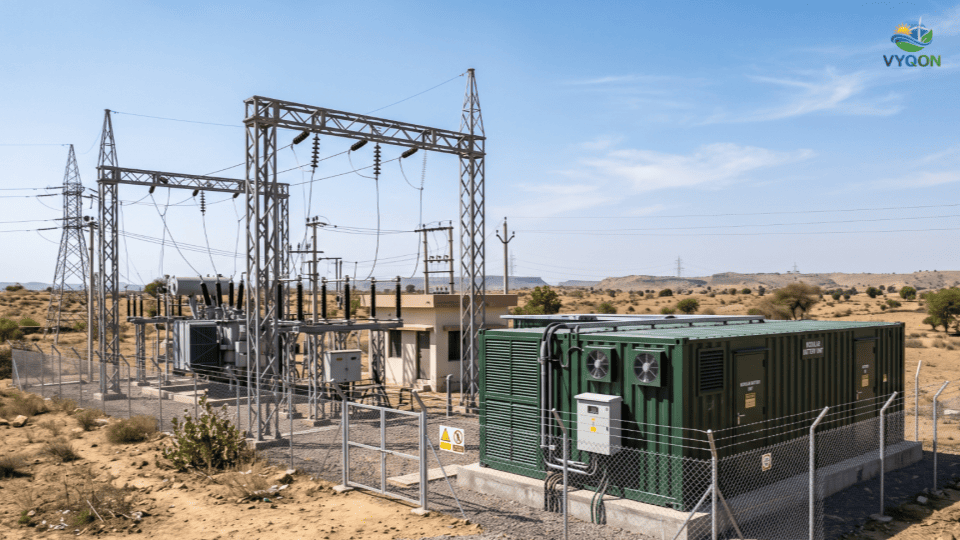
Seeking to mitigate escalating grid curtailment challenges currently impacting solar assets in the state, Jaipur Vidyut Vitran Nigam Limited (JVVNL) has issued a tender for a decentralized 2 MW / 4 MWh Battery Energy Storage System (BESS) pilot project. Implemented under the CAPEX model, this initiative focuses on deployment at the Distribution Transformer (DTR) level to enhance local grid stability across the Jaipur Discom. Interested developers must submit their bids by the final deadline of September 15, 2026.
Tender Overview and Key Dates
This procurement, issued under NIT No. JVVNL/SE(KUSUM)/XEN(RE-DSM)/TN-BESS-02, follows a single-stage, two-part bidding process consisting of technical and financial evaluations.
| Event | Date & Time |
| Tender Document Availability | August 14, 2026, 6:00 PM |
| Pre-Bid Meeting | August 21, 2026, 3:00 PM (Vidyut Bhawan, Jaipur) |
| Online Bid Submission Start | September 1, 2026, 3:00 PM |
| Bid Submission & Fee Deadline | September 15, 2026, 5:00 PM |
| Technical Bid Opening | September 17, 2026, 3:00 PM |
Project Configuration and Technical Specifications
The pilot project is designed as a proof-of-concept for decentralized storage, aiming to provide JVVNL with empirical data on the operational benefits of storage at the edge of the distribution network.
- Total Capacity: 2 MW / 4 MWh.
- Unit Configuration: The project comprises 20 small-scale standalone units.
- Individual Unit Capacity: 100 kW / 200 kWh per unit.
- Deployment Level: Installation will occur at the Distribution Transformer (DTR) level within the Jaipur Discom jurisdiction.
- Strategic Objective: To provide grid support and assess the efficacy of distributed storage in managing peak loads and renewable energy integration.
Financial Obligations and Eligibility
Bidders must adhere to the following financial parameters. Notably, all tender-related fees are mandatory and must be settled via RTGS/NEFT.
- Estimated Project Cost: Approximately Rs 6 crore.
- Tender Document Fee: Rs 10,000 + 18% GST (Non-refundable, payable via RTGS/NEFT).
- E-procurement Processing Fee: Rs 2,950 inclusive of 18% GST (Payable via RTGS/NEFT).
- Earnest Money Deposit (EMD): 2% of the estimated cost, calculated at a rate of Rs 300 per kWh of quoted capacity.
- Accepted EMD Formats: Physical Bank Guarantee, Insurance Surety Bond, or Payment on Order Instrument via RTGS/NEFT.
Scope of Work and Contractual Terms
The selected developer will manage the entire project lifecycle, with the tender envisaging a long-term infrastructure commitment through 12-year developer contracts.
- Service Scope: Comprehensive responsibilities including site survey, planning, design, engineering, transportation, supply, testing, installation, integration, and commissioning.
- Hardware and Balance of System (BOS): Requirements include battery packs, power-conditioning systems (PCS), containers, structures, earthing, battery interconnections, air-conditioning, fire-fighting systems, UPS, sensors, and associated monitoring, control, and safety systems.
- Maintenance: The contract includes a five-year Comprehensive Annual Maintenance Contract (CAMC) to ensure peak operational reliability.
Market Context: Grid Stability and BESS Trends
The JVVNL tender reflects broader shifts in the Indian energy landscape as identified by recent ICRA analysis. Rajasthan has increasingly reported grid curtailments for solar assets during peak generation blocks due to stability requirements, making storage an operational imperative rather than a luxury.
- Cost Dynamics and Viability: The cost of BESS has plummeted from Rs 10.84 lakh/MW/month in 2022 to under Rs 2.0 lakh/MW/month today, bolstered by Viability Gap Funding (VGF). Currently, the levelized cost of BESS for 2-4 hour storage is estimated at Rs 4.0–7.0 per unit.
- Competitive Landscape: While Pumped Storage Hydropower (PSP) remains slightly more cost-effective for longer durations at approximately Rs 5.0 per unit, BESS is increasingly favored for pilots and rapid deployment due to its significantly lower execution risk and shorter gestation periods compared to large-scale hydro projects.
- National Trajectory: To support the transition to non-fossil energy targets, India is projected to require 50 GW of energy storage capacity by 2030, specifically focusing on systems with a 5-6 hour storage duration. This JVVNL pilot serves as a localized precursor to this massive national infrastructure requirement.
Official Regulatory & Government Sources
- Rajasthan Electricity Regulatory Commission (RERC) — Official Orders Access official petitions, regulatory orders, and tariff determinations: RERC Jaipur Government of Rajasthan Orders
- Rajasthan Electricity Regulatory Commission (RERC) — Official Regulations Access state-level power, battery storage, and renewable purchase obligation frameworks: RERC Jaipur Government of Rajasthan Regulations
- Jaipur Vidyut Vitran Nigam Limited (JVVNL) — Official Portal The official homepage of the state-owned distribution utility issuing the tender: Jaipur Discom (JVVNL) Portal
- Government of Rajasthan e-Procurement Portal — Official Tender Page The official portal to download JVVNL tender documents, submit bids, and track NIT status: Rajasthan Government e-Procurement Portal — JVVNL Tender Link
Leave a Comment