
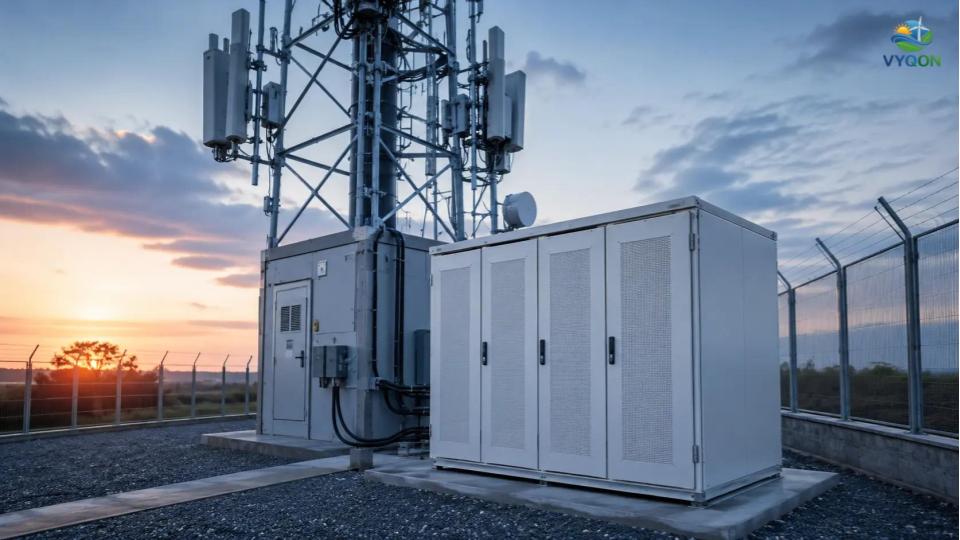
Hyderabad-based energy storage manufacturer Cygni Energy Private Limited and telecom infrastructure major Indus Towers Limited have signed a Memorandum of Understanding (MoU) to explore collaboration on sourcing energy storage solutions for India’s telecom networks. Announced on October 5, 2026, the proposed partnership includes plans to establish battery energy storage system (BESS) manufacturing capacity of up to 1.5 GWh for the evolving energy needs of telecom infrastructure.
The agreement brings together one of the world’s largest passive telecom infrastructure companies and an IIT Madras-incubated battery maker at a time when tower operators are moving away from diesel generators and lead-acid batteries towards lithium-ion storage and solar power.
What the MoU Covers
The proposed collaboration has two components:
- Dedicated manufacturing: BESS manufacturing capacity of up to 1.5 GWh, focused specifically on telecom infrastructure in India.
- Technology evaluation: A joint assessment of advanced battery technologies for telecom applications, aimed at enhancing reliability, improving energy efficiency and enabling more sustainable operations.
The agreement is exploratory in nature. The companies have not yet disclosed an investment figure, timeline or plant location.
Cygni’s Roadmap for Telecom Storage
Cygni Energy Founder and CEO Venkat Rajaraman said the initiative “goes beyond supplying batteries.” He described it as building the scale, technology capabilities and manufacturing readiness needed to support one of the world’s largest passive telecom infrastructure companies. Cygni plans to develop capacity of up to 2 GWh while evolving its portfolio from today’s 100Ah solutions to higher-capacity 314Ah systems and emerging battery technologies. Its stated ambition is to combine scale, reliability and Indian engineering in storage that grows alongside India’s digital infrastructure.
Prof. Ashok Jhunjhunwala, Institute Professor at IIT Madras and Chairman of the ITEL Foundation, noted that collaboration between users, startups, manufacturers and technology institutions can support the development and adoption of energy storage in India. He added that telecom is an important application for advancing battery technologies and manufacturing capabilities.
Indus Towers: The Scale of the Opportunity
Indus Towers’ network size shows how large the telecom storage market can be. Its audited results for Q1 FY27 (April–June 2026) report:
| Metric (as of June 30, 2026) | Value | Y-o-Y change |
| Macro towers | 267,611 | +6.3% |
| Co-locations | 432,250 | +5.1% |
| Sharing factor | 1.62 | — |
| Consolidated revenue (quarter) | ₹8,431 crore | +4.6% |
Source: Indus Towers Q1 FY27 media release
The company operates in all 22 telecom circles and describes itself as an industry pioneer in adopting green energy initiatives. MD and CEO Prachur Sah said investments in energy management are strengthening operational agility, while noting that the quarter saw supply chain disruptions arising from geopolitical developments.
Every tower site needs battery backup to keep networks running through grid outages. Even at modest capacity per site, aggregate demand across more than 2.6 lakh towers is substantial.
Energy Transition at Tower Sites
Management commentary on Indus Towers’ Q1 FY27 earnings call shows how quickly tower energy systems are changing. Diesel consumption fell 13% year-on-year despite growing network load, supported by digital energy management, solar deployments and lithium-ion battery installations. About 3,700 sites gained solar access during the quarter, taking the total to roughly 46,000 sites and the installed solar base to 259 MW.
Lithium-ion batteries cost more upfront than lead-acid, but their longer life lowers total cost of ownership. With the transition running across a portfolio of this size, and with the supply disruptions the company flagged, a reliable domestic source of telecom-grade storage has clear strategic value.
About Cygni Energy
Incubated at IIT Madras, Cygni designs and manufactures energy storage products ranging from 1 kWh units to multi-MWh containerised BESS. It serves e-mobility, residential, commercial and industrial, telecom and banking, data centre and utility-scale applications.
Its gigafactory at the Electronics Manufacturing Cluster in Maheshwaram, Hyderabad, is a 4.8 GWh rated cell-to-container facility. The line is chemistry-agnostic, handling cells of varying sizes, and is IATF certified with a Manufacturing Execution System and end-to-end traceability. At the plant’s inauguration in April 2025, Cygni announced plans to expand capacity to 10.8 GWh within the same facility by 2027.
For telecom, Cygni offers its VoltEdge LiX lithium-ion series for 3G/4G/5G, fixed-line and datacom applications. The company rates it for more than 3,000 charge cycles and a 10–15 year life, with up to four times faster recharge than VRLA-based systems.
Why It Matters
- Anchor demand for local manufacturing: Telecom offers large, steady and predictable battery demand that can justify dedicated domestic production lines.
- A broader sourcing strategy: A week earlier, Indus Towers signed a separate MoU with Replus Engitech covering 1.5 GWh of dedicated BESS production capacity over two years, signalling a deliberate push to build multiple domestic supply partners.
- Supply-chain resilience: Local sourcing reduces exposure to import disruptions of the kind Indus Towers faced this year.
- Lower diesel use and operating costs: Higher-capacity lithium-ion storage paired with on-site solar cuts generator runtime, fuel spending and emissions at tower sites.
- Ready for 5G and new chemistries: The planned move from 100Ah to 314Ah systems, and the joint technology evaluation, position the partnership for denser networks and next-generation batteries.
Outlook
The Cygni–Indus Towers MoU remains at an exploratory stage, with commercial terms still to be announced. Its direction is nonetheless clear: India’s telecom backbone is emerging as a major market for domestically manufactured energy storage. If the proposed 1.5 GWh capacity materialises, it would deepen India’s battery manufacturing base and help telecom networks shift towards cleaner, more reliable power.
References
- Indus Towers – Media Release, Q1 FY27 Results (NSE filing, July 27, 2026)
- Indus Towers – Official Website (investor materials and earnings call transcripts)
- Cygni Energy – Official Website
- Cygni Energy – Gigafactory
- Cygni Energy – Telecom & Banking Solutions
- Business Standard – Cygni Energy signs MoU with Indus Towers (linked from Cygni’s official website)
- UNI India – Cygni Energy, Indus Towers sign MoU (wire release, October 5, 2026)
- BioEnergy Times – Full press release text with quotes
Leave a Comment