
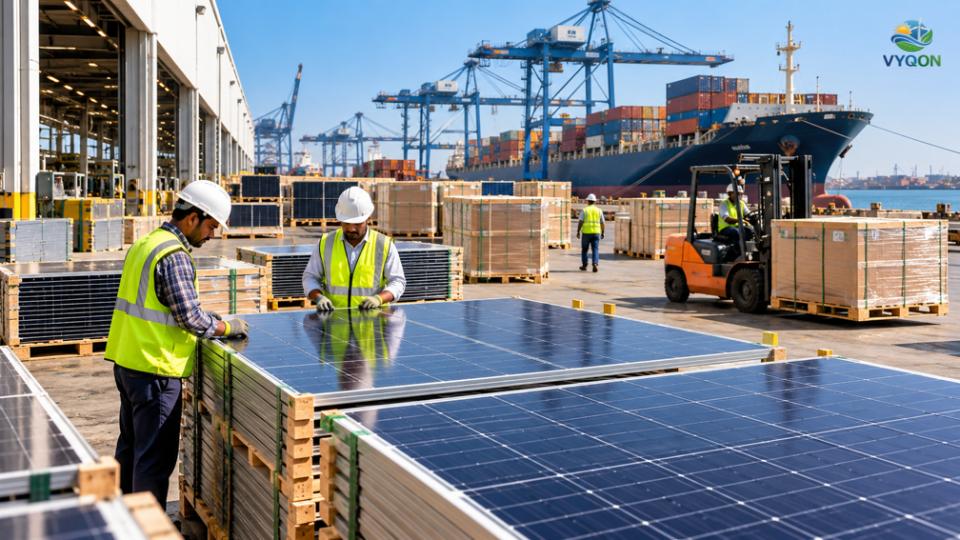
The Ministry of New and Renewable Energy is facilitating discussions with India Exim Bank to support solar and wind equipment exporters in diversifying beyond the United States, with Europe, Africa and Latin America emerging as potential markets.
India’s Ministry of New and Renewable Energy (MNRE) is facilitating discussions between domestic renewable energy equipment manufacturers and the Export-Import Bank of India (India Exim Bank) to explore financing opportunities that could help Indian solar and wind companies expand into international markets.
The initiative comes as Indian solar manufacturers face growing trade uncertainty in the United States, which accounts for approximately 97% of India’s solar module exports, according to estimates cited by Financial Express.
In a report published on 10 October 2026, MNRE Secretary Santosh Kumar Sarangi confirmed that renewable energy exporters are engaging with India Exim Bank to evaluate available export-financing instruments, including Lines of Credit and Buyer’s Credit.
The discussions aim to support Indian manufacturers in exploring alternative markets across Europe, Africa and Latin America, while reducing dependence on a single export destination.
However, the initiative remains at the consultation stage. No dedicated solar-export financing scheme, new credit allocation or confirmed overseas supply agreement has been announced through these discussions.
India’s Solar Exports Face Growing Pressure from US Trade Measures
The United States has emerged as the largest overseas destination for Indian solar photovoltaic modules, making domestic manufacturers particularly sensitive to changes in American trade policy.
According to Alekhya Datta, Director of the Electricity and Renewables Division at The Energy and Resources Institute (TERI), India’s solar module exports were valued at approximately US$1.05 billion during FY 2025–26, of which around US$1.02 billion went to the United States.
This represents approximately 97% of total solar module export value, highlighting the concentration of India’s overseas solar market.
The reported figures also indicate that India’s solar module exports declined by 6.19% in value, compared with approximately US$1.12 billion in FY 2024–25. Export value to the United States fell by around 6.42%, although shipment volumes declined much less sharply.
These changes suggest that international module prices, product mix and commercial conditions have influenced export performance. The reduction cannot be attributed entirely to trade investigations.
The situation became more challenging following the US Department of Commerce’s final affirmative antidumping and countervailing-duty determinations on 11 September 2026, covering crystalline silicon photovoltaic cells from India, including cells assembled into modules.
The department reported a 123.04% weighted-average dumping margin and a 126.09% countervailing subsidy rate for the relevant Indian producer and exporter categories.
The adjusted antidumping cash-deposit rate was listed at 107.17%, reflecting the applicable subsidy-offset adjustment.
These percentages represent distinct findings under US trade-remedy procedures and should not simply be added together or interpreted as a uniform final duty applicable to every Indian solar product.
The US International Trade Commission is conducting a separate injury determination process, which is relevant to the final outcome of the trade proceedings.
For Indian solar manufacturers, higher trade barriers can increase the delivered cost of modules, potentially affecting competitiveness, profit margins and future export orders.
The developments underline the importance of expanding overseas market access while maintaining competitive manufacturing costs.
India Exim Bank Could Support Export Diversification
India Exim Bank already offers financial instruments designed to support Indian exporters entering international markets.
Among these are Lines of Credit (LOCs), which provide financing to eligible overseas governments, financial institutions and other organisations for purchasing Indian goods, equipment and services.
Another important mechanism is Buyer’s Credit, which can finance eligible overseas buyers and support Indian exporters participating in international projects.
These facilities can be particularly relevant for renewable energy infrastructure because solar and wind projects often involve substantial initial investment and long-term financing arrangements.
For example, an overseas solar project developer seeking to purchase Indian photovoltaic modules may require financing to support equipment procurement. An eligible export-financing arrangement could help facilitate the transaction, subject to the applicable programme conditions.
Such mechanisms may improve access to prospective buyers who are interested in Indian renewable energy equipment but face financing constraints.
However, financing alone cannot guarantee export competitiveness. Manufacturers must also consider module prices, shipping costs, product certification, warranty commitments, currency exposure and the financial strength of overseas customers.
MNRE’s role in the current initiative is primarily to facilitate engagement between renewable energy exporters and India Exim Bank to identify suitable financial arrangements.
The discussions should therefore be viewed as an exploration of existing export-financing opportunities rather than confirmation of a newly sanctioned government subsidy or dedicated lending programme.
Europe, Africa and Latin America Offer Potential Opportunities
As Indian solar manufacturers seek to reduce dependence on the United States, alternative export destinations are attracting greater attention.
Europe, Africa and Latin America represent geographically diverse renewable energy markets, each with different procurement requirements, regulatory frameworks and financing conditions.
European markets typically place considerable emphasis on technical compliance, product certification, performance warranties and supply-chain documentation.
For Indian manufacturers, successful entry may require demonstrating consistent quality, reliable module performance and compliance with applicable technical and environmental standards.
Several African countries are pursuing renewable energy development to expand electricity access and improve energy infrastructure. Export-financing mechanisms may help eligible buyers procure equipment and services for such projects.
Latin American markets also offer opportunities in utility-scale solar development and distributed renewable energy applications, although commercial conditions vary between countries.
India Exim Bank has previously supported international project exports and renewable energy-related infrastructure, demonstrating the potential role of financial institutions in facilitating overseas business.
Nevertheless, entering these markets will require more than identifying potential demand. Indian manufacturers must establish reliable distribution arrangements, competitive prices, appropriate product certification and dependable after-sales support.
Actual export growth will depend on confirmed orders, financing agreements and successful commercial delivery.
Implications for India’s Solar Manufacturing Industry
India’s domestic solar manufacturing industry has expanded significantly through investment in photovoltaic module and cell production facilities.
The growing manufacturing base creates opportunities to serve both domestic renewable energy demand and international markets.
However, manufacturing capacity does not automatically translate into production or confirmed sales.
Factory utilisation, cell and module pricing, equipment efficiency, quality control and reliable supply agreements all influence manufacturers’ commercial performance.
A decline in demand from a major export destination could encourage manufacturers to redirect part of their production towards India’s domestic solar market.
While this may provide additional procurement options for developers, increased domestic supply could also intensify competition and influence module pricing.
Export diversification could help manufacturers distribute commercial risk across different markets rather than relying heavily on one destination.
At the same time, expanding into new markets may require modifications to product specifications, certification processes, logistics arrangements and customer-support services.
Manufacturers will therefore need to align export strategies with technological capabilities, production economics and market-specific requirements.
Government facilitation and export finance may support these efforts, but sustained international competitiveness will ultimately depend on product quality, pricing and reliable commercial performance.
Conclusion
MNRE’s engagement with India Exim Bank represents an early initiative to help Indian solar and wind equipment manufacturers explore international export opportunities amid changing global trade conditions.
With approximately 97% of India’s solar module export value directed towards the United States in FY 2025–26, diversification has become an important consideration for the domestic manufacturing industry.
Existing financing instruments, including Lines of Credit and Buyer’s Credit, could potentially support eligible overseas transactions and help manufacturers access customers in Europe, Africa and Latin America.
However, no dedicated new financing allocation or confirmed export agreement has been announced under the current discussions.
The next important developments will be the identification of suitable financing arrangements, establishment of overseas commercial partnerships and confirmation of actual export orders.
For India’s expanding solar manufacturing sector, long-term competitiveness will depend not only on increasing production capacity but also on building diversified, financially sustainable and reliable international markets.
Reference
U.S. Department of Commerce – Official Solar Antidumping and Countervailing Determinations
India Exim Bank – Official Lines of Credit
India Exim Bank – Official Buyer’s Credit.
India Exim Bank 2024–25 annual report
Bank-origin documentation describing existing export-finance and overseas-credit programmes; it does not announce a new solar-only facility.-https://www.eximbankindia.in/sites/default/files/2025-07/Exim-Bank_AR%202024-25-%28English%29.pdf
Leave a Comment