
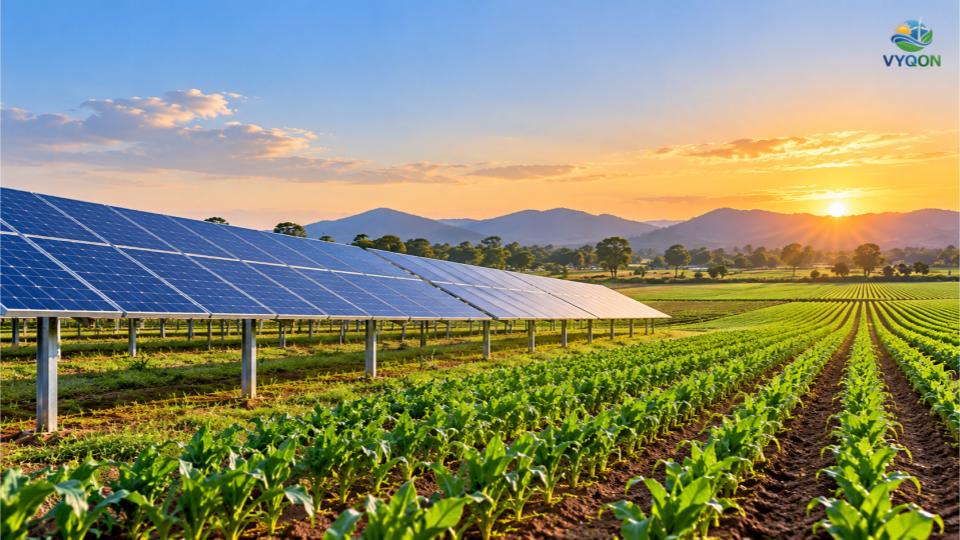
The Gujarat government is reportedly examining measures to limit solar installations on productive agricultural land, highlighting the need to balance renewable energy expansion with farming and food security. No new statewide prohibition has been formally confirmed.
Gandhinagar, 20 October 2026: The Gujarat government is reportedly considering a policy to restrict the installation of solar photovoltaic panels on fertile agricultural land, as concerns grow over the conversion of productive farmland for renewable energy projects. The proposal reflects an emerging challenge in India’s energy transition: expanding solar power capacity while protecting agricultural resources that support food production and rural livelihoods.
According to a report published by The Times of India on 20 October 2026, the state government is examining possible restrictions intended to discourage the use of fertile agricultural land for conventional solar installations. The reported initiative seeks to preserve valuable farmland while allowing renewable energy development to continue in suitable locations.
However, the discussions remain at the reported policy-consideration stage. No new Gujarat government notification establishing a blanket prohibition on solar installations across fertile farmland has been identified. The proposed restrictions should therefore not be interpreted as an already implemented statewide ban or as confirmation that existing solar projects have been cancelled.
Gujarat’s Solar Expansion Raises Agricultural Land-Use Questions
Gujarat has established itself as a major renewable energy development centre, supported by solar and wind resources, industrial electricity demand and expanding transmission infrastructure. Continued investment in renewable electricity is an important component of the state’s long-term energy strategy.
However, large ground-mounted solar photovoltaic projects require suitable land for solar modules, mounting structures, inverter stations, substations, internal roads and associated electrical infrastructure. As development activity expands, competition can arise between electricity generation, agriculture and other land uses.
Fertile agricultural land represents a particularly important resource because its value extends beyond the immediate income generated from cultivation. Productive farmland supports agricultural employment, food supply chains, irrigation infrastructure and related rural economic activities.
The reported policy discussion indicates that Gujarat may place greater emphasis on distinguishing productive agricultural land from less agriculturally valuable sites when considering future solar development.
Such a distinction could influence project planning, particularly in areas where agricultural productivity is high and landowners are considering long-term leasing arrangements with renewable energy developers.
Nevertheless, the precise scope of any future restrictions remains unclear. The state has not publicly established, through a newly identified notification, which agricultural land categories would be covered, what exemptions might apply or how projects already under development would be treated.
Existing Gujarat Renewable Energy Policy and the Proposed Restrictions
The reported proposal should be considered alongside the Gujarat Integrated Renewable Energy Policy 2025, which was notified by the state’s Energy and Petrochemicals Department on 24 December 2025.
The existing policy provides a framework for renewable energy development and supports the deployment of multiple technologies, including ground-mounted solar, rooftop solar, floating solar, wind, hybrid projects and battery energy storage systems.
Importantly, the policy also recognises agrivoltaics, an approach that allows agricultural activities and photovoltaic electricity generation to coexist on the same land.
The policy identifies agrivoltaics and other innovative renewable energy technologies as opportunities for expanding clean electricity generation while improving the productive use of available land.
This existing support for dual-use solar development is relevant to the latest discussion. A possible restriction on conventional solar installations occupying fertile agricultural land would not necessarily mean that all solar-related activities on farmland would be prohibited.
A future policy could potentially distinguish between installations that displace cultivation and systems designed to preserve agricultural operations. However, any such distinction would need to be established through official government documentation.
Until further clarification is issued, stakeholders should continue to distinguish the state’s existing renewable energy framework from the additional restrictions currently being discussed.
Implications for Solar Developers and Project Investment
Any future restrictions on the use of fertile agricultural land could have implications for solar project developers, engineering companies, infrastructure investors and landowners.
Land availability is one of the earliest and most important considerations in utility-scale solar project development. Developers assess several factors when selecting suitable sites, including solar irradiation, topography, land ownership, construction accessibility, environmental conditions and proximity to transmission infrastructure.
Restrictions based on agricultural land classification could introduce additional considerations into this process. Developers may need to establish whether proposed project locations fall within protected agricultural categories or require specific approvals before proceeding.
Such requirements could influence land-acquisition schedules, project financing, construction planning and the timing of electricity supply commitments.
For financial institutions, secure land rights and regulatory certainty are important because utility-scale solar assets are generally developed for long operating periods. Uncertainty regarding permissible land use can influence project risk assessments and investment decisions.
However, the proposed restrictions have not yet been finalised, and it would be premature to assume that they will impose particular approval procedures, financial penalties or development limitations.
The eventual impact on the solar industry will depend on the final policy language, its implementation framework and the treatment of projects that have already obtained relevant permissions.
Agrivoltaics Could Offer an Alternative Development Model
Agrivoltaics may offer one possible approach to balancing solar electricity generation with the continued use of agricultural land.
Unlike conventional ground-mounted photovoltaic systems, agrivoltaic installations are designed to maintain agricultural production beneath or between solar panels. This may involve elevated mounting structures, wider spacing between photovoltaic rows or other engineering arrangements suited to farming activities.
The technology could allow landowners to continue cultivating crops while participating in renewable electricity generation, depending on the commercial arrangements and technical characteristics of individual projects.
Nevertheless, agrivoltaic development introduces additional engineering and economic considerations.
Elevated structures may require more construction material, stronger foundations and designs that accommodate agricultural equipment. Photovoltaic layouts must also consider the amount of sunlight reaching crops, irrigation requirements, machinery movement and worker safety.
Agricultural performance can vary according to crop type, climate, soil conditions and the degree of shading created by solar installations. Consequently, dual-use arrangements must be assessed through site-specific research rather than assuming that all crops will benefit from photovoltaic shading.
Gujarat’s existing renewable energy policy provides a foundation for considering such systems. However, no specific exemption for agrivoltaics under the newly reported farmland restrictions has yet been confirmed.
Any future regulatory framework would need to explain whether qualifying agrivoltaic projects are treated differently from conventional ground-mounted solar installations.
Alternative Locations for Renewable Energy Development
Greater emphasis on protecting fertile agricultural land could encourage solar developers to examine alternative locations for future projects.
Industrial premises, commercial rooftops, unused or degraded land, reservoirs and other technically suitable areas may provide opportunities for photovoltaic development without directly displacing productive farming.
Rooftop solar installations can use existing building surfaces, while floating solar systems can utilise suitable water bodies. Projects developed on industrial or previously disturbed land may also reduce competition with agricultural activities.
However, these alternatives have their own technical and commercial limitations.
Rooftop installations require suitable structural capacity and appropriate electrical connections. Floating solar projects involve specialised anchoring systems, environmental assessments and arrangements for managing changing water levels.
Less productive land may be located farther from major substations or transmission networks, potentially increasing electricity evacuation costs. Some sites may also require additional road access, land preparation or engineering work.
As a result, shifting solar development away from fertile farmland requires coordinated planning rather than simply identifying land that is not currently being cultivated.
The availability of suitable electricity infrastructure, project economics and applicable land-use requirements will remain important in determining whether alternative sites can support commercially viable renewable energy projects.
Policy Clarity Will Be Important for Farmers and Investors
The reported discussion raises questions that will need to be addressed before any additional restrictions can be implemented effectively.
A future policy would require clear definitions of fertile agricultural land and transparent criteria for determining whether a particular site is eligible for conventional solar development.
It would also need to clarify how existing land-use agreements, previously approved projects and installations already under construction would be treated.
For farmers, such clarification would be important when evaluating long-term land leasing, agricultural income and participation in renewable energy development.
For project developers and investors, clearly defined approval procedures could help reduce uncertainty and support more reliable investment decisions.
Coordination between the agriculture, revenue and energy departments would also be important because solar development involves both electricity infrastructure and land administration.
These considerations are potential policy-design requirements rather than confirmed provisions of a new Gujarat government regulation.
The next significant development will be the publication of an official government resolution, consultation paper or notification explaining the proposed restrictions and their implementation.
Conclusion
Gujarat’s reported consideration of restrictions on solar installations over fertile agricultural land highlights an increasingly important challenge in renewable energy development: balancing clean electricity expansion with the protection of productive farmland.
The proposal could encourage greater attention to land classification, site suitability and alternative solar deployment models, including agrivoltaics.
However, the latest development remains a reported policy discussion, not a formally notified statewide prohibition. Its implications for farmers, landowners, developers and investors will depend on the specific provisions adopted by the Gujarat government.
As the state continues expanding renewable energy infrastructure, a clear and balanced approach to land-use planning could help protect agricultural productivity while supporting sustainable solar development.
Sources and References
1. Ministry of New and Renewable Energy — Official Government Source
Policy and Regulatory Updates, December 2025 — Gujarat Integrated Renewable Energy Policy 2025.
Government reference describing Gujarat’s existing renewable energy framework, including support for emerging renewable technologies and agrivoltaics.
2. Gujarat Electricity Regulatory Commission — Official Regulatory Source
Petition No. 2630 of 2026.
Official regulatory documentation referencing the Gujarat Integrated Renewable Energy Policy 2025, notified on 24 December 2025.
https://gercin.org/wp-content/uploads/2026/04/Petition-No.-2630-of-2026.pdf
Leave a Comment