
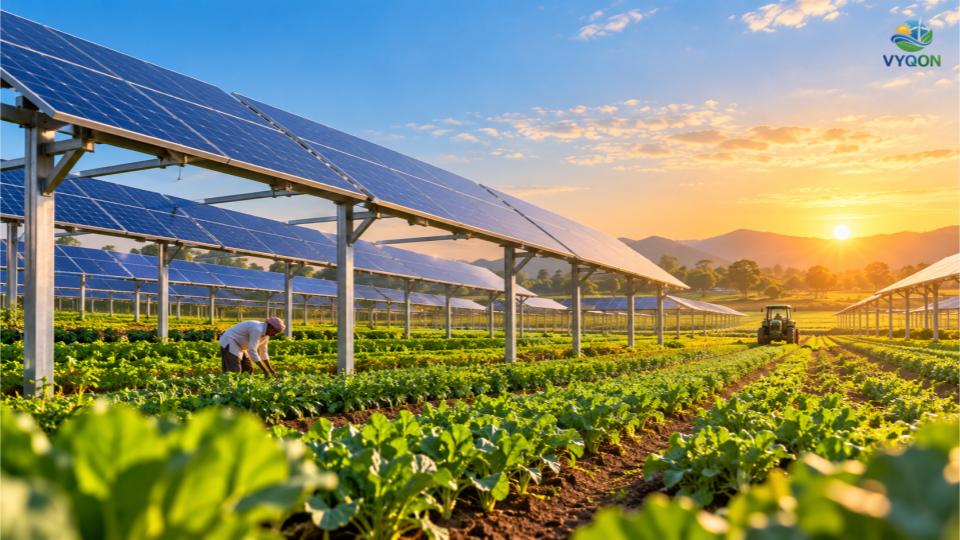
The Ministry of New and Renewable Energy is reportedly examining financial support mechanisms for agrivoltaic projects, potentially through PM-KUSUM or a separate programme, as India seeks to expand solar capacity while protecting agricultural productivity.
New Delhi, 20 October 2026: India is considering financial incentives to promote agrivoltaics, an emerging approach that combines solar photovoltaic electricity generation with agricultural cultivation on the same land. The proposed initiative could help address growing concerns over land availability for renewable energy projects while creating opportunities for farmers to diversify their income without abandoning agricultural activities.
According to a report published by The Indian Express on 19 October 2026, the Ministry of New and Renewable Energy (MNRE) is discussing possible financial support mechanisms with the Ministry of Finance. MNRE Secretary Santosh Kumar Sarangi indicated that the government is examining whether incentives could be introduced through the existing Pradhan Mantri Kisan Urja Suraksha evam Utthaan Mahabhiyan (PM-KUSUM) framework or through a separate centrally supported programme encouraging states to adopt agrivoltaic systems.
The reported discussions follow an earlier government announcement in September 2026, when Union Minister for New and Renewable Energy Pralhad Joshi stated that the next phase of PM-KUSUM would include a dedicated agrivoltaics component. However, a new agrivoltaics-specific financial incentive scheme, including its subsidy amounts, eligibility conditions and application procedures, has not yet been formally notified.
Government Examines Financial Support for Dual-Use Agricultural Land
Agrivoltaics involves installing solar photovoltaic modules in configurations that allow agricultural activities to continue beneath or between solar arrays. Unlike conventional ground-mounted solar projects, which primarily utilise land for electricity production, agrivoltaic installations are designed to accommodate both renewable energy generation and farming.
The approach is becoming increasingly relevant as India’s renewable energy sector expands and access to suitable land remains a major consideration for large-scale solar development. Agricultural land supports food production and rural livelihoods, making it important to examine technologies that can increase renewable electricity generation without unnecessarily displacing cultivation.
The proposed financial incentives are intended to address some of the economic challenges associated with agrivoltaic installations. These projects may require elevated module mounting structures, additional structural reinforcement, wider spacing between panel rows and customised layouts that allow farm machinery and workers to operate safely.
Such arrangements can increase project development costs compared with conventional solar installations. Financial assistance could potentially improve commercial viability, encourage investment and make dual-use solar projects more accessible to farmers, cooperatives and renewable energy developers.
However, any new financial support mechanism will require a clearly defined policy framework. The government would need to establish eligibility criteria, funding arrangements, technical requirements, implementation responsibilities and monitoring standards before incentives could become operational.
PM-KUSUM Could Provide a Foundation for Agrivoltaic Expansion
The ongoing discussions are closely connected with India’s existing efforts to integrate renewable energy into agriculture through PM-KUSUM. The programme supports decentralised solar electricity generation, standalone agricultural solar pumps and the solarisation of grid-connected irrigation systems.
Under the existing framework, Component A supports decentralised renewable energy plants, including eligible ground-mounted and stilt-mounted installations. Component B focuses on standalone solar agricultural pumps, while Component C supports the solarisation of grid-connected pumps and agricultural feeders.
Agrivoltaics could build upon this framework by encouraging installations that maintain agricultural production while generating solar electricity. Such an approach would place greater emphasis on the productive use of land rather than treating electricity generation and farming as competing activities.
During a government event on 9 September 2026, Union Minister Pralhad Joshi outlined the potential role of agrivoltaics in supporting small and marginal farmers, Farmer Producer Organisations, cooperatives and panchayats. He emphasised the importance of allowing farmers to retain land ownership while exploring additional income opportunities through renewable electricity generation.
The Minister also identified the need for lower-cost mounting structures, region-specific agricultural research and technical configurations that allow tractors and harvesting equipment to operate effectively.
These statements demonstrate the government’s policy interest in agrivoltaic development. Nevertheless, the September announcement and the October discussions should not be interpreted as confirmation that an additional central subsidy has already been approved or made available to project applicants.
Technical and Economic Challenges in Agrivoltaic Development
The successful implementation of agrivoltaic projects depends on achieving an appropriate balance between electricity generation and agricultural productivity. Solar panel height, orientation, spacing and shading characteristics can influence the performance of both activities.
Conventional solar projects generally optimise photovoltaic layouts to maximise electricity generation within the available area. Agrivoltaic systems introduce additional considerations because crops require suitable sunlight, irrigation, ventilation and access for cultivation.
The impact of solar shading differs according to crop type, climate and seasonal conditions. Certain crops may benefit from reduced exposure to intense sunlight, while others may experience lower yields if insufficient light reaches the plants. Consequently, suitable project designs must be supported by agricultural research and location-specific performance assessments.
The Ministry of New and Renewable Energy has highlighted ongoing research at BAIF’s Rural Innovation Centre in Pune, where different photovoltaic configurations are being examined across multiple crops. Such studies can provide important evidence for understanding how solar equipment design influences crop productivity under different operating conditions.
The financial performance of agrivoltaic projects also requires careful evaluation. Higher structural costs, modified installation procedures, equipment maintenance and agricultural operating requirements can influence overall project expenditure.
Developers must assess electricity generation alongside the economic value of continued cultivation. A commercially successful agrivoltaic installation should provide measurable benefits from both activities rather than relying exclusively on installed solar capacity.
Future financial incentives may therefore need to consider agricultural outcomes and long-term land productivity alongside electricity generation performance.
Agricultural Land Protection and Farmer Participation
Agrivoltaics could provide an alternative approach to renewable energy development in areas where agricultural land availability and food security are important concerns.
Instead of converting productive farmland exclusively into solar installations, carefully designed agrivoltaic projects may allow electricity generation and cultivation to coexist. However, this requires suitable technical arrangements and clear agreements between farmers, project developers and electricity purchasers.
Farmers’ participation will be essential to the success of such projects. Land-use arrangements should clearly define responsibilities for equipment installation, agricultural access, crop protection, irrigation infrastructure and ongoing maintenance activities.
Depending on the ownership structure, participating farmers may receive income through agricultural production, land-use agreements or electricity-generation arrangements. The actual financial benefits will depend on project-specific contracts, tariffs, investment requirements and operating performance.
Long-term monitoring will also be important. Assessments should examine electricity generation, crop yields, water consumption, soil conditions and overall project economics across multiple agricultural seasons.
Such evidence could help policymakers design support mechanisms that encourage meaningful dual use of land while protecting the interests of agricultural communities.
Agrivoltaics World Conference 2026 to Support Industry Discussion
The policy discussions come ahead of the 7th Agrivoltaics World Conference, scheduled for 21–23 October 2026 at Bharat Mandapam, New Delhi.
The international event will bring together policymakers, researchers, renewable energy companies, agricultural organisations, technology providers and financial institutions to examine opportunities for expanding agrivoltaic development.
The conference is expected to provide a platform for discussing photovoltaic technologies, agricultural productivity, project financing, regulatory requirements and business models suitable for different farming environments.
For India, such discussions are relevant to the wider challenge of expanding renewable energy generation while maintaining agricultural sustainability. Experience from demonstration projects and international research could help identify practical solutions for different climatic regions, crop systems and project-development models.
The next important policy milestone will be the publication of formal government guidelines explaining how agrivoltaics will be supported under the next phase of PM-KUSUM or any separate financial incentive programme.
Until such documentation is issued, the proposed incentives remain under consideration rather than an approved subsidy available to applicants.
Conclusion
India’s exploration of financial incentives for agrivoltaics reflects increasing policy interest in technologies that support both renewable electricity generation and agricultural activity. By allowing farming and solar power production to coexist, agrivoltaic systems could improve land utilisation, support rural income diversification and reduce pressure to convert productive farmland exclusively into energy infrastructure.
The effectiveness of any future support mechanism will depend on suitable technical standards, reliable agricultural research, transparent farmer agreements and financially sustainable project structures.
While the government has indicated its intention to encourage agrivoltaic development, the specific financial incentives and implementation framework are still being examined. Formal notification of the proposed programme will be necessary before any new subsidy or financial entitlement can be treated as available.
Official Sources and References
1. Press Information Bureau — Ministry of New and Renewable Energy
Government announcement on agrivoltaics, farmer participation and the proposed dedicated component under the next phase of PM-KUSUM.
Date: 9 September 2026
https://www.pib.gov.in/newsite/erelcontent.aspx?lang=2®=3&relid=294498
2. Ministry of New and Renewable Energy — PM-KUSUM
Official programme information covering the existing PM-KUSUM components and implementation framework.
https://mnre.gov.in/en/pradhan-mantri-kisan-urja-suraksha-evam-utthaan-mahabhiyaan-pm-kusum
3. Agrivoltaics World Conference 2026 — Official Website
Official conference information covering the event scheduled for 21–23 October 2026.
https://www.agrivoltaics-conference.org
4. The Indian Express — Reported Policy Discussions
Centre Considers Incentives for Elevated Solar Panels Above Farms.
Published: 19 October 2026
Leave a Comment