
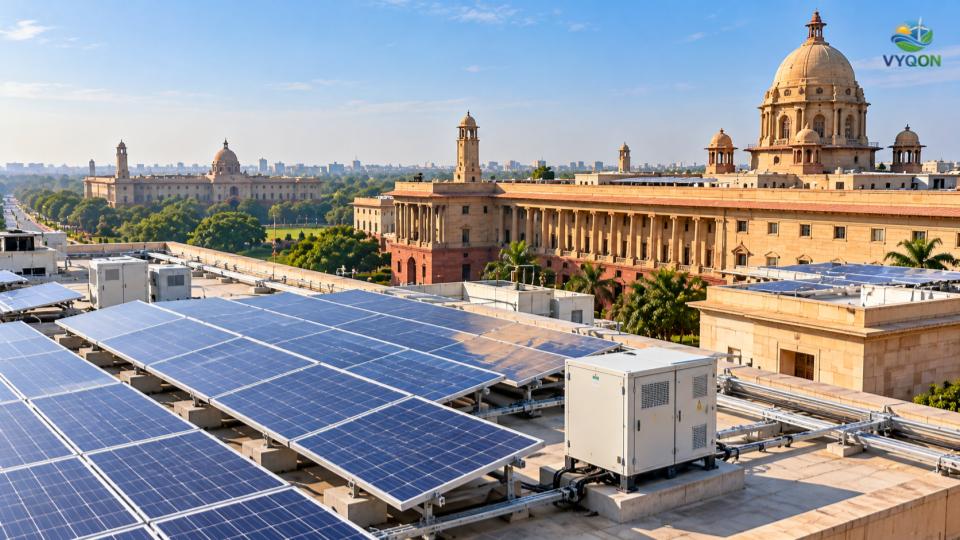
Solar Energy Corporation of India Limited and the Ministry of Home Affairs have signed a new Memorandum of Understanding to facilitate grid-connected rooftop solar installations across MHA buildings nationwide under the PM Surya Ghar Yojana, strengthening the government’s efforts to expand clean energy adoption in public infrastructure.
New Delhi, 24 October 2026: Solar Energy Corporation of India Limited (SECI) has signed a Memorandum of Understanding (MoU) with the Ministry of Home Affairs (MHA) to facilitate the installation of grid-connected rooftop solar photovoltaic systems across government buildings administered by the ministry.
The agreement was signed and exchanged on 23 October 2026 in New Delhi, according to an official announcement issued by SECI.
The MoU was signed by Ishaan Sharma, Deputy Secretary, Ministry of Home Affairs, and Manas Ranjan Mishra, Deputy General Manager (Solar), SECI, representing their respective organisations.
The collaboration will support the deployment of rooftop solar photovoltaic systems at MHA buildings across India under the PM Surya Ghar Yojana, contributing to the wider adoption of renewable electricity within government infrastructure.
The agreement represents a fresh institutional commitment to rooftop solar development. However, SECI has not announced the total installation capacity, investment value, number of buildings, project implementation schedule or expected commissioning dates associated with the new MoU.
The announcement should therefore be interpreted as a cooperation agreement rather than confirmation that construction or electricity generation has commenced.
SECI and MHA Strengthen Government Rooftop Solar Cooperation
The latest agreement brings together a central government ministry with one of India’s principal renewable energy implementation agencies.
SECI operates under the administrative control of the Ministry of New and Renewable Energy (MNRE) and supports renewable energy development through project facilitation, procurement, power trading and other implementation activities.
The Ministry of Home Affairs administers a broad network of government organisations and facilities, creating opportunities to assess the suitability of institutional buildings for rooftop photovoltaic installations.
Under the new agreement, SECI will facilitate the installation of grid-connected solar photovoltaic systems across eligible MHA buildings.
Such projects can make use of existing building rooftops to generate electricity without requiring the extensive land areas associated with large ground-mounted solar developments.
The initiative also aligns with the government’s broader objective of increasing renewable energy adoption within public-sector infrastructure.
However, the precise responsibilities, financing arrangements and project execution mechanisms under the newly signed agreement have not been fully detailed in SECI’s public announcement.
These provisions will need to be established through subsequent implementation documents, site assessments and procurement decisions.
New Agreement Builds on Earlier Cooperation
The October 2026 MoU is not the first rooftop solar agreement between SECI and the Ministry of Home Affairs.
In May 2022, the two organisations signed an earlier MoU covering rooftop solar development at campuses of the Central Armed Police Forces (CAPFs) and the National Security Guard (NSG).
According to the Ministry of New and Renewable Energy’s official announcement issued on 9 May 2022, that agreement was intended to support rooftop solar installations under a Renewable Energy Service Company model.
The Ministry of Home Affairs also reported that SECI had estimated approximately 71.68 MW of rooftop solar potential across CAPF and NSG campuses based on information available at the time.
That figure belongs specifically to the earlier assessment and should not be attributed to the new October 2026 agreement.
The latest MoU identifies a nationwide initiative concerning buildings under MHA through the PM Surya Ghar framework.
The public announcement does not clarify whether the new agreement replaces, extends or operates alongside every provision of the earlier arrangement.
Accordingly, the two agreements should be treated as separate announcements unless the government releases further clarification.
The new signing demonstrates continued cooperation between the organisations in developing rooftop solar opportunities within government infrastructure.
Role of PM Surya Ghar in Government Building Solarisation
The latest SECI–MHA initiative is linked to the PM Surya Ghar: Muft Bijli Yojana, which includes a framework for expanding rooftop solar installations on government buildings.
In July 2024, MNRE issued operational guidelines for the saturation of government buildings with rooftop solar systems.
The guidelines apply to eligible buildings under central ministries, state and Union Territory government departments and associated public-sector institutions.
They identify experienced Central Public Sector Enterprises as Scheme Implementation Partners (SIPs) to help government organisations develop rooftop solar projects.
SECI is among the public-sector enterprises listed within this implementation framework.
The guidelines provide mechanisms through which government departments and implementation partners can assess rooftops, determine feasible generation capacity and select suitable project delivery models.
This framework is particularly relevant for organisations managing buildings distributed across multiple regions.
However, the new SECI–MHA MoU does not establish that every participating building will use the same project financing or electricity procurement structure.
The residential consumer subsidy provisions of PM Surya Ghar also should not automatically be applied to government-building installations.
The applicable commercial and implementation arrangements will depend on the government’s specific guidelines and the agreements executed for individual projects.
Rooftop Solar Offers Opportunities Across Government Facilities
Government-building rooftop solar projects can contribute to distributed renewable electricity generation by using existing infrastructure.
Solar photovoltaic modules convert incident sunlight into direct-current electricity, which is converted into alternating current through inverters.
The electricity can then be used to support building consumption or supplied through an approved grid-connected arrangement, depending on the system design and applicable regulations.
For government offices and institutional facilities, solar generation can be particularly relevant where a significant portion of electricity consumption occurs during daylight hours.
However, actual energy generation depends on available rooftop space, sunlight exposure, building orientation, system efficiency and operating conditions.
An important advantage of rooftop photovoltaics is that they can utilise otherwise underused building surfaces.
Nevertheless, not every rooftop is technically suitable for installing solar modules.
Building age, structural integrity, shading, roof access and existing electrical infrastructure can influence the installation capacity that can be developed.
The new MoU creates a framework for cooperation, but the eventual generation capacity will depend on the assessment of specific MHA facilities.
No verified aggregate capacity or annual electricity generation forecast has been disclosed under the latest agreement.
Technical Assessment Will Be Important for Implementation
A nationwide rooftop solar initiative requires careful technical planning because government facilities may vary considerably in age, location, design and electricity consumption.
Before installation, project teams generally need to evaluate roof dimensions, structural suitability, shading and access conditions.
Electrical assessments are also necessary to determine inverter arrangements, cable routing, protection equipment, earthing and potential grid interconnection requirements.
Solar photovoltaic installations must comply with applicable electrical safety standards and utility requirements.
Installation activity may need to be coordinated with the normal operations of government facilities.
For buildings serving essential administrative or security-related functions, project planning must account for operational continuity and appropriate site-access procedures.
Long-term maintenance is another important consideration.
Photovoltaic modules, inverters, protective devices and electrical connections require inspections and maintenance to support reliable operation.
System monitoring can help identify equipment faults, reduced energy production and other performance issues.
The specific monitoring arrangements, service obligations and performance guarantees for the new SECI–MHA programme have not yet been disclosed.
These requirements will need to be established through the relevant implementation and procurement documents.
Commercial Models for Public-Sector Rooftop Solar
MNRE’s government rooftop solar guidelines provide several approaches for implementing projects through designated public-sector agencies.
These include implementation-partner-owned deployment, aggregation through RESCO developers, process-management consultancy and turnkey project execution.
Under a RESCO arrangement, a developer typically finances and operates a photovoltaic installation while recovering its investment through contracted electricity sales.
A capital expenditure arrangement may instead involve direct investment by the government organisation or an authorised implementation partner.
The appropriate model can depend on the host organisation’s financial arrangements, building portfolio, electricity demand and procurement requirements.
SECI has experience in conducting competitive renewable energy procurement and facilitating projects involving government institutions.
That experience may be relevant as the new collaboration progresses towards implementation.
However, the 23 October 2026 announcement does not identify a final RESCO tariff, EPC contractor, power purchase agreement or project investment amount.
It would therefore be premature to describe the new MoU as an awarded rooftop solar contract under a particular tariff or financing structure.
Those commercial details will need to be verified through future official documents.
Opportunities for India’s Rooftop Solar Industry
The agreement is relevant to India’s distributed solar industry because public-sector rooftop programmes can create opportunities for developers, engineering companies and equipment suppliers.
Potential project implementation may require photovoltaic modules, inverters, mounting structures, protection systems, monitoring equipment and electrical installation services.
A nationwide building portfolio may also require regional project coordination, equipment logistics and long-term maintenance arrangements.
However, the latest MoU does not identify specific participating developers or equipment manufacturers.
It should not be interpreted as a confirmed procurement award for any individual company.
For the wider industry, the significance lies in extending the institutional framework through which suitable government rooftops may be evaluated and developed for renewable electricity generation.
Actual commercial opportunities will depend on the release of project specifications, procurement arrangements and implementation schedules.
Outlook: From Institutional Agreement to Project Implementation
The 23 October 2026 MoU between SECI and the Ministry of Home Affairs represents a new step towards expanding rooftop solar adoption across government buildings in India.
The agreement provides a framework for cooperation under the PM Surya Ghar Yojana, with SECI facilitating grid-connected photovoltaic installations at MHA facilities.
It also builds on the organisations’ earlier experience with rooftop solar initiatives involving government security establishments.
The next important milestones will include identification of participating buildings, technical feasibility assessments, capacity planning and the selection of appropriate implementation arrangements.
Subsequent project-level announcements will be necessary to establish the total solar capacity, investment requirements, procurement outcomes and commissioning schedules.
For India’s renewable energy sector, the collaboration reinforces the importance of distributed solar generation within public infrastructure.
The confirmed development is the signing of a new rooftop solar MoU on 23 October 2026—not the commissioning of new solar capacity or the award of a quantified installation contract.
Official Sources and References
1. Solar Energy Corporation of India Limited — Official Company Announcement, 23 October 2026
SECI Signs MoU with Ministry of Home Affairs to Accelerate Rooftop Solar Adoption.
Confirms the new agreement, signatories, nationwide MHA rooftop solar objective and PM Surya Ghar association.
https://www.linkedin.com/company/solar-energy-corporation-of-india
2. Ministry of New and Renewable Energy — Official Government Rooftop Solar Guidelines, 3 July 2024
Operational Guidelines for Saturation of Government Buildings with Rooftop Solar under PM-Surya Ghar: Muft Bijli Yojana.
3. Press Information Bureau / MNRE — Official Announcement, 9 May 2022
SECI Signs MoU with MHA to Set Up Solar Energy Panels.
Provides historical information about the earlier MoU involving CAPF and NSG campuses.
https://www.pib.gov.in/PressReleasePage.aspx?PRID=1823829
4. Press Information Bureau / Ministry of Home Affairs — Official Announcement, 7 May 2022
MHA and SECI Sign MoU to Realise India’s Green Energy Initiative.
Leave a Comment