
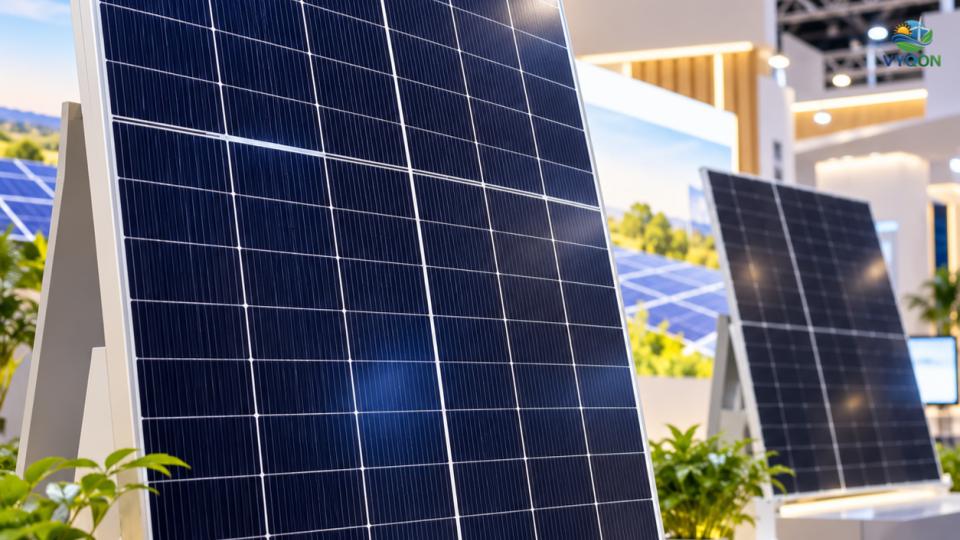
Gujarat-based solar manufacturer Solex Energy Limited has introduced its TAPI RQ photovoltaic module at Renewable Energy India Expo 2026 in Greater Noida. Combining N-Type TOPCon technology with a quarter-cell architecture, the new product is offered in the 650–670 Wp power range and targets high-capacity solar applications.
Greater Noida, 24 October 2026: Solex Energy Limited has unveiled its latest photovoltaic module, TAPI RQ, at the Renewable Energy India (REI) Expo 2026, held from 22 to 24 October at India Expo Mart, Greater Noida, Uttar Pradesh.
The product combines N-Type TOPCon solar cell technology with a quarter-cell module architecture, marking another addition to the manufacturer’s high-efficiency solar portfolio.
According to Solex Energy’s official product-launch communications, the TAPI RQ series offers a rated power range of 650–670 watts-peak (Wp).
The company describes TAPI RQ as India’s first N-Type quarter-cell solar module, although this industry-first claim has not been independently verified against all competing products.
Solex confirmed the product’s unveiling through its official communication channels and included the announcement in its corporate disclosures to the stock exchanges.
The launch represents a new product introduction rather than an announcement of additional operational manufacturing capacity or a newly commissioned solar power project.
TAPI RQ Expands Solex Energy’s High-Power Module Portfolio
The TAPI RQ series has been introduced as part of Solex Energy’s ongoing efforts to develop photovoltaic modules for increasingly demanding solar project applications.
High-power modules are relevant to developers seeking to optimise electricity generation within available installation areas.
As solar project sizes increase, manufacturers are refining cell technologies, interconnection designs and module configurations to improve power density and long-term performance.
The new TAPI RQ series combines an established high-efficiency solar cell technology with a different approach to cell segmentation and electrical interconnection.
According to the company, the module is intended for larger solar installations where performance, reliability and project economics are important considerations.
However, rated module output alone does not establish the actual electricity generation achievable at a particular project.
Energy yield depends on environmental conditions, equipment specifications, installation design and system operation.
The commercial significance of the product will ultimately depend on verified technical performance, manufacturing consistency and acceptance by project developers.
Understanding N-Type TOPCon Technology
TOPCon stands for Tunnel Oxide Passivated Contact, a photovoltaic technology designed to reduce electrical losses associated with charge-carrier recombination.
In crystalline silicon solar cells, sunlight creates charge carriers that must be collected efficiently to generate electricity.
Some of those carriers can recombine before contributing to useful electrical output.
TOPCon technology incorporates a passivated contact structure intended to reduce these losses and improve charge-carrier collection.
N-Type silicon cells are increasingly used in high-efficiency photovoltaic modules because of their potential for strong conversion performance and favourable degradation characteristics.
However, actual performance depends on manufacturing quality, cell architecture and the materials used in a specific product.
The TAPI RQ introduction reflects Solex Energy’s continued emphasis on N-Type technology.
The company already manufactures other TOPCon-based module series, including its TAPI R and TAPI RC products.
TAPI RQ expands that portfolio through its quarter-cell configuration.
What Makes Quarter-Cell Architecture Different?
In conventional photovoltaic module manufacturing, full solar cells can be divided into smaller electrical sections before being interconnected.
Half-cell modules use cell segments created by dividing conventional cells into two sections.
Quarter-cell configurations involve further segmentation, with the objective of improving the electrical arrangement within the module.
Cell segmentation can help reduce resistive losses under suitable circuit configurations because smaller cell sections may carry lower current.
Electrical losses associated with resistance are related to the square of the current flowing through a conductor.
Therefore, reducing current within an appropriately designed electrical path can provide performance benefits.
However, the actual advantage depends on the module’s electrical interconnection, cell layout and operating conditions.
Simply dividing a cell into more sections does not guarantee superior energy yield.
Additional interconnections must also be designed and manufactured reliably.
Cell cutting, interconnection integrity and resistance to microcracking are important considerations when evaluating advanced segmented-cell modules.
For TAPI RQ, the precise improvement over Solex’s existing half-cell products should ultimately be assessed using the manufacturer’s validated technical data and comparable independent performance tests.
High-Power Modules and Utility-Scale Applications
Solar module manufacturers are increasingly developing products for large commercial, industrial and utility-scale projects.
These applications often require careful optimisation of module dimensions, installed DC capacity, mounting arrangements and electrical design.
Higher-rated modules can reduce the number of individual panels required to achieve a specified project DC capacity, although overall system costs depend on many other variables.
Mounting systems, electrical cables, inverters, labour, transportation and maintenance access must all be considered.
For large solar power plants, the levelised cost of electricity is influenced by both initial expenditure and the amount of electricity generated throughout the project life.
A module’s rated power is therefore only one part of the technology-selection process.
Developers also evaluate product degradation, temperature behaviour, mechanical reliability, warranty conditions and bankability.
The TAPI RQ series enters a market where buyers increasingly expect high power ratings alongside documented long-term performance.
Its adoption will depend on how effectively Solex can demonstrate those characteristics through technical documentation, manufacturing quality and commercial supply.
REI 2026 Provides a Platform for Product Introduction
Renewable Energy India Expo 2026 brought together renewable energy manufacturers, technology developers, service providers and industry stakeholders at India Expo Mart in Greater Noida.
Solex Energy participated in the exhibition at Hall 10, Booth B193, where it presented the TAPI RQ module.
The company has used previous editions of REI to introduce additions to its photovoltaic technology portfolio.
Its earlier TAPI R series featured N-Type TOPCon technology using rectangular cells, while its TAPI RC development incorporated rear-contact cell technology.
The TAPI RQ launch continues this emphasis on differentiating module designs and improving product performance.
Industry exhibitions provide opportunities for manufacturers to introduce products, engage with potential customers and assess market requirements.
However, an exhibition launch should not be confused with confirmation of large-scale commercial shipments.
The publicly accessible launch communications reviewed for this article do not identify a confirmed TAPI RQ supply order, delivery volume or project commissioning involving the new module.
Those developments will require separate announcements.
Manufacturing Capabilities in Gujarat
Solex Energy is headquartered in Surat, Gujarat, and operates photovoltaic module manufacturing facilities at Tadkeshwar.
According to the company’s official information, its existing module manufacturing capacity is approximately 4 GW annually.
This established manufacturing base supports its range of photovoltaic products, including modules using N-Type TOPCon and other crystalline silicon technologies.
The company has also outlined plans to expand its presence across additional stages of the renewable energy manufacturing value chain.
Its Vision 2030 roadmap includes proposed development of solar cell manufacturing, battery energy storage manufacturing and upstream photovoltaic materials capabilities.
These plans are strategically relevant because access to high-quality solar cells is important for module production.
Greater integration could provide a manufacturer with additional control over technology selection, material sourcing and product development.
However, proposed manufacturing capacity is not equivalent to installed and operational production capacity.
The TAPI RQ product launch should therefore be viewed separately from the company’s longer-term investment and manufacturing expansion targets.
Product Validation and Commercial Readiness
For solar project developers, the next important consideration is the availability of complete technical and quality documentation for the TAPI RQ series.
A commercial photovoltaic module datasheet typically identifies electrical ratings, physical dimensions, operating characteristics and applicable environmental limits.
Product certification and reliability documentation are also important for procurement decisions.
Testing under relevant IEC standards can provide evidence concerning module design qualification and electrical safety.
Long-term field performance may also depend on installation practices, environmental exposure and equipment maintenance.
At present, the launch announcement establishes the new module’s introduction and its company-reported power range.
It does not independently demonstrate that TAPI RQ will outperform every competing N-Type TOPCon module in real-world operation.
Specific performance improvements should be assessed using comparable testing conditions and independently verifiable results.
Outlook
Solex Energy’s unveiling of the TAPI RQ N-Type TOPCon quarter-cell solar module represents a further step in the development of its photovoltaic product portfolio.
The new series combines a 650–670 Wp rated power range with a segmented-cell architecture intended for high-capacity solar applications.
The launch also reflects the wider solar manufacturing industry’s efforts to improve module design, conversion performance and long-term reliability.
For India’s renewable energy sector, domestic development and manufacture of advanced photovoltaic products can contribute to a more competitive and technically capable supply chain.
The next milestones for TAPI RQ will be the availability of complete product specifications, independent performance documentation, confirmed commercial orders and field deployment.
The confirmed development is Solex Energy’s introduction of TAPI RQ at REI 2026—not a new manufacturing plant commissioning or a confirmed utility-scale solar project award.
Official Sources and References
1. Solex Energy Limited — Official Investor Relations and Corporate Announcements
Press Release: Solex Energy to Unveil India’s First N-Type Quarter Cell Solar Module at REI 2026, dated 22 October 2026 and filed with the stock exchanges on 23 October.
2. Solex Energy Limited — Official LinkedIn Company Announcements
Company-authored REI 2026 product launch communications confirming the TAPI RQ introduction, N-Type TOPCon technology and 650–670 W power range.
https://www.linkedin.com/company/solexenergyin
3. Solex Energy Limited — Official Product and Manufacturing Information
Company manufacturing capacity and existing photovoltaic module portfolio.
Leave a Comment