
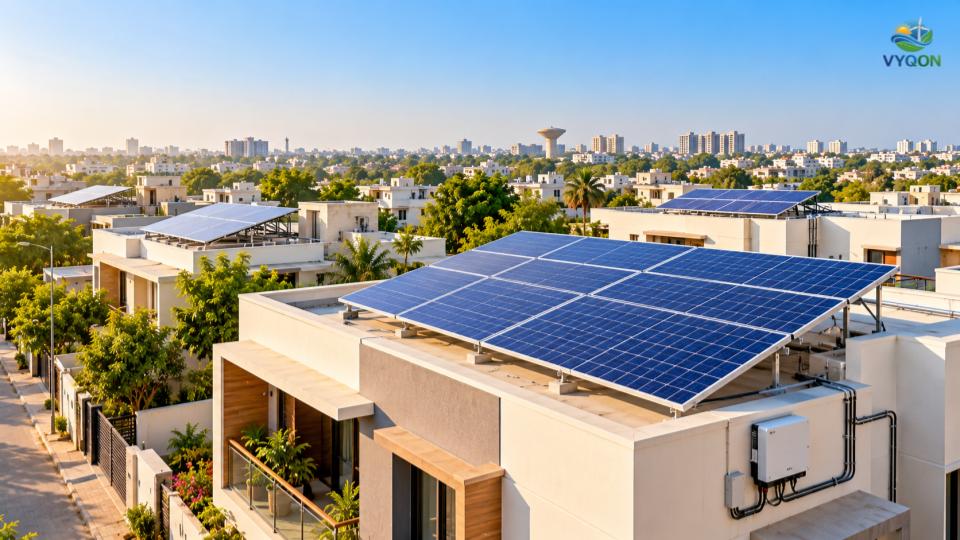
The Gujarat government has approved an additional state subsidy under PM Surya Ghar: Muft Bijli Yojana, reducing the beneficiary contribution for eligible residential rooftop solar installations to 10% of the prescribed cost, or 5% for Scheduled Caste and Scheduled Tribe consumers. The initiative is expected to benefit more than three lakh families.
Gandhinagar, 24 October 2026: The Government of Gujarat has approved additional financial assistance for residential rooftop solar installations under the PM Surya Ghar: Muft Bijli Yojana, introducing a state-level subsidy designed to substantially reduce the cost borne by eligible households.
The decision was taken during a Cabinet meeting chaired by Chief Minister Bhupendra Patel on 21 October 2026.
According to the government’s announcement, eligible general-category electricity consumers will contribute 10% of the prescribed rooftop solar installation cost, while eligible consumers belonging to Scheduled Caste and Scheduled Tribe communities will contribute 5%.
The balance of eligible costs will be supported through the existing central government assistance and the newly approved Gujarat government subsidy.
The state estimates that the measure will benefit more than three lakh families, with anticipated government expenditure of approximately ₹1,000 crore.
The announcement marks a significant policy development for residential rooftop solar adoption in Gujarat, particularly for households facing financial barriers to investing in distributed renewable electricity generation.
Gujarat Introduces Additional Support Under PM Surya Ghar
The new state subsidy is intended to complement financial assistance already available through PM Surya Ghar: Muft Bijli Yojana.
The central scheme was approved by the Union Cabinet in February 2024 to support residential rooftop solar installations across India.
Under the programme, eligible households can receive Central Financial Assistance for installing grid-connected solar photovoltaic systems.
The central government’s published subsidy structure provides assistance based on installed capacity, subject to applicable scheme requirements.
Gujarat’s newly approved support is designed to reduce the remaining financial contribution required from eligible consumers after central assistance is considered.
This approach allows state-level resources to complement a national renewable energy programme.
The additional subsidy is particularly relevant for households that may otherwise postpone rooftop solar investment because of the upfront installation cost.
Reduced Beneficiary Contribution Could Improve Affordability
For many residential consumers, upfront cost is a major consideration when deciding whether to install solar photovoltaic systems.
Although rooftop solar can reduce dependence on purchased grid electricity, the installation generally requires expenditure on photovoltaic modules, inverters, supporting structures, cabling, protective equipment and installation services.
The new Gujarat subsidy seeks to reduce the eligible beneficiary’s share of this expenditure.
Under the announced arrangement, general-category beneficiaries will contribute 10% of the applicable prescribed cost.
Eligible SC/ST consumers will contribute 5%, reflecting a higher level of financial support.
The remaining eligible amount will be covered through the combined contributions of the central and state governments.
However, these percentages should not be interpreted as an unconditional guarantee that every installation will cost the customer only 5–10% of any price quoted by a contractor.
Actual financial assistance will depend on the applicable benchmark cost, system eligibility, installation specifications and administrative requirements.
The detailed implementation provisions will determine how the final payable amount is calculated for individual consumers.
More Than Three Lakh Families Expected to Benefit
The Gujarat government has estimated that the additional assistance could directly benefit more than three lakh households.
The projected expenditure of approximately ₹1,000 crore indicates the scale of the state’s intended financial support.
These figures represent the government’s announced expectations rather than completed installations or subsidies already disbursed.
Actual programme performance will need to be assessed through subsequent data on approved applications, commissioned rooftop systems and financial assistance delivered to beneficiaries.
Expanding access to small residential photovoltaic systems can contribute to greater participation in distributed renewable energy generation.
It can also encourage households that previously considered rooftop solar financially inaccessible to evaluate the technology.
However, installation decisions should continue to account for electricity consumption patterns, building suitability, expected generation and long-term maintenance requirements.
Why Smaller Rooftop Solar Systems Matter
Residential rooftop photovoltaic systems allow electricity to be generated close to the point of consumption.
Solar panels convert sunlight into direct-current electricity, which an inverter converts into alternating-current electricity suitable for normal household electrical applications.
Grid-connected systems can supply electricity to household appliances and interact with the distribution network according to the applicable metering and interconnection arrangements.
The amount of electricity generated depends on the system’s rated capacity, sunlight availability, installation orientation, shading and equipment performance.
For households with daytime electricity consumption, rooftop solar can reduce the amount of electricity purchased from the distribution network.
The financial benefit will nevertheless vary depending on system performance and the applicable electricity tariff and settlement arrangements.
Small rooftop installations also provide an opportunity to make use of existing residential building space without developing large ground-mounted solar facilities.
These characteristics make rooftop photovoltaic systems an important component of India’s distributed renewable energy strategy.
Implementation Will Depend on Technical and Administrative Requirements
Financial assistance is only one part of successful residential rooftop solar deployment.
Consumers and installers must also ensure that proposed systems are technically appropriate for the building and comply with applicable electricity distribution requirements.
Structural suitability, available roof space, electrical safety and system configuration all influence the feasibility of installation.
The PM Surya Ghar programme provides a national framework through which eligible consumers can apply for rooftop solar installations and access approved vendors.
The Gujarat government’s additional subsidy will operate alongside this broader programme.
However, the state’s detailed conditions regarding eligible DC capacity, commissioning dates, payment procedures and additional restrictions must be confirmed from the applicable Government Resolution and distribution company implementation instructions.
Consumers should verify the latest requirements before assuming that a proposed system qualifies for the additional state benefit.
Implications for Gujarat’s Solar Industry
The subsidy decision could create additional opportunities for residential rooftop solar developers, installers and equipment suppliers.
Lower beneficiary contributions may improve household interest in photovoltaic installations and encourage demand for appropriately sized systems.
This could support activity across solar module distribution, inverter supply, mounting structures, electrical installation and maintenance services.
The extent of industry growth will depend on consumer uptake, installation capacity, vendor availability and efficient administrative implementation.
Distribution companies will also play an important role in ensuring that eligible rooftop systems can be safely connected to the electricity network.
For the wider renewable energy sector, the policy demonstrates how state-level assistance can complement central programmes to address affordability barriers.
It also highlights the importance of distinguishing government financial approvals from actual installations and electricity generation.
Outlook
Gujarat’s decision to introduce an additional subsidy under PM Surya Ghar represents a significant step towards improving the affordability of residential rooftop solar.
By reducing the prescribed beneficiary contribution to 10% for eligible general-category consumers and 5% for eligible SC/ST consumers, the state aims to make smaller solar installations accessible to more households.
The proposed financial commitment of approximately ₹1,000 crore is expected to support more than three lakh families.
The next important developments will include confirmation of the detailed implementation conditions, subsidy-processing procedures and the number of installations completed under the revised arrangement.
The effectiveness of the initiative will ultimately depend on how the announced support translates into verified consumer benefits and operational rooftop solar capacity.
The confirmed development is Gujarat’s approval of additional state-level rooftop solar assistance—not the completion of three lakh installations or the disbursement of the entire announced expenditure.
Official Sources and References
1. Akashvani News, Prasar Bharati — 22 October 2026
Official public broadcaster’s report confirming Gujarat’s Cabinet decision, 10% and 5% beneficiary contributions, anticipated beneficiaries and approximate expenditure.
2. Press Information Bureau, Ministry of New and Renewable Energy — 29 February 2024
Original Union Cabinet approval and Central Financial Assistance structure for PM Surya Ghar: Muft Bijli Yojana.
https://www.pib.gov.in/PressReleasePage.aspx?PRID=2010133
3. PM Surya Ghar: Muft Bijli Yojana — Official National Portal
National scheme information, consumer applications and vendor registration.
Leave a Comment