
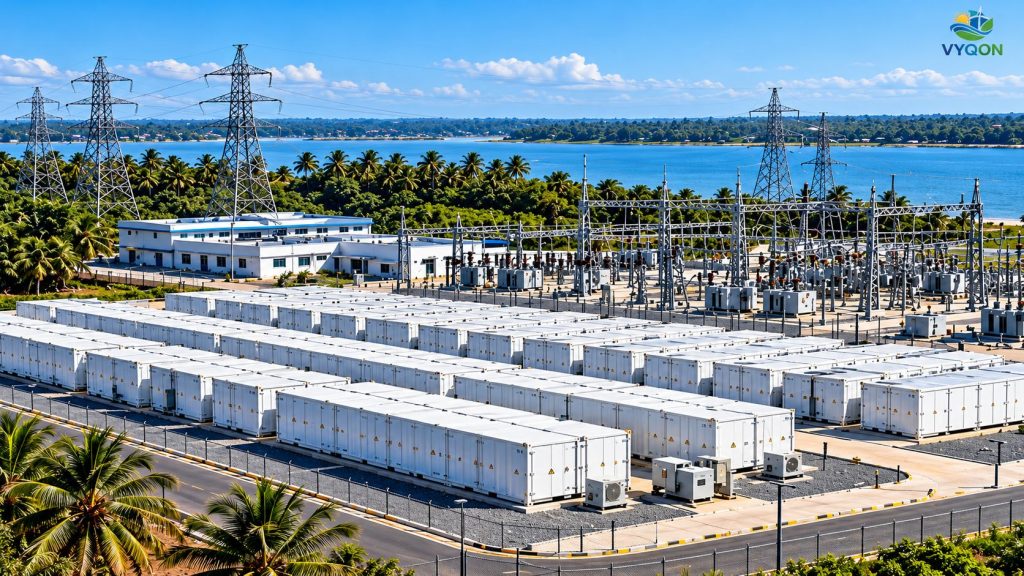
The Central Transmission Utility of India Limited (CTUIL) has issued an advisory, dated 20 October 2026, prescribing minimum storage durations for battery energy storage system (BESS) projects seeking connectivity to the inter-state transmission system (ISTS). Under the advisory, BESS applications outside the right of first refusal (RoFR) category, as well as standalone BESS projects at renewable energy (RE) pooling stations or substations, must provide a minimum discharge duration of four hours. Eligible RoFR applications require a minimum of two hours. The advisory also sets out how co-located renewable capacity for charging BESS should be sized and commissioned, and gives pending applicants a route to meet the new threshold.
Minimum Duration by Application Category
The RoFR category covers connectivity grantees under Regulation 4.1 of the Central Electricity Regulatory Commission (CERC) Connectivity and General Network Access (GNA) Regulations, 2022 that are eligible under Regulation 5.11(b), and entities whose Regulation 4.1 applications were under process as on 9 September 2025 and eligible under Annexure-IV(4) or the CERC order of 8 December 2025 in Petition No. 14/SM/2025. Their BESS applications under Regulation 5.2 submitted up to 21 February 2026, or under Regulation 5.11(a) submitted between 9 September 2025 and 21 February 2026, need a minimum discharge duration of two hours.
The four-hour requirement applies to all non-RoFR applications. These include applications under Regulation 5.11(a)(i), applications under Regulation 5.11(a)(ii) received between 9 September 2025 and 21 February 2026 from entities not eligible under Regulation 5.11(b) or Annexure-IV(4), and every application received on or after 22 February 2026. Standalone BESS applications under Regulation 4.1 at RE pooling stations or substations are also subject to the four-hour minimum.
| Application category | Minimum storage duration | Co-located REGS application |
| RoFR (Regulation 5.2 / 5.11(a), filed up to 21 February 2026) | 2 hours | Depends on option chosen (A, B or C) |
| Non-RoFR, including all applications from 22 February 2026 | 4 hours | Not required separately; REGS quantum to be declared |
| Standalone BESS at RE pooling station/substation (Regulation 4.1) | 4 hours | Mandatory under Regulation 5.2 |
Charging Options for RoFR Applicants
RoFR applicants under Regulation 5.2 have three options. Option A involves installing commensurate co-located renewable energy generating stations (REGS) to charge the BESS, which requires an application under Regulation 5.2. Option B, which also needs a Regulation 5.2 application, covers co-located REGS on a direct AC-side interconnection, allowing power to be scheduled through the ISTS in addition to charging the BESS. Under Option C, the BESS is charged from REGS of an earlier connectivity or through the ISTS, and the advisory marks the application requirement as not applicable.
For RoFR applications under Regulation 5.11(a), Option A needs no separate REGS application, in line with Annexure IV, Clause 1(l) of the GNA Regulations, but the applicant must inform CTUIL of the REGS quantum before the final grant is issued, or in writing for an amendment if it already has been. Option B again requires an application under Regulation 5.2.
Non-RoFR and Standalone Projects
Non-RoFR applicants do not need a separate application for co-located REGS, provided the rated inverter capacity connected to the ISTS stays within the granted connectivity quantum at all times. Those yet to receive an in-principle grant must declare the REGS quantum during or after the relevant Consultation Meeting for Evolving Transmission Schemes (CMETS), while fresh applicants under Regulation 5.11(a) must enter it as REGS for charging BESS in the “Installed capacity” field. Standalone BESS projects at pooling stations, by contrast, must apply under Regulation 5.2 for co-located REGS.
Sizing and Commissioning of Charging Capacity
For non-RoFR and standalone projects, the advisory describes commensurate REGS as desirable for optimal utilisation of the ISTS grid, with capacity equivalent to the MWh capacity of the BESS. CTUIL’s earlier confirmation format for RE developers illustrates this: a 200 MW BESS with four hours of storage (800 MWh) needs REGS capable of generating 800 MWh to fully charge the system in one cycle. Co-located REGS may be commissioned to match the BESS start date of connectivity, or within 36 months of the in-principle grant or firm start date of connectivity, whichever is later. The entity is also permitted to draw power from the ISTS for charging, subject to available transmission margins.
Transition for Pending Applications
Non-RoFR applications under Regulation 5.11(a) and standalone BESS applications under Regulation 4.1 that are under process without an in-principle grant, and have less than four hours of storage, can raise their energy storage capacity (MWh) without changing installed capacity (MW) during the respective CMETS discussions. Applicants must furnish eligibility documents under Regulation 5.2(h) within two months of the advisory’s publication or of the CMETS meeting where the application is agreed for grant, whichever is later. The enhanced capacity must also comply with land, financial closure and scheduled commercial operation date (SCOD) requirements.
This complements CTUIL’s advisory of 14 September 2026, which allows projects already granted connectivity to increase MWh capacity by applying under Regulation 5.2 with nil additional MW.
From Two Hours to Four
The advisory builds on directions recorded in CTUIL’s CMETS meetings in April 2026, under which only BESS applications with at least two hours of storage were to be considered under the RoFR mechanism. CTUIL noted that a Central Electricity Authority (CEA) study recommends a minimum storage duration of two hours initially, rising to four to six hours in phases, which would also lower transmission charges ultimately borne by consumers.
The framework stems from CERC’s Third Amendment to the GNA Regulations, effective 9 September 2025, which introduced solar hour and non-solar hour access to address under-utilisation of the ISTS during evening and night hours.
Outlook
By tying a four-hour minimum to new connectivity applications, CTUIL aims to make fuller use of the ISTS beyond solar hours. For developers, the immediate tasks are to reassess storage sizing for queued applications, meet the two-month documentation window, and plan matching renewable capacity within the 36-month commissioning period.
Official Sources
- CTUIL – Advisory on Minimum Storage Duration for BESS and Installation of Commensurate REGS (20 October 2026), listed under “Application related” on CTUIL’s Advisory page: https://ctuil.in/advisory
- CTUIL – Advisory on Modalities for Enhancement of Energy Storage Capacity (MWh) of BESS Projects already granted Connectivity (14 September 2026): https://ctuil.in/uploads/assets/178937941914Advisory-BESS%20MWHR%20enhancement%20-%20Final.pdf
- CTUIL – Format for Confirmation by RE Developers with Clarification on Commensurate REGS: https://ctuil.in/uploads/assets/178058433496Format%20for%20Confirmation%20by%20RE%20Developers%20with%20Clarification%20on%20Commensurate%20REGS.pdf
- CTUIL – Minutes of the 44th CMETS-WR Meeting (10 April 2026): https://ctuil.in/uploads/ists_consultation_meeting/minutes/177695647142MOM%20for%2044th%20CMETS-WR.pdf
- CTUIL – Minutes of the 46th CMETS-NR Meeting (10 April 2026): https://www.ctuil.in/uploads/ists_consultation_meeting/minutes/17769530156746th%20CMETS%20MOM_Final.pdf
- CTUIL – Agenda for the 47th CMETS-NR Meeting: https://ctuil.in/uploads/ists_consultation_meeting/agenda/177882123779Agenda%20for%2047th%20CMETS%20NR%20meeting%20with%20Annex.pdf
Leave a Comment