
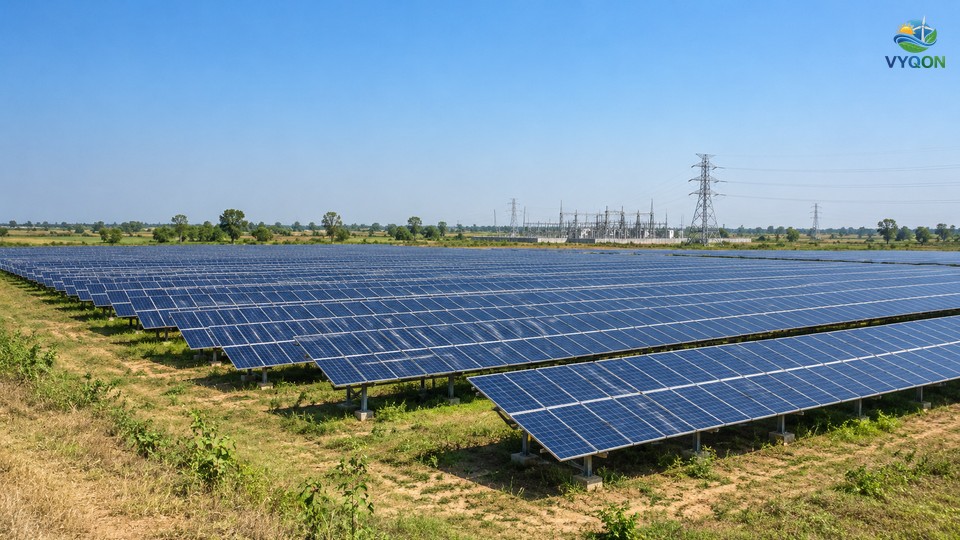
The Solar Energy Corporation of India Limited (SECI) has invited bids for a turnkey 60 MW (AC) solar photovoltaic power plant at Gaya in Bihar, connected to the inter-state transmission system (ISTS). The tender, numbered SECI/C&P/OP/11/0007/26-27, covers design, engineering, supply, construction, erection, testing, commissioning and operation and maintenance (O&M) of the plant. It was published on 30 September 2026, and online bids are due by 12 November 2026 at 18:00.
Key dates and bidding process
SECI is running the tender online with an e-reverse auction. The tender fee, or bid processing fee, is Rs 25,000 plus applicable GST. The earnest money deposit and performance bank guarantee are specified in the tender documents rather than on the summary page.
The pre-bid meeting was scheduled for 15 October 2026 at 15:30, and SECI uploaded a notice about the site visit and pre-bid meeting on 6 October. Offline submission closes on 16 November at 18:00, and bids will be opened on 17 November at 18:00.
Project details
The plant has an AC capacity of 60 MW and a DC capacity of 84 MWp, a DC-to-AC ratio of about 1.4. It will use a power transformer of 80 MVA. The modules will be mounted on south-facing, fixed-tilt structures, and the plant has a design life of 25 years. The site is at Habibpur, Dariaura and adjacent villages, next to the Dobhi-Patna Road in Gaya district. The land is leased by SECI, and SECI will own the project.
Power will be evacuated at a 132 kV bay at the 400/220/132 kV Power Grid Corporation of India substation at Chandauti. The contractor must build a 33/132 kV plant pooling substation with a double bus scheme at 132 kV, and the plant must deliver 60 MW at the point of interconnection with a power factor range of -0.95 to +0.95 at 50°C ambient temperature.
Scope of work
The contractor will work on a turnkey basis: design and engineering, procurement and supply of equipment, testing at manufacturers’ works, civil works, installation, testing and commissioning, and performance demonstration. The tender then requires five years of comprehensive O&M from the completion date of the operational acceptance tests.
The contractor must also submit a design basis report, an energy-yield simulation and a plant-level PSS/E model that will go to Grid-India and the Central Transmission Utility of India before first-time charging clearance. Power system studies for load flow, short circuit and relay coordination are required, along with a study of how the plant responds to voltage transients. The plant must comply with the Central Electricity Authority’s connectivity and grid standards and the CERC regulations on connectivity and general network access.
Module and performance requirements
The technical specification requires monocrystalline silicon TOPCon cells in glass-glass modules with aluminium frames, with an efficiency of at least 22.20% and a rating of at least 600 Wp at standard test conditions. Annual degradation must not exceed 1% in the first year and 0.40% from the second year, and the maximum system voltage is 1,500 V.
The modules and the cells inside them must be made domestically. Modules must be listed in List-I of the Approved List of Models and Manufacturers (ALMM) for solar PV modules, and the cells in List-II, as notified by the Ministry of New and Renewable Energy (MNRE). They must also carry the Bureau of Indian Standards registration mark. The performance warranty must run for at least 25 years from the date of the last tax invoice under the contract, and the product warranty for at least 10 years.
On output, the tender sets a functional guarantee of 125.56 GWh at P75 for operational acceptance, measured at the 132 kV plant-end substation. A shortfall during the O&M period attracts liquidated damages under the O&M agreement.
Context: Bihar’s solar push
The Gaya plant adds to a growing list of solar and storage projects in Bihar. The state’s Renewable Energy Policy 2025 targets more than 23 GW of renewable capacity by 2030, along with battery storage, and the state has begun adding utility-scale projects such as the Kajra solar-plus-storage project in Lakhisarai district, whose first phase has been commissioned.
SECI is best known for auctions that award long-term power purchase agreements to private developers. Here it is procuring an EPC contract for a plant it will own on land it has leased, which gives construction companies a direct, government-owned order rather than a developer-led project.
What it means for India’s clean-energy sector
For EPC contractors, the tender is a mid-sized order with a defined technical specification and a five-year O&M commitment, which adds a recurring revenue stream after construction. The domestic content condition on both cells and modules shows how ALMM List-II is now being written into central procurement. It favours manufacturers with domestic cell capacity and pushes bidders to line up TOPCon module supply early.
For the grid, a 60 MW plant connected at a 132 kV bay of an existing inter-state substation makes use of transmission infrastructure in eastern India and adds clean power in Bihar. The emphasis on grid-code compliance, reactive power support and ride-through studies reflects what is now routine for plants connecting to the inter-state network.
Bidders have until 12 November to submit their bids.
Official references
SECI tender page, “Tender for Design, Engineering, Supply, Construction, Erection, Testing, Commissioning and O&M of ISTS-Connected 60 MW (AC) Solar PV Power Plant at Gaya, Bihar” (Tender No. SECI/C&P/OP/11/0007/26-27): https://www.seci.co.in/tender-details/Ympz
SECI technical tender document, 60 MW Gaya (Section VII, Sub-Sections A and B): https://www.seci.co.in/uploads/tenders/Technical_tender_document_60_MW_Gaya.pdf
Leave a Comment