
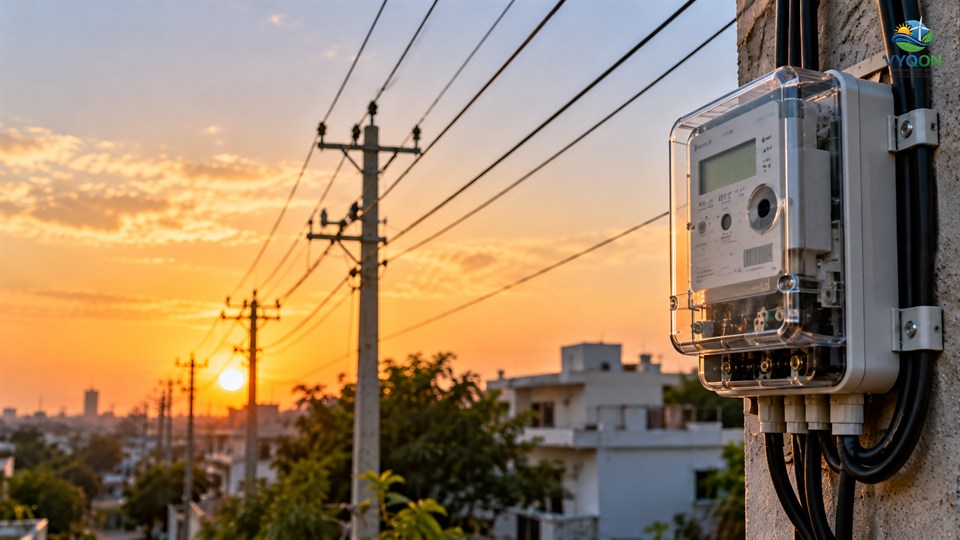
GMR Power and Urban Infra Limited (GPUIL) reported smart meter revenue of ₹112.01 crore for the September 2026 quarter, down 61% from ₹288.89 crore a year earlier and from ₹224.52 crore in the June quarter. The company reported the figures on 30 October 2026 and attributed the fall to a temporary slowdown in the pace of installation. About 42 lakh of the 75.7 lakh meters in its Uttar Pradesh projects are in place. Smart meters contributed 7.2% of consolidated total income in the quarter.
Key Details of the Smart Meter Business
GMR Smart Electricity Distribution Private Limited, a GPUIL subsidiary, is building advanced metering infrastructure for two Uttar Pradesh distribution companies across 22 districts. The contract value is about ₹7,590 crore including goods and services tax. The three projects are:
- Kashi: 27.3 lakh meters for PuVVNL in the Varanasi and Azamgarh zones, ₹2,740 crore
- Triveni: 22.9 lakh meters for PuVVNL in the Prayagraj and Mirzapur zones, ₹2,390 crore
- Agra: 25.5 lakh meters for DVVNL in the Agra and Aligarh zones, ₹2,470 crore
Bosch Global Software Technologies holds 10% in each of the three project companies, and a bundled software service contract with Bosch covers the IT solution. The installed total of about 42 lakh as of 30 September 2026 equals about 55% of the contracted meters. The company has not explained why installation slowed or how long it expects the slowdown to last. It has also not given installed numbers by project, or a completion date.
Earnings and Debt
Under Indian accounting standards, the smart meter business earned EBITDA of ₹19.5 crore, with a 17% margin, against ₹34.4 crore a year earlier. It recorded a loss after tax of ₹17.6 crore, against a profit of ₹10.7 crore a year earlier. Interest and finance charges rose to ₹49.1 crore from ₹20.3 crore. First-half segment revenue was ₹336.53 crore, against ₹472.35 crore a year earlier.
Net debt in the business stood at about ₹1,530 crore at the end of September 2026. It rose by about ₹100 crore during the quarter, while gross debt rose by about ₹220 crore. Smart meters contributed 4.7% of consolidated EBITDA in the quarter.
The presentation also gives a proforma view, which treats meter and installation cost as a fixed asset and shows quarterly revenue of ₹65.3 crore and EBITDA of ₹35.6 crore. Its note says this revenue includes a one-time recovery of meter cost and subsequent rentals.
Group Results
Consolidated total income was ₹1,590.73 crore, against ₹1,922.04 crore a year earlier. Consolidated profit after tax was ₹153.97 crore, against ₹894.70 crore. Exceptional items were ₹225.91 crore, against ₹1,022.97 crore a year earlier. Excluding exceptional items, the presentation shows a loss from continuing operations of ₹72.8 crore, against ₹127.9 crore.
The energy segment remains the largest contributor. Plant load factors were 69% at Warora and 77% at Kamalanga, both affected by shutdowns for overhauling units. The Warora plant also received ₹301 crore from DNH and DD Power Corporation Limited in full and final settlement of claims under a 2013 power purchase agreement. Of that amount, ₹40.98 crore was recognised as late payment surcharge income.
Policy Backdrop
The projects sit within a national programme to replace conventional meters. Under the Revamped Distribution Sector Scheme (RDSS), 20.33 crore smart meters have been sanctioned. The Ministry of Power told the Rajya Sabha on 27 July 2026 that 5.73 crore had been installed under the scheme as on 30 June 2026. The total across all schemes was 7.24 crore.
The answer’s annexure shows 2,85,26,730 meters sanctioned for Uttar Pradesh and 97,53,753 installed. The ministry cited earlier delays in tendering, contract signing and agreements on direct debit facilities, along with inadequate consumer engagement. It also said a few utilities faced difficulties with the public-private partnership model. Its responses include prioritising government and high-load consumers, bill rebates for prepaid meters and installing check meters to build confidence in accuracy. Power Finance Corporation Ltd and REC Ltd monitor the works as nodal agencies.
The ministry says smart meters improve revenue collection and energy accounting at distribution companies. In a statement of 30 March 2026, it said aggregate technical and commercial (AT&C) losses fell to 15.04% in FY25 from 21.91% in FY21. It credited RDSS and other measures for the improvement.
About the Company
GPUIL has 1,650 MW of operating thermal capacity, made up of the 600 MW Warora plant and the 1,050 MW Kamalanga plant, with 350 MW under development. Its portfolio also includes 1,425 MW of hydro projects under development, 31 MW of operating solar and 3.4 MW of wind. It holds road assets, an urban infrastructure site in Tamil Nadu and an electric vehicle charging business.
The company is developing a solar project of about 26 MW at Kamalanga. It says it is evaluating proposals for solar and wind hybrid projects in Karnataka and Andhra Pradesh, and it has not disclosed a capacity for them.
Outlook
GPUIL has listed implementation of its metering business and participation in upcoming smart metering opportunities among its strategic priorities. The company calls the slowdown temporary but has not said when the pace will recover. About 33.7 lakh meters remain to be installed, and it has not published an installation schedule for the three projects. The Ministry of Power’s answer gives 31 March 2028 as the sunset date of RDSS. The company’s next results will cover the December 2026 quarter.
Official Sources
- GMR Power and Urban Infra Limited – Unaudited financial results for the quarter ended 30 September 2026 (NSE, 30 October 2026): https://nsearchives.nseindia.com/corporate/GPUIL_30102026184552_outcome.pdf
- GMR Power and Urban Infra Limited – Investor presentation, Q2 FY27 (NSE, 30 October 2026): https://nsearchives.nseindia.com/corporate/GPUIL_30102026190413_Investorpresentation.pdf
- Ministry of Power – Rajya Sabha Unstarred Question No. 943, Delay in Smart Meter Installation (27 July 2026): https://www.powermin.gov.in/static/uploads/2026/07/f59419a881df9acc24bed8753f6d9fda.pdf
- Ministry of Power – Power Distribution Reforms and Financial Sustainability of Discoms (PIB, 30 March 2026): https://www.pib.gov.in/PressReleasePage.aspx?PRID=2246897
Leave a Comment